EU ON THE BRINK OF COLLAPSE?! A massive political earthquake is shaking Europe as shock polling figures just sent panic straight through Brussels!
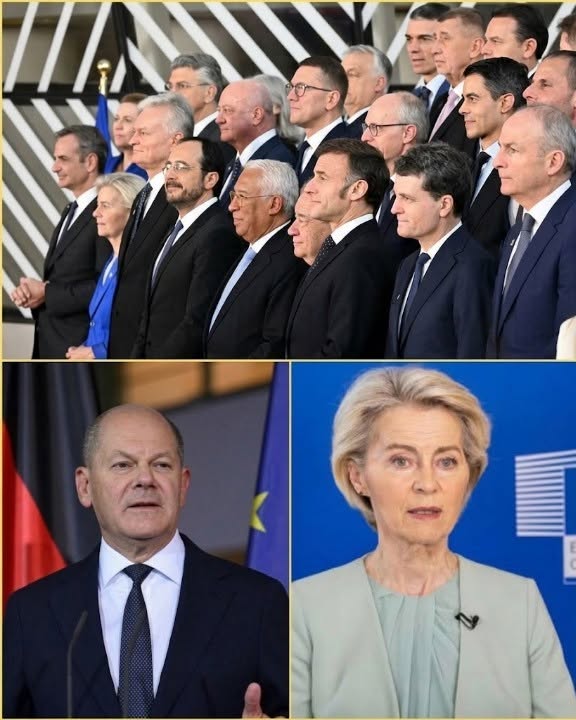
Europe’s Right-Wing Surge Sparks Fresh Fears in Brussels — but the EU Is Not on the Brink of Collapse
A new wave of polling across Europe has reignited fears that the continent’s political centre is weakening, with right-wing and nationalist parties gaining momentum in two of the European Union’s most important countries: Germany and France.
The language spreading online is dramatic: “EU on the brink,” “Brussels in panic,” “referendums that could shatter the bloc.” The reality is serious, but more complicated. There is no verified evidence that the European Union is about to collapse. What is true is that the rise of parties such as Germany’s Alternative für Deutschland and France’s National Rally is creating one of the biggest political tests the EU has faced since Brexit.
In Germany, recent polling aggregators and surveys have shown the AfD polling at or near the top nationally, with some July 2026 surveys putting it around 27–29%, ahead of or level with the traditional centre-right CDU/CSU. In France, Marine Le Pen’s National Rally and Jordan Bardella remain central to the 2027 presidential race, with European observers noting that Le Pen’s renewed presidential ambitions continue to worry opponents in Brussels.
Why Brussels Is Worried
The fear in Brussels is not simply that right-wing parties are polling well. The deeper concern is that Europe’s largest member states may become harder to govern from the centre.
Germany and France are not ordinary EU members. They are the engine room of the bloc. When Berlin and Paris are aligned, the EU can usually move. When they are divided, stalled, or led by parties hostile to deeper integration, the whole European project slows down.
That is why polling shifts in Germany and France matter far beyond domestic politics. If the AfD becomes the strongest force in Germany, or if the National Rally captures the French presidency, the EU would face pressure on migration, climate policy, defence spending, Ukraine, budget rules, enlargement, farming, trade and sovereignty.
This does not mean the EU would instantly collapse. But it could mean a much more confrontational Union, where national capitals resist Brussels more openly and where core policy becomes harder to agree.
Germany: The AfD Breaks Through
Germany has long been seen as the EU’s stabilising power. That is why the AfD’s rise is so politically unsettling.
Recent polling has put the AfD ahead of the CDU/CSU in some national surveys, with ARD’s DeutschlandTrend reporting in July that the AfD was five points ahead of the Union. Other polling trackers also show the AfD in the high twenties, a level that would once have been almost unthinkable for a far-right party in post-war Germany.
The AfD’s strength reflects anger over migration, energy costs, economic anxiety, distrust of mainstream parties, and resentment toward what some voters see as elite consensus politics. Its rise has also forced other parties to decide whether to isolate it, imitate parts of its agenda, or confront it directly.
The danger for the EU is that even without entering government, the AfD can reshape German politics. If mainstream parties shift rightward on migration or become more cautious on EU spending because they fear losing voters, Brussels will feel the effects.
France: National Rally Moves Closer to Power
France presents a different but equally serious challenge.
National Rally is no longer a fringe protest party. It is a major national force with a strong parliamentary presence, a powerful media operation, and a plausible route to the presidency in 2027. Marine Le Pen remains a dominant figure, while Jordan Bardella has worked to reassure business leaders and broaden the party’s appeal. The Wall Street Journal recently reported that Bardella has been courting France’s corporate establishment as he tries to present National Rally as a credible steward of the EU’s second-largest economy.
That effort matters. In the past, National Rally’s economic and EU positions frightened moderate voters and financial markets. Le Pen’s earlier call to leave the euro damaged her 2017 presidential campaign, and the party later abandoned that position. Today, the party is trying to look less like a revolutionary threat and more like a government-in-waiting.
That is the “shocking twist” in the European right’s rise: the most successful nationalist parties are not always campaigning to leave the EU outright. Many are instead trying to change it from within.
Are Referendums Really Coming?
The claim that right-wing leaders in France and Germany are preparing referendums that could “shatter” the EU should be treated cautiously.
France has a history of EU referendum trauma, especially the 2005 vote rejecting the proposed European Constitution. That result left a lasting mark because many voters felt their rejection was later bypassed through the Lisbon Treaty. Le Monde recently noted that Frexit was once a central demand of the French far right and parts of the radical left, but that the temptation has faded compared with the years before and after Brexit.
In Germany, the AfD has historically included hard Eurosceptic voices, but a German EU-exit referendum would face major constitutional, political, economic and coalition barriers. Germany’s export economy, financial system and post-war political identity are deeply tied to the EU. Even a strong AfD result would not automatically create a path to “Dexit.”
So the real threat is less an immediate referendum that destroys the bloc overnight, and more a gradual weakening of EU authority from inside member states.
Why the EU Is Vulnerable
The EU is vulnerable because several crises are colliding at once.
Migration remains the most explosive issue. Southern states want help with arrivals. Eastern and Central European states resist relocation. Northern and Western voters are demanding tougher controls. The new EU migration pact is supposed to create greater cooperation, but divisions remain deep.
Economic pressure is another factor. Inflation, energy costs, weak growth, industrial competition from China and the United States, and anger over climate rules have all made voters more receptive to parties promising national protection.
Security is also central. Russia’s war against Ukraine has forced Europe to rethink defence, borders and energy. But public support for open-ended commitments varies sharply across countries.
Then there is the democratic problem: many voters feel decisions are made too far away, by institutions they cannot easily remove. Right-wing parties have successfully turned that frustration into a sovereignty argument.
Supporters Say This Is Democracy, Not a Crisis
Supporters of parties like AfD and National Rally argue that Brussels is not facing a crisis of extremism, but a crisis of accountability.
They say voters are tired of being told that migration, climate rules, EU integration and globalisation are non-negotiable. In their view, the rise of the right is a democratic correction: people are demanding borders, lower costs, national control and politicians who listen.
From this perspective, Brussels is not panicking because democracy is threatened. It is panicking because voters are challenging the EU consensus.
That argument has political force. Across Europe, many citizens believe mainstream parties ignored concerns until populist rivals made those concerns impossible to dismiss.
Critics Say the Stakes Are Higher
Critics warn that the rise of nationalist parties could weaken the EU’s ability to act collectively at the worst possible moment.
If Germany turns inward, France elects a nationalist president, and other member states continue resisting common migration or budget policy, the EU could become less coherent, less united against Russia, less able to compete economically, and less capable of enforcing rule-of-law standards.
Critics also warn that some far-right rhetoric turns frustration into blame — especially against migrants, Muslims, refugees, Brussels officials or political opponents. That, they argue, risks deepening social division and weakening liberal democracy.
The question is not whether voters have the right to choose right-wing parties. They do. The question is what happens if enough governments inside the EU reject the assumptions on which the EU was built.
The Brexit Lesson
Brexit still shapes this debate.
For Eurosceptics, Brexit proved that leaving the EU is possible. For many European nationalist parties, however, Brexit also showed how costly and complicated withdrawal can be. That is why several parties have shifted from “leave the EU” to “change the EU.”
This strategy may be more dangerous for Brussels than outright exit campaigns. A country that leaves creates a crisis. A group of governments that remain inside while blocking, resisting or rewriting EU policy creates a permanent struggle over the bloc’s direction.
That is the real possibility now facing Europe: not collapse, but transformation.
Conclusion
The latest polling in Germany and France has not placed the EU on the edge of immediate collapse. But it has exposed how fragile the old European centre has become.
The AfD’s rise in Germany and National Rally’s strength in France show that large numbers of voters are no longer satisfied with the political consensus that shaped Europe for decades. Migration, sovereignty, living costs, identity and distrust of Brussels are now driving politics in ways the EU cannot ignore.
The dramatic claim of a sudden “EU collapse” is overstated. But the underlying story is real: Europe is entering a period in which the right may not simply protest from the outside, but shape policy from the inside.
The question for Brussels is no longer whether nationalist forces can be contained.
The question is whether the European Union can adapt without losing the principles that hold it together.