Europe’s migration battle has entered a dangerous new phase—and Poland is refusing to back down.
Poland Draws a Line at Europe’s Eastern Frontier — and Forces the EU Into a Migration Showdown
Europe’s migration struggle has entered a new and potentially decisive phase, and once again Poland finds itself standing at the centre of the storm.
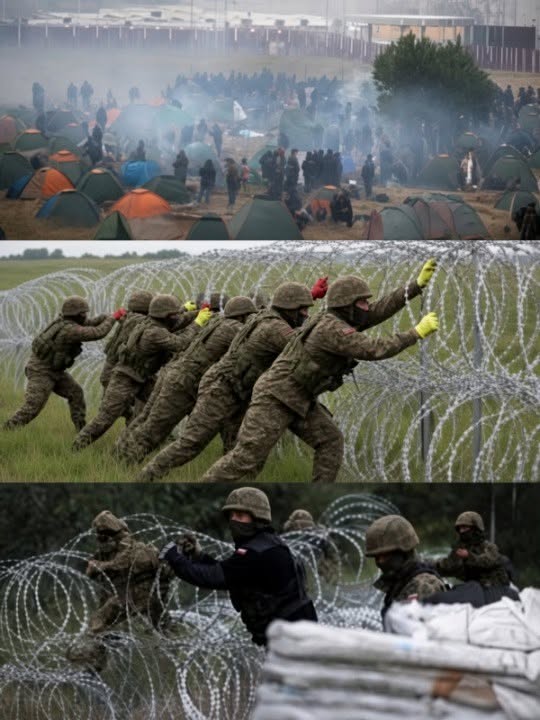
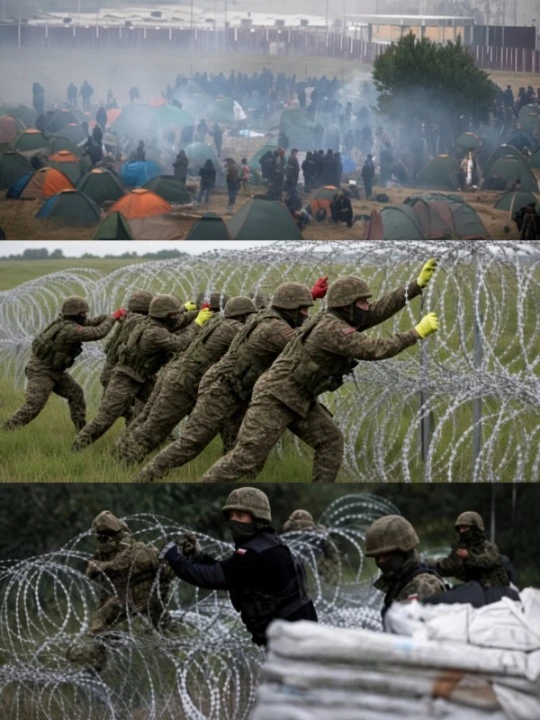
Along the country’s heavily fortified frontier with Belarus, razor wire, surveillance systems, military patrols and emergency legal measures have transformed what was once simply an external European Union border into something Warsaw describes as the front line of a much broader security confrontation. Polish officials insist the pressure there cannot be understood as ordinary migration. They argue that Belarus and Russia have deliberately used migrants as political instruments — directing people toward the EU frontier in an effort to destabilise Poland and the wider bloc.
That claim has fundamentally changed the political calculation in Warsaw.
Instead of treating every attempted crossing primarily as an immigration or humanitarian question, the Polish government increasingly frames the eastern border as a national-security issue. And that has led to one of the most controversial policies anywhere in the European Union: a temporary restriction on the right to submit applications for international protection at the Polish-Belarusian border.
The measure first came into force on March 27, 2025. Since then, Polish authorities have repeatedly extended it in 60-day periods. By May 2026, the government described that extension as the seventh since the system began, saying the measure had reduced pressure on the frontier and discouraged migrants from using the Belarus route.
For Warsaw, the argument is straightforward.
A country cannot be required to treat what it considers an organised hostile operation as though it were a normal flow of spontaneous asylum seekers.
For Poland’s critics, however, that logic creates an equally serious danger.
If governments can suspend access to asylum whenever migration is described as a security threat, what remains of the principle that a person fleeing persecution must have an opportunity to seek protection?
That question is now colliding with an even larger transformation taking place across the European Union.
On June 12, 2026, the EU’s long-debated Pact on Migration and Asylum entered into application. The ten-part legislative package is intended to create a more unified migration system, including common rules for screening arrivals, accelerated border procedures, clearer responsibility for asylum claims and a solidarity mechanism designed to assist states facing disproportionate migratory pressure.
Brussels presents the system as an attempt to resolve one of Europe’s most persistent political failures.
For years, frontline countries complained that they were expected to carry an unfair burden simply because geography placed them at Europe’s external borders. Governments farther north and east resisted mandatory relocation schemes. Successive crises exposed deep disagreements over who should accept asylum seekers, who should pay and how responsibility should be divided.
The new pact is supposed to replace that chaos with predictability.
Poland, however, has made clear that European solidarity cannot come at the expense of what it considers its own security.
Warsaw announced in June that it would not accept migrants relocated from other EU countries or pay related solidarity costs, saying negotiations had secured treatment reflecting Poland’s unusual circumstances — particularly its enormous effort supporting people displaced by Russia’s invasion of Ukraine and the continuing pressure on the Belarusian frontier. Polish officials said they would implement the elements of the pact that strengthened border protection, migration controls and access to security data.
That position illustrates how dramatically Europe’s migration debate has changed.
Only a few years ago, the argument was largely presented as a clash between pro-migration humanitarianism and nationalist opposition.
Today the picture is far messier.
Poland is simultaneously one of Europe’s strongest supporters of millions of Ukrainians displaced by war and one of the continent’s toughest advocates of restricting irregular migration from Belarus.
That apparent contradiction is central to Warsaw’s argument.
Polish leaders distinguish between refugees escaping a neighbouring war and migrants who, they say, are being intentionally transported and directed toward a militarily sensitive border by an authoritarian regime.
EU institutions themselves acknowledge that the “instrumentalisation” of migration by Belarus and Russia has affected eastern member states. The European Union Agency for Asylum noted that Poland continued to maintain both its border buffer zone and temporary limitations on asylum applications in response to pressure at the Belarus frontier.
But acknowledging the threat is not the same as accepting every response to it.
Human-rights organisations, UN bodies and European lawmakers have warned that Poland’s suspension mechanism risks violating the fundamental principle of non-refoulement — the requirement that states must not return people to places where they face persecution, torture or serious danger.
Questions submitted in the European Parliament have specifically challenged whether Poland’s restrictions comply with EU and international law. Critics have also raised allegations of pushbacks along the Belarusian border and argued that even geopolitical manipulation does not erase an individual asylum seeker’s legal rights.
That is where the confrontation becomes exceptionally difficult.
Imagine two realities existing at exactly the same time.
In the first, Belarus deliberately facilitates thousands of crossings in an effort to overwhelm Poland, manufacture political instability and exploit European asylum rules.
In the second, among the people arriving at that border are individuals who genuinely fear persecution and who may have legitimate claims to protection.
Both things can be true.
A security strategy capable of recognising only the first risks abandoning vulnerable people.
An asylum system capable of recognising only the second risks becoming dangerously vulnerable to manipulation by hostile governments.
Europe is now attempting to design policy inside that uncomfortable space.
The stakes extend far beyond Poland.
Finland has also adopted exceptional measures in response to concerns about instrumentalised migration from Russia. Latvia and other eastern states have reinforced borders and introduced tougher controls. Across the continent, governments once reluctant to discuss hard borders are increasingly talking about returns, external security and preventing irregular entry.
Migration policy is moving politically toward enforcement.
Yet Europe remains legally and morally committed to asylum.
That tension may become one of the defining challenges of the next decade.
Poland’s experience also exposes the uncomfortable reality behind the language of “European solidarity.” Solidarity sounds simple until countries are asked to decide what it actually means.
Does solidarity mean accepting relocated asylum seekers?
Does it mean paying another member state to manage them?
Does it mean deploying border guards?
Does sheltering millions of Ukrainians count toward a country’s responsibility?
And should a nation facing what it considers a hostile border operation be asked to contribute in exactly the same way as a country facing no comparable threat?
The European Commission has long maintained that member states remain legally bound by the migration pact. Earlier Commission guidance made clear that the solidarity framework does not simply disappear because one country objects to it, although states can meet solidarity obligations through different forms of contribution and countries under significant migratory pressure may receive reductions.
That makes Poland’s political message particularly important.
Warsaw is not necessarily rejecting European cooperation itself.
It is demanding that cooperation recognise national circumstances.
And that distinction could determine whether the new EU migration system survives.
If Brussels attempts to impose identical expectations on countries facing radically different pressures, resistance will grow.
If every national government can invoke exceptional circumstances to avoid common obligations, however, the supposedly common European system could become meaningless.
This is therefore no longer simply a Polish border dispute.
It is a test of whether the European Union can simultaneously protect borders, preserve asylum rights and maintain political solidarity between 27 countries with profoundly different experiences of migration.
Poland has chosen its priority clearly.
Security comes first.
Its leaders argue that Europe cannot protect refugees, maintain free movement or preserve democratic stability if its external borders can be manipulated by hostile states. From that perspective, a fortified frontier is not a rejection of European values but a defence of the political space in which those values survive.
Critics see something different.
They fear emergency measures becoming permanent, asylum protections gradually shrinking and governments discovering that almost any irregular migration flow can be described as a security emergency.
Both sides therefore believe something fundamental is at risk.
For Warsaw, it is sovereignty and national security.
For human-rights advocates, it is the legal protection owed to individuals seeking refuge.
For Brussels, it is the credibility of a European migration system that took years of bitter negotiation to construct.
The border between Poland and Belarus may be geographically distant from Paris, Rome, Madrid or Brussels.
Politically, however, what happens there could shape all of them.
Because the real question Europe is confronting is no longer merely how many migrants should enter or which country should receive them.
It is whether a union built on open internal borders can maintain those freedoms without establishing firm control over its external ones — and whether it can do so without abandoning the protections that distinguish a democracy from the authoritarian governments applying pressure against it.
Poland has drawn its line.
Now Europe has to decide where its own line lies.