Andy Burnham’s lost again after his pathetic attempt to criminalise the Union Jack and the St George’s Cross. Shrewsbury turned red, white and blue overnight and you could hear the message all the way to Whitehall.
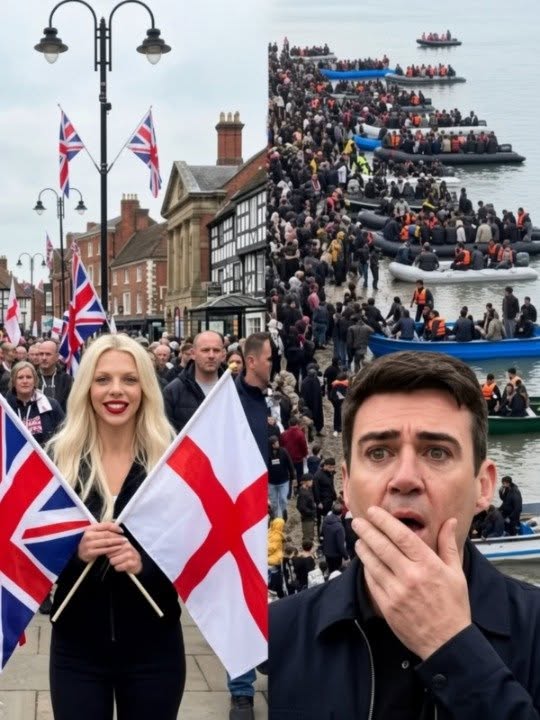
Shrewsbury Turns Red, White and Blue — and the Flag Debate Explodes Across Britain
Shrewsbury has become the latest flashpoint in Britain’s increasingly fierce debate over national identity, patriotism and the meaning of the St George’s Cross.
Across roads, bridges and lamp posts, the familiar red-and-white cross has appeared alongside the Union Flag, transforming parts of the town into a striking display of British and English colours. Supporters describe the campaign as an unapologetic expression of national pride. Critics see something very different: an organised political movement whose links to the far right cannot simply be ignored.
The controversy surrounding the campaign known as Operation Raise the Colours has now become impossible to dismiss as merely a dispute about flags.
It is a fight over what it means to be proud of England—and who gets to define that pride.
The campaign gained national attention in August 2025, when people began attaching Union and St George’s flags to lamp posts and painting St George’s crosses on public infrastructure. In Shrewsbury, dozens of flags appeared along Mount Pleasant Road, followed by further displays around Meole Island and Oteley Road.
Supporters insist that the message is simple: England’s national symbols should not be treated as embarrassing, controversial or somehow illegitimate.
For them, the St George’s Cross is not a political weapon. It is the flag of England—the same symbol seen at football matches, national celebrations and community events. They argue that ordinary people should be able to display it without being automatically associated with extremism.
That sentiment deserves to be heard.
At the same time, the political reality surrounding Operation Raise the Colours is more complicated. Reporting has documented links between some organisers and far-right figures, while critics have warned that the campaign has sometimes been associated with anti-immigration politics.
That creates an uncomfortable tension.
Can someone proudly display the St George’s Cross without being far right?
Of course.
But can a movement associated with national flags also attract extremists and anti-immigration activists?
That has happened too.
The challenge for Britain is not to pretend one of those realities does not exist.
Yet Shrewsbury’s streets demonstrate why simply branding every participant a racist or extremist is unlikely to settle the argument. The people attracted to the campaign are not necessarily motivated by the same political beliefs. Some are plainly expressing patriotism. Others are responding to immigration policy, distrust of government or a feeling that British national identity has become politically uncomfortable.
And that frustration is not confined to one ideological corner.
The flags have attracted support from people connected to different political parties, including Labour, Conservatives and Reform UK.
That matters.
Britain’s national symbols cannot belong exclusively to one political faction.
The Union Flag does not belong to Conservatives. The St George’s Cross does not belong to Reform UK. Neither belongs to the far right.
They belong to the country.
But ownership of a symbol is different from ownership of public infrastructure.
This is where councils have a legitimate argument. A lamp post is not someone’s private garden fence. It is public infrastructure, and attaching objects to it can create maintenance, safety and legal problems. Shropshire Council has previously indicated that it would remove unauthorised flags when necessary, particularly where safety issues arise.
Oxfordshire has gone further. In 2026, the council sought legal restrictions against people attaching flags to highway structures, citing safety and public-order concerns. A High Court injunction subsequently prohibited unauthorised flag attachment and painting on roads in the county.
That is a fundamentally different argument from saying that the St George’s Cross itself is unacceptable.
Britain must be capable of making that distinction.
A council can say, “You cannot attach something to this lamp post without permission,” without saying, “You cannot be proud of England.”
Those are not the same proposition.
Likewise, someone can oppose unauthorised flag displays without being anti-British.
This distinction has become increasingly important because the flag debate has become emotionally charged.
For many people, seeing an English flag flying above a street produces nothing more sinister than a feeling of familiarity and pride. During the 2025 European Women’s Championship, for example, St George’s flags were widely displayed in support of England’s football team. The same cross that appears on a football shirt can therefore represent national celebration to one person and political provocation to another.
The symbol itself cannot tell us which interpretation is correct.
Intent matters.
Context matters.
Conduct matters.
And so does the law.
That is why claims that Britain is somehow moving toward a blanket ban on the English flag should be treated cautiously. A viral claim in 2025 alleged that the government was considering banning public displays of the England flag, but Full Fact found the story to be fabricated and reported that the government had no such plan.
The real dispute has been about where and how flags are displayed—not whether the English flag is legal.
That distinction has sometimes been lost amid the political noise.
For supporters of Operation Raise the Colours, however, the controversy itself has become part of the message. Every removal can be portrayed as evidence that authorities are uncomfortable with patriotism. Every new flag can then become an act of defiance.
And that creates a cycle.
Officials remove flags.
Supporters put up more.
Critics complain about intimidation.
Supporters accuse critics of being ashamed of their country.
More flags appear.
The result is not a calmer Britain. It is a more polarised one.
That should concern everyone.
There is nothing inherently wrong with wanting Britain to feel proud of itself. There is nothing inherently racist about displaying the flag of England. But neither should patriotism be used as a shield for harassment, intimidation or hostility toward people because of their race, religion or immigration status.
The strongest form of patriotism does not need intimidation.
It does not need threats.
It does not need hatred.
It simply needs confidence.
And perhaps that is the deeper message emerging from Shrewsbury.
The national identity debate is no longer something Britain can postpone. People are asking difficult questions about immigration, integration, borders, national traditions and whether they are still allowed to express pride in their country without being placed into a political category.
Politicians would be wise to listen rather than simply shout labels back.
At the same time, those waving the flags should recognise that national pride carries responsibilities. If the flag is supposed to represent everyone, then its supporters have an interest in ensuring that it is not turned into a symbol of exclusion.
The St George’s Cross can mean England without meaning hatred.
The Union Flag can mean Britain without meaning hostility to foreigners.
And criticism of immigration policy can exist without hostility toward immigrants themselves.
That is the mature position.
Shrewsbury’s streets, therefore, are not simply a battlefield between “patriots” and “the left.” They are a visible expression of a much larger struggle over Britain’s identity.
The answer should not be to criminalise patriotism.
Nor should it be to pretend that every political movement using the flag is automatically innocent.
Britain can do better than that.
It can defend the right of ordinary people to love their country while enforcing sensible rules about public property. It can challenge racism without branding every display of national pride as racist. And it can acknowledge the country’s legitimate concerns about immigration without turning national identity into a weapon against minorities.
The red, white and blue—or the red and white of St George—will continue to fly.
The real question is what Britain chooses to make those colours mean.
If they become symbols of confidence, shared history and belonging, they can bring people together.
If they become symbols of division and permanent political confrontation, they will only deepen the fractures already running through the country.
Shrewsbury has raised the colours.
Now Britain has to decide what those colours stand for.