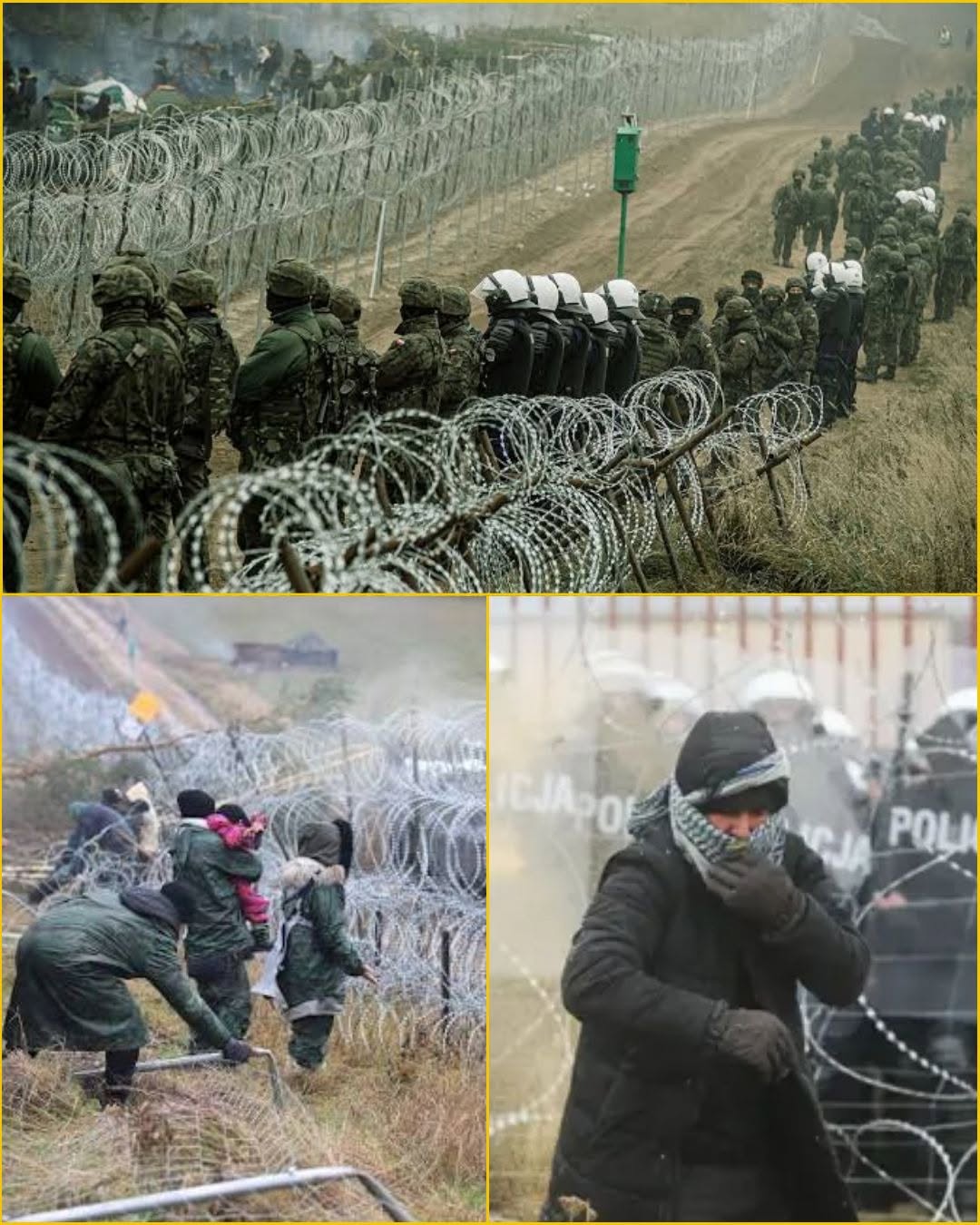
MASS BORDER SHUTDOWN: A massive migrant attempt to breach the Polish border was just brutally shut down at the gates—and the terrifying secret measures deployed on the front lines to turn them away have left observers completely frozen in sh0ck..
An alarming online headline claims that Polish border guards recently stopped a large group of migrants attempting to cross the country’s frontier, allegedly using extraordinary security measures. While Poland has faced genuine migration-related tensions along its border with Belarus, the latest dramatic account provides no confirmed date, location or official evidence. What is known about the border crisis, and how should reports of a major confrontation be assessed?
A Dramatic Claim From Europe’s Eastern Frontier
Poland’s eastern border has become one of Europe’s most politically sensitive frontiers, with migration, national security and international tensions increasingly intertwined.
A circulating headline now claims that a massive attempt by migrants to breach the Polish border was stopped by security forces.
The account describes a dramatic confrontation and suggests that unusual measures were deployed to prevent people from entering the country.
However, the claim does not identify the location of the alleged incident, the number of people involved or the date on which it supposedly occurred.
It also offers no authenticated video, official border guard statement or independent reporting establishing what happened.
The description of secret security measures is particularly difficult to assess because no specific equipment or tactics are identified.
The supplied information does not establish that a new mass border breach occurred or that Polish authorities deployed previously undisclosed measures.
Nevertheless, the wider security challenges facing Poland are real and have developed over several years.
Why Poland’s Border With Belarus Matters
Poland shares an eastern border with Belarus, a country closely aligned with Russia.
The frontier is also part of the European Union’s external border, giving developments there significance beyond Poland itself.
Since 2021, Polish authorities have reported repeated attempts by migrants to enter from Belarus.
Poland and European Union officials have accused the Belarusian government of facilitating migration toward the border as a means of exerting political pressure.
Belarus has rejected accusations that it deliberately orchestrated the crisis.
The confrontation emerged amid wider tensions between Minsk and European governments following Belarus’s disputed 2020 presidential election and subsequent sanctions.
Poland responded by strengthening border security, deploying additional personnel and introducing restrictions in sensitive areas.
The situation has continued to raise difficult questions about sovereignty, international law and the treatment of people seeking protection.
The Construction of Poland’s Border Barrier
One of Poland’s most visible responses was the construction of a substantial physical barrier along parts of its border with Belarus.
Completed in its initial form in 2022, the steel barrier was designed to make unauthorised crossings more difficult.
It was accompanied by surveillance technology and additional border monitoring systems.
Polish officials have argued that such measures are necessary to protect the country’s territory and maintain control over entry.
Security personnel have also faced challenging conditions in forested and remote border areas.
However, physical barriers cannot eliminate every crossing attempt.
Migrants may seek alternative routes, while smugglers can adapt their methods.
Border infrastructure therefore forms only one part of a wider strategy involving surveillance, patrols, law enforcement and international cooperation.
The existence of these systems does not confirm the circulating headline’s suggestion that a new or secret defensive measure was recently deployed.
Security Concerns and Allegations of Political Pressure
Polish officials have frequently described the border situation as more than a conventional migration challenge.
They argue that Belarus has used migrants as instruments of pressure against Poland and the European Union.
European institutions have also expressed concern about the deliberate exploitation of migration for political purposes.
From this perspective, strengthening the border is presented as a national security necessity.
Supporters of Poland’s approach argue that governments have a responsibility to prevent unauthorised entry and respond to organised efforts to destabilise their borders.
Critics, however, warn that security policies must not disregard the rights and safety of individuals attempting to cross.
These positions address different aspects of the same challenge.
A government may have legitimate security concerns while still being required to comply with its legal obligations toward people seeking international protection.
What Does International Law Require?
International law recognises that states have authority to manage their borders.
However, that authority is subject to important limitations.
The principle of non-refoulement generally prohibits returning people to places where they face persecution or certain other serious harms.
European and international human rights standards also establish safeguards concerning detention, treatment and access to protection procedures.
Human rights organisations have criticised aspects of border enforcement along the Poland-Belarus frontier, including allegations of unlawful pushbacks and inadequate humanitarian assistance.
Polish authorities have defended their actions by emphasising security threats and the need to counter irregular migration.
Assessing individual incidents requires reliable evidence about the circumstances involved.
A person attempting to cross a border without authorisation does not automatically lose fundamental human rights protections.
Equally, humanitarian obligations do not eliminate a state’s ability to investigate unlawful activity or respond to violence against its personnel.
The Humanitarian Situation Along the Frontier
Beyond political arguments, the border crisis has involved significant human suffering.
The forested region separating Poland and Belarus can be dangerous, particularly during cold weather.
People attempting to cross may face exhaustion, dehydration, injury and exposure to severe conditions.
Humanitarian organisations have reported deaths and other serious incidents in the border area over the years.
Some migrants have described becoming trapped between competing enforcement systems, unable to move safely in either direction.
These experiences highlight the vulnerability of individuals caught in a geopolitical confrontation.
The people travelling toward Europe have varied backgrounds and motivations.
Some may be seeking asylum, while others may be pursuing economic opportunities or travelling through irregular migration networks.
Their circumstances cannot responsibly be reduced to a single explanation.
Accurate reporting should distinguish between people seeking protection, suspected smugglers and anyone involved in violent conduct.
Were Extraordinary Measures Used?
The most sensational element of the circulating claim concerns supposedly terrifying security measures deployed by Polish forces.
Yet the headline offers no description that can be independently examined.
Poland has publicly invested in barriers, surveillance systems and additional border personnel.
Those measures are documented aspects of its broader security policy.
However, there is no evidence in the supplied account that authorities used an undisclosed weapon, unusual enforcement tactic or newly developed technology during a recent incident.
Suggesting otherwise would turn speculation into apparent fact.
If a major confrontation occurred, credible reporting would need to identify the relevant border crossing or geographical area.
It would also need to establish how many people were involved, whether anyone was injured and what actions security personnel took.
Without those details, the dramatic language remains unsupported.
Why Border Headlines Generate Strong Reactions
Migration and border security are among Europe’s most contested political issues.
They involve concerns about public safety, national sovereignty, humanitarian protection and international responsibility.
Stories describing large groups approaching a border can provoke immediate anxiety, particularly when presented as an attempted invasion or violent breach.
Such language may obscure important distinctions between irregular entry, organised criminal activity and genuine threats to security personnel.
Similarly, descriptions of migrants being brutally repelled can imply serious violence without providing evidence.
Both possibilities require careful investigation.
Responsible journalism should avoid treating every border crossing attempt as a violent attack.
It should also avoid dismissing documented threats faced by border guards.
The challenge is to report events accurately without exaggerating danger or minimising suffering.
What Would Confirm the Alleged Incident?
A credible account of the reported confrontation would begin with an official statement from Poland’s Border Guard.
That statement should identify the date, location and number of people involved.
Independent journalists could then compare the official account with available video footage, witness testimony and humanitarian reporting.
If unusual enforcement measures were allegedly used, their nature and legal basis would require examination.
Any reported injuries or deaths should be independently verified.
Statements from European Union institutions or relevant monitoring organisations could provide additional context.
It would also be important to establish whether the incident represented a genuinely new development or a dramatic retelling of an earlier event.
Until those questions are answered, claims of a massive border shutdown should be treated cautiously.
The Wider European Challenge
Poland’s border difficulties form part of a broader European debate about migration management.
European governments continue to confront questions about border enforcement, asylum procedures, smuggling networks and cooperation with neighbouring countries.
Countries on the European Union’s external borders often argue that they carry a disproportionate responsibility for managing arrivals.
At the same time, humanitarian organisations stress that effective border management must include lawful access to protection.
The situation involving Belarus adds a geopolitical dimension that makes solutions particularly difficult.
Strengthening physical security may reduce some unauthorised crossings, but it does not resolve the underlying causes of displacement or international political tensions.
Long-term policy requires coordination between national governments, European institutions and humanitarian agencies.
Conclusion: A Real Border Crisis, but an Unverified New Confrontation
Poland has faced serious and sustained challenges along its border with Belarus.
The country has expanded security infrastructure, increased monitoring and argued that its frontier is being subjected to politically motivated pressure.
Human rights organisations, meanwhile, have raised concerns about the treatment of vulnerable people attempting to enter Europe.
These are established dimensions of a complex and continuing dispute.
However, the latest headline claiming that a massive migrant breach was brutally stopped using secret measures provides no verifiable evidence of a specific new incident.
There is insufficient information to confirm the alleged mass confrontation, its scale or the tactics supposedly used by Polish authorities.
Border security and humanitarian protection are both legitimate public concerns.
Neither is served by sensational reporting that substitutes dramatic language for documented facts.
The most responsible approach is to examine official evidence, seek independent confirmation and recognise the human consequences of decisions made along Europe’s eastern frontier.
In a region already marked by political tension and suffering, accurate information remains essential to understanding what is truly happening.