IRELAND ON THE EDGE? Viral “2% Revolution” Claims Collide With a Far More Complicated Reality
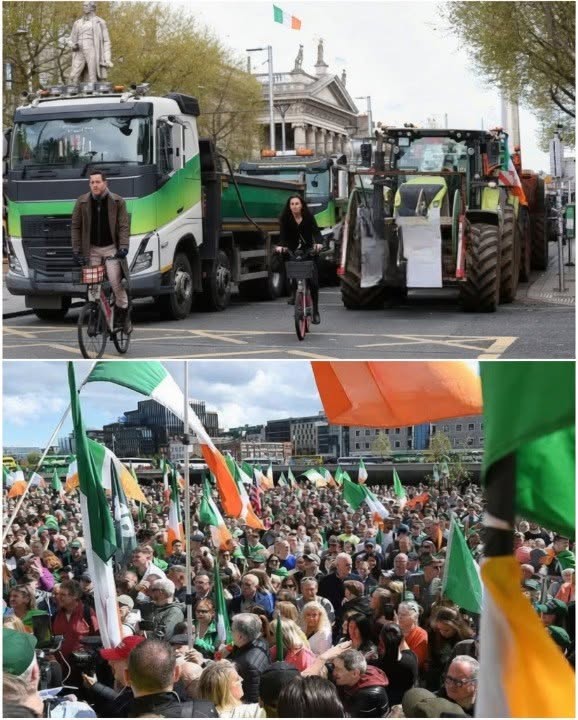
Dramatic posts describe a nationwide shutdown, 200,000 protesters, blocked ports and a constitutional mechanism capable of bringing down Ireland’s government. But without independent confirmation, those claims should be treated cautiously — and the supposed “2% threshold” requires particular scrutiny.
Ireland has a long history of political movements born from the land, the workplace and the countryside. Farmers, fishermen, hauliers and other working communities have repeatedly taken to the streets when they believe decisions made in Dublin or Brussels threaten their livelihoods.
Against that historical backdrop, dramatic images of tractors, trucks and crowds carrying Irish tricolours can acquire extraordinary power online.
In recent days, social-media posts have circulated with an especially explosive description of events in Ireland. According to the viral narrative, the country has entered the fifth day of a “total nationwide shutdown.” It claims approximately 200,000 people have marched on parliament, truck drivers are blocking highways, fishermen are preparing to close ports and the military has been placed on standby.
The posts go further still.
They describe the confrontation as a “2% revolution” and suggest that a little-known numerical threshold could force the Irish government to dissolve almost immediately.
If all of those claims were accurate, Ireland would unquestionably be experiencing one of the most consequential political crises in its modern history.
But extraordinary claims require correspondingly strong evidence.
And the most important distinction in understanding the story is the difference between genuine political frustration — which can certainly exist — and the much more dramatic claims being attached to photographs and videos circulating online.
At present, the material presented with this story does not by itself establish that Ireland is undergoing a nationwide shutdown, that 200,000 demonstrators have surrounded parliament, that the military has been mobilised because of the protests, or that a “2% threshold” can automatically dissolve the Irish government.
That does not mean every image, grievance or demonstration associated with the narrative is false.
It means each claim needs to be examined separately.
And when that is done, the picture becomes considerably more complicated.
A Powerful Image — But What Does It Actually Prove?
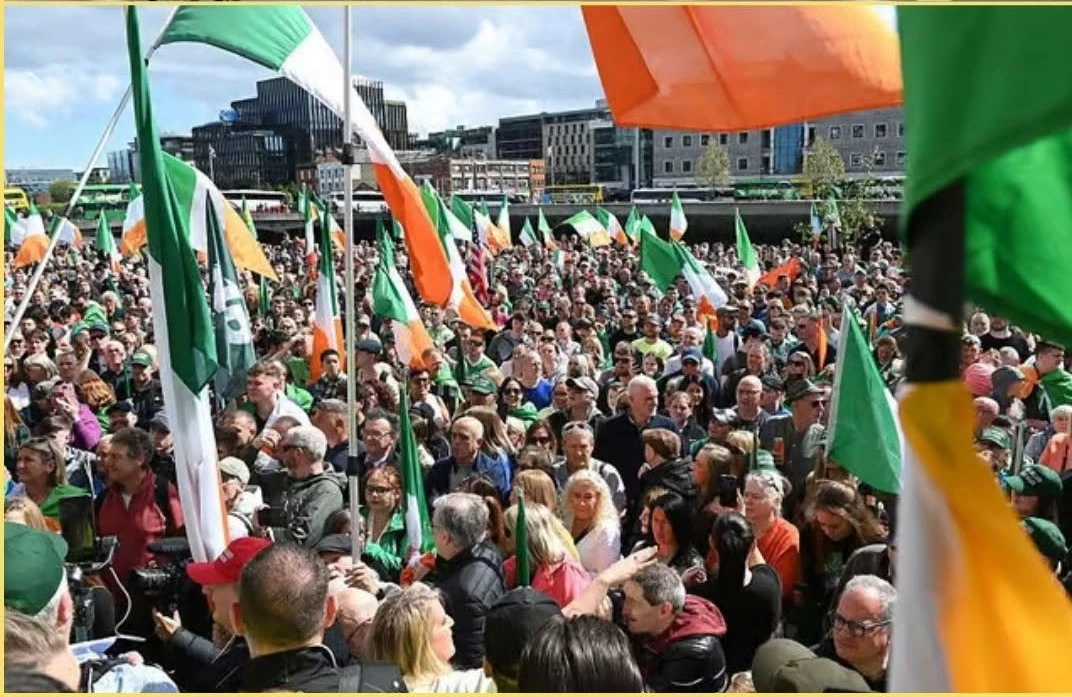
The images accompanying viral accounts show scenes that are immediately recognisable as political protest.
Heavy agricultural or commercial vehicles occupy urban streets. One tractor displays a sign reading “NO FARMS NO FOOD.”
Another photograph shows a large crowd surrounded by Irish flags.
Those scenes are visually dramatic. They communicate dissatisfaction, solidarity and national symbolism with almost no explanation required.
But photographs have limitations.
An image can demonstrate that a crowd gathered at a particular location. It cannot necessarily establish how many people attended.
A photograph of tractors in Dublin does not by itself prove that Ireland’s road network has been shut down.
A picture of fishermen protesting does not prove that every commercial port has stopped operating.
And an image of thousands of people carrying Irish flags cannot establish that the Irish government is about to collapse.
This distinction has become increasingly important in the age of social media.
Photographs from one demonstration can be combined with footage from another. Old images can return during a new controversy. Attendance estimates can grow as posts are copied. Predictions can gradually be presented as facts.
Eventually, a collection of individually plausible details can become a narrative far more dramatic than the evidence supporting it.
That is why location, date, original source and independent reporting matter.
The Claim of a “Total Nationwide Shutdown”
Perhaps the biggest assertion in the viral account is that Ireland has entered Day 5 of a total nationwide shutdown.
The word total matters.
A genuine nationwide shutdown would represent something much larger than demonstrations or temporary road blockades.
It would normally involve major disruption to several critical systems simultaneously: transportation, ports, supply chains, workplaces, public services or commercial activity.
Such an event would be extremely difficult to conceal.
Businesses would experience shortages. Freight schedules would change. Public transport would be affected. Ports and logistics companies would issue notices. Emergency authorities would provide guidance. National and international news organisations would be reporting continuously from affected areas.
Individual blockades, slow-moving tractor demonstrations or temporary disruptions can certainly have serious consequences.
But they are not necessarily equivalent to a nationwide shutdown.
Without corroborating evidence showing widespread and sustained interruption of Ireland’s critical infrastructure, describing the country as being under a “total shutdown” goes beyond what photographs of demonstrations alone can establish.
What About the Claim of 200,000 Protesters?
The figure of 200,000 demonstrators is equally consequential.
Ireland has a population of only several million people. A political demonstration attracting 200,000 participants would therefore represent an enormous mobilisation.
Crowd estimates, however, are notoriously difficult.
Organisers frequently produce one estimate, police or authorities another, while independent observers may arrive at a third number.
Photographs create additional problems because perspective can radically alter perceptions of crowd size.
A tightly packed street photographed with a telephoto lens can appear enormous. Conversely, a demonstration spread across a large area can look relatively small in individual photographs.
Reliable estimates typically require information about the physical area occupied by protesters, crowd density, transportation data and sometimes aerial imagery.
Therefore, a photograph showing a substantial gathering does not independently establish an attendance figure of 200,000.
The number should be treated as an allegation unless supported by credible, independently verifiable estimates.
That distinction does not diminish the significance of a real demonstration.
Ten thousand people protesting can be politically significant.
Fifty thousand can be extraordinary.
But journalism should not turn uncertainty into precision merely because a larger number produces a more dramatic headline.
Farmers and the Politics of Rural Anger
Where the viral narrative becomes more credible in a broader sense is in its description of economic frustration among agricultural communities.
Farmers across Europe have spent recent years protesting over combinations of environmental regulation, fuel and fertiliser costs, competition, trade rules, taxation, bureaucracy and declining margins.
Ireland is particularly sensitive to agricultural politics because farming occupies a position in Irish society that extends far beyond its direct economic contribution.
Agriculture is connected to land ownership, rural identity, family inheritance, food production and the country’s political history.
The slogan visible on the tractor — “No Farms, No Food” — captures that worldview in remarkably few words.
For supporters of agricultural protests, the argument is straightforward: governments cannot continually impose additional costs and restrictions on producers while simultaneously expecting inexpensive and secure domestic food supplies.
Environmental advocates counter that agriculture cannot be exempted from efforts to address climate change, water quality and biodiversity loss simply because reform is politically difficult.
Those positions are not mutually exclusive.
A country can need environmental reform while also needing economically viable farms.
The difficult question is how quickly that transition should occur, who should pay for it and how governments protect farmers whose businesses operate on narrow margins.
Why Tractors Have Become Political Symbols
Agricultural demonstrations have a distinctive advantage over many other protests: farmers possess machinery capable of physically transforming public space.
A few hundred protesters on foot can occupy a square.
A few hundred tractors can disrupt an entire transport network.
That makes agricultural protests unusually visible.
Tractors also carry enormous symbolic power.
They represent food production, rural communities and manual work. When lined up outside government buildings, they visually communicate a simple message: the people producing essential goods believe policymakers are no longer listening.
But the effectiveness of tractor demonstrations creates another dilemma.
Road blockades can inconvenience people who have nothing to do with the disputed policies.
Workers can miss shifts. Deliveries can be delayed. Small businesses can lose customers. Ambulances and other emergency services may face complications unless routes are carefully protected.
Protest movements therefore face a constant strategic question:
How much disruption generates political attention before disruption begins reducing public sympathy?
There is no universal answer.
Truck Drivers and the Power of Logistics
The viral story also claims truck drivers have begun blocking highways.
If independently confirmed on a large scale, involvement by haulage operators would substantially increase the economic significance of any protest.
Modern economies depend on extraordinarily precise logistics.
Supermarkets receive frequent deliveries rather than storing enormous inventories. Manufacturers depend on components arriving according to production schedules. Fuel, medicine and food travel through interconnected distribution networks.
Truck drivers therefore occupy one of the most strategically important positions in the economy.
Even limited disruption can create visible consequences relatively quickly.
But once again, scale matters.
A convoy demonstration is not the same as a national freight strike.
A temporary motorway blockade is not the same as the collapse of Ireland’s road transport network.
And photographs of trucks participating in demonstrations cannot establish that the haulage industry as a whole has joined a national shutdown.
Fishermen and the Threat to Ports
The allegation involving fishermen is perhaps even more dramatic: that fishing communities are preparing to “strangle every port.”
Ports are critical infrastructure for an island economy.
Ireland depends heavily on maritime trade for imports and exports. Any prolonged closure of major ports would have consequences extending far beyond fishing communities.
That is precisely why claims of complete port blockades require particularly careful verification.
A protest involving fishing vessels near a harbour may be politically powerful.
A temporary obstruction can attract enormous media attention.
But closing every port would require coordination on an entirely different scale and would almost certainly produce immediate official warnings and commercial consequences.
Until evidence demonstrates that level of disruption, it is more accurate to describe such language as a claim or threat attributed to protesters rather than an established national reality.
The Military “On Standby” Claim
Another element of the viral story deserves special caution: the allegation that the military is on standby.
Military involvement dramatically changes the emotional meaning of a political story.
It can imply that authorities expect violence, fear institutional collapse or are preparing for an unprecedented confrontation.
But governments maintain contingency capabilities for numerous reasons.
Security forces can be prepared for major events without being deployed against protesters. Defence personnel can also support civilian authorities during transportation emergencies, severe weather, infrastructure problems and other situations.
Even if some form of contingency planning existed, that would not automatically mean soldiers were preparing to confront demonstrators.
There is an important difference between:
contingency preparation, operational readiness, deployment and direct intervention.
Those terms should not be treated as interchangeable.
Without clear official confirmation, the phrase “military on standby” should therefore be regarded cautiously.
The Most Explosive Claim: What Is the “2% Threshold”?
At the centre of the viral narrative is something presented almost like a constitutional secret.
According to the posts, Ireland possesses a “2% threshold” capable of forcing the government to dissolve.
This is the claim most in need of scrutiny.
Ireland is a parliamentary democracy governed under the Constitution of Ireland.
The government remains politically dependent on maintaining sufficient support in Dáil Éireann, the lower house of the Oireachtas.
A government that loses political support can face serious consequences.
But Irish constitutional government does not ordinarily operate through a mechanism under which protests involving a particular percentage of the population automatically dissolve the government.
That is the central problem with the “2% revolution” narrative.
Public demonstrations can create enormous political pressure.
Opinion polls can destabilise political parties.
Coalition partners can withdraw support.
Members of parliament can change allegiance.
Governments can lose confidence.
Elections can transform the political landscape.
But none of those things means that gathering two percent of the population in the streets automatically triggers dissolution.
How an Irish Government Can Actually Fall
To understand why the claim is questionable, it is useful to separate street politics from parliamentary mechanics.
Ireland’s head of government is the Taoiseach.
The Taoiseach must retain sufficient parliamentary support to govern.
If a government loses the confidence of the Dáil, the political consequences can become severe.
That could ultimately lead to resignation, attempts to construct another government or a general election, depending on the circumstances and constitutional process.
Coalition politics also matters enormously.
Ireland frequently operates through coalition governments because no single party necessarily commands an outright parliamentary majority.
That means comparatively small changes inside parliament can sometimes have major consequences.
A coalition partner withdrawing support can create a crisis.
A significant rebellion among government TDs can weaken the administration.
A defeat on a crucial vote can expose the government’s inability to command the chamber.
But those are parliamentary thresholds, not protest-percentage thresholds.
Two percent of Ireland’s population demonstrating outside Leinster House could certainly influence politicians.
It would not, merely because it crossed two percent, automatically terminate their constitutional authority.
Why the “2%” Idea Sounds Convincing
The claim nevertheless has psychological appeal.
Two percent sounds simultaneously small and enormous.
It is small enough that people can imagine reaching it.
But in a country of millions, it represents tens of thousands of people — enough to create spectacular aerial images and enormous demonstrations.
Political researchers and activists have long debated whether there are participation thresholds beyond which mass movements become unusually difficult for governments to resist.
Research on civil resistance has sometimes been simplified online into numerical rules suggesting that mobilising a certain percentage of the population guarantees political success.
Such research can be valuable.
But historical statistical observations are not constitutional laws.
A finding that large nonviolent movements have historically achieved high success rates does not mean reaching a specific percentage automatically removes a government from office.
Political outcomes depend on institutions, elections, parliamentary arithmetic, public opinion, elite defections, economic conditions, police behaviour, leadership and numerous other variables.
A percentage can describe historical patterns.
It cannot magically override a constitution.
Protest Is Political Power — Just Not Automatic Legal Power
None of this means mass demonstrations are irrelevant.
Quite the opposite.
A government can remain legally entitled to govern while becoming politically incapable of sustaining its programme.
Large demonstrations can pressure legislators.
They can change polling.
They can cause coalition members to reconsider their positions.
They can influence elections.
They can persuade governments to modify legislation.
They can force ministers to resign.
And occasionally they can contribute to the collapse of an administration.
The distinction is between political pressure and automatic constitutional effect.
A million protesters do not necessarily possess a legal mechanism to remove a government.
But a government confronting a million angry citizens might decide that continuing unchanged is politically impossible.
That difference is fundamental.
“Get Our Country Back”: The Politics Behind the Language
The phrase attributed to protesters — “Get our country back” — belongs to a broader political vocabulary increasingly common across Western democracies.
Its meaning varies considerably depending on who uses it.
For some rural protesters, it can mean restoring economic security and protecting domestic agriculture.
For others, it can express frustration with political elites.
Elsewhere, similar language has been associated with debates over immigration, sovereignty, European integration, taxation or national identity.
Because the phrase can carry several meanings simultaneously, journalists should avoid assuming that every participant interprets it identically.
A farmer protesting agricultural regulations may have entirely different political motivations from someone attending the same demonstration because of immigration.
Large protest movements are rarely ideologically uniform.
They are coalitions of grievances.
That diversity can increase their size while making their long-term political objectives more difficult to define.
Is Ireland’s Working Class in Revolt?
The viral narrative describes the events as a working-class uprising.
Again, that characterization requires evidence.
“Working class” is an enormously broad category.
Truck drivers, farmers and fishermen certainly represent important occupational communities, but their interests do not automatically represent every working household in Ireland.
Urban renters may prioritise housing.
Healthcare workers may focus on staffing and wages.
Young professionals may worry about housing affordability and emigration.
Farmers may concentrate on regulation and agricultural economics.
Fishing communities may focus on quotas and access to marine resources.
These frustrations can overlap without being identical.
The crucial question for any genuine mass political movement is whether it can connect those separate grievances into a coherent national programme.
That is considerably harder than organising a demonstration.
Ireland’s Housing Pressure
Any serious examination of Irish political dissatisfaction must also acknowledge housing.
Ireland has experienced intense arguments over housing availability, rents, home ownership and infrastructure.
For younger generations especially, housing can determine almost every major life decision.
Can someone afford to leave their parents’ home?
Can a couple start a family?
Can workers live near their jobs?
Can teachers, nurses and other essential workers afford communities where their services are needed?
Housing shortages create political consequences precisely because they affect people who otherwise have very different political identities.
When a society experiences strong economic indicators while substantial numbers of citizens still struggle to secure affordable housing, frustration can become particularly intense.
People naturally ask why national prosperity does not translate into personal security.
Immigration and Population Growth
Immigration has also become a significant subject of political debate in Ireland.
As in many European countries, legitimate questions about housing capacity, asylum processing, public services and integration coexist with concerns about hostility toward migrants.
Those issues require careful separation.
Governments have a responsibility to manage borders and immigration systems effectively.
Communities can legitimately ask whether infrastructure is sufficient to accommodate rapid population changes.
Citizens can debate asylum policy without hostility toward individual asylum seekers.
At the same time, migrants should not be blamed collectively for structural problems that may have developed over decades.
Housing shortages, for example, can involve planning restrictions, construction capacity, financing, land policy, infrastructure and government decisions extending far beyond immigration.
Reducing complicated structural problems to a single group may produce powerful political rhetoric but rarely produces an adequate explanation.
The European Dimension
Ireland’s relationship with the European Union inevitably enters many discussions involving farming, fishing and environmental regulation.
EU membership has brought Ireland substantial economic and political advantages.
Access to the single market has been central to Ireland’s economic transformation.
European investment, agricultural programmes and freedom of movement have reshaped the country.
But membership also involves common rules.
Agricultural policy, environmental standards, fisheries management and trade agreements can therefore become politically sensitive when communities believe decisions are being made too far from those directly affected.
Supporters of European integration argue that Ireland benefits enormously from participating in a larger economic and regulatory system.
Critics argue that national governments sometimes use European obligations to justify policies that voters cannot easily change.
Both perspectives form part of Ireland’s democratic debate.
Climate Policy and Rural Communities
Agriculture also sits at the centre of the climate debate.
Ireland has international and European commitments to reduce greenhouse-gas emissions.
Agriculture represents an important part of the country’s emissions profile, particularly because of livestock production.
Environmental groups argue that meaningful climate targets cannot be achieved while ignoring agricultural emissions.
Farm organisations often respond that food production cannot simply be treated like another industrial sector.
They point to global food demand, rural employment and the risk that reducing domestic production could simply shift production — and emissions — abroad.
The argument therefore extends beyond whether emissions should decline.
It concerns how, how quickly, and who absorbs the economic cost.
A durable solution requires policies that can survive democratic pressure.
Climate measures that communities perceive as economically impossible may produce resistance rather than transition.
When Protest Becomes Disruption
There is another issue that any balanced account must confront.
Democratic societies protect the right to peaceful protest.
But that right is not unlimited.
Blocking roads, obstructing ports or preventing other citizens from working creates legal and ethical questions.
Supporters of disruptive protest argue that demonstrations incapable of causing inconvenience are easy for governments to ignore.
Many historic movements succeeded precisely because they disrupted normal economic or political activity.
Critics respond that protesters cannot claim democratic legitimacy while preventing millions of other citizens from going about their lives.
Both arguments have historical support.
The dividing line often depends on proportionality, duration, public safety and whether emergency access remains available.
Are Protesters Being Called “Thugs”?
The viral account also claims that “legacy media” are describing protesters as “thugs.”
Such allegations should be attributed carefully.
Different newspapers, broadcasters, commentators and individual journalists may use dramatically different terminology.
“The media” is not a single institution.
A commentator criticising aggressive behaviour at one demonstration does not necessarily mean an entire national press has labelled peaceful farmers criminals.
Likewise, footage showing peaceful protesters does not prove that no misconduct occurred elsewhere.
Large demonstrations can contain thousands of peaceful participants and a small number of people behaving aggressively at the same time.
Responsible reporting should distinguish between them.
If violence occurs, it should be documented specifically.
If demonstrations remain peaceful, that should also be reported accurately.
Collective labels rarely improve understanding.
The Viral-Footage Problem
Perhaps the greatest challenge surrounding stories like this is the speed at which visual material circulates.
A dramatic photograph is posted.
Someone adds a caption.
Another account adds a number.
A third account adds a constitutional claim.
A fourth transforms speculation into breaking news.
Within hours, thousands of people may encounter an apparently coherent story whose individual components originated from entirely different sources.
The resulting narrative can feel authentic because photographs are authentic.
But authentic photographs do not guarantee authentic captions.
This phenomenon is particularly powerful during protests because demonstrations naturally generate dramatic imagery.
Flags, police lines, tractors, smoke, enormous crowds and government buildings are perfect material for social media.
Context is less visually exciting.
But context is what determines what those photographs actually mean.
Five Questions to Ask Before Sharing
Readers encountering dramatic claims about Ireland — or any political crisis — can apply several basic tests:
- When was the photograph or video recorded?
- Where was it recorded?
- Who produced the crowd estimate?
- Has the claimed shutdown been independently confirmed by transportation, port or government sources?
- Does the supposed constitutional mechanism actually appear in Irish law or constitutional procedure?
These questions do not require people to distrust everything.
They simply require evidence to match the magnitude of the claim.
Could Protests Still Bring Down a Government?
Absolutely — politically.
History provides countless examples of governments weakened or ultimately removed following sustained public mobilisation.
But usually the mechanism involves several forces operating together.
Public demonstrations reduce political confidence.
Opinion polls deteriorate.
Backbench politicians become nervous.
Coalition partners reconsider their positions.
Government legislation becomes harder to pass.
Internal divisions intensify.
Eventually, parliamentary support collapses or political leaders conclude that an election is unavoidable.
That is how street pressure can migrate into institutional change.
The street does not replace parliament.
It changes the calculations of the people inside parliament.
What Would Signal a Genuine Government Crisis?
Rather than focusing on viral numerical thresholds, observers should watch measurable institutional developments.
A serious threat to an Irish government would become apparent if coalition partners withdrew support, government TDs defected in sufficient numbers, crucial parliamentary votes were repeatedly lost or the Taoiseach could no longer command confidence in the Dáil.
Those developments matter much more constitutionally than the size of any individual demonstration.
Polling would also be important.
If demonstrations corresponded with a dramatic and sustained collapse in public support for governing parties, politicians would inevitably respond.
Similarly, large-scale participation from organised labour, agricultural organisations, transportation workers and other established institutions would indicate that unrest was developing beyond isolated protest networks.
That is the evidence needed before describing events as a national political rupture.
The Difference Between a Movement and a Moment
Mass demonstrations frequently create the impression that political transformation is imminent.
Sometimes it is.
Often it isn’t.
The difficult stage begins after the crowds leave.
Movements need leadership.
They need specific demands.
They need negotiating structures.
They need strategies for elections and parliamentary politics.
And they need agreement about what victory actually means.
“Get our country back” may mobilise people.
But governments cannot negotiate with a slogan.
Does victory mean lower taxes?
Different agricultural regulations?
Changes to climate policy?
Immigration reform?
Housing construction?
Fisheries reform?
An election?
Withdrawal from particular EU policies?
Unless a protest movement translates dissatisfaction into specific objectives, governments can sometimes survive simply by waiting for mobilisation to fragment.
The Government’s Responsibility
Governments also make a mistake when they dismiss public anger merely because some claims circulating around demonstrations are exaggerated.
Misinformation and genuine grievances can coexist.
A viral post may exaggerate attendance while participants still have legitimate economic concerns.
A false constitutional theory may circulate among people experiencing real housing insecurity.
An exaggerated description of a blockade does not automatically invalidate complaints about farming policy.
Political leaders therefore face two responsibilities simultaneously:
Correct misinformation where necessary.
And listen to legitimate grievances.
Treating every critic as misinformed can deepen distrust.
Accepting every viral claim as fact can do exactly the same thing.
Protesters Have Responsibilities Too
The same principle applies to protest movements.
Credibility is political capital.
Movements strengthen themselves when they correct exaggerated claims circulating among their own supporters.
If 30,000 people attended, claiming 200,000 does not make the protest stronger.
It makes future claims easier to dismiss.
If several roads were disrupted, describing the entire nation as shut down creates unnecessary scepticism.
And if no constitutional “2% rule” exists, continuing to promote it can distract from legitimate arguments.
A movement confident in its grievances should not need numerical mythology.
Ireland Is Changing
Whatever the accuracy of the most dramatic viral claims, there is a broader reality that should not be ignored.
Ireland has changed extraordinarily quickly.
Within a few generations, the country moved from relative economic isolation and significant emigration toward global integration, substantial foreign investment and demographic transformation.
Social attitudes changed.
Cities expanded.
The economy internationalised.
Migration patterns reversed.
Housing pressures intensified.
Environmental policy became increasingly important.
And relationships between rural Ireland, Dublin and European institutions evolved.
Rapid transformation creates winners.
It also creates people who feel left behind.
That does not mean Ireland is collapsing.
Nor does it mean dissatisfaction should be dismissed.
It means the country’s political institutions are confronting the same fundamental challenge facing many prosperous democracies:
How can economic transformation remain legitimate when significant parts of the population believe they are carrying its costs?
Why the Rural-Urban Divide Matters
The geography of political frustration may become increasingly important.
Policy designed in metropolitan environments can look very different when experienced in rural communities.
A fuel increase may be manageable for someone with access to extensive public transportation.
For someone driving long distances because no practical alternative exists, it can represent a significant household cost.
Environmental regulation designed at national level can appear reasonable in aggregate while imposing substantial costs on an individual farm.
Conversely, rural opposition to environmental reform can frustrate urban voters who believe governments are moving too slowly on climate change.
Neither perspective automatically invalidates the other.
Effective government requires understanding both.
Could Ireland Face a New Political Realignment?
That is perhaps the most consequential long-term question.
Periods of sustained dissatisfaction can alter party systems even when individual protests fade.
Voters who believe established parties no longer represent them may seek independents, new parties or previously marginal political movements.
Ireland’s electoral system already provides significant opportunities for independents and smaller parties.
A successful protest movement therefore does not necessarily need to overthrow a government in the streets.
Its influence might emerge gradually through elections.
That transformation is slower than the dramatic “government falls today” narrative circulating online.
But in democratic systems, it is often more consequential.
What We Know — and What Remains Unproven
Based solely on the material accompanying the viral narrative, several conclusions can be drawn cautiously.
The images are consistent with significant Irish protest activity and demonstrate the political symbolism of farmers, vehicles and large crowds.
They do not, by themselves, establish every claim attached to them.
The following assertions require independent verification before being presented as established fact:
- that Ireland is experiencing a fifth consecutive day of a total nationwide shutdown;
- that 200,000 people have marched on parliament as part of the claimed action;
- that truck drivers have effectively closed Ireland’s highway network;
- that fishermen are shutting or preparing to shut every Irish port;
- that Ireland’s military has been placed on standby specifically because of this protest movement;
- and, most importantly, that a “2% threshold” automatically forces the Irish government to dissolve.
The final claim appears particularly misleading when presented as an automatic constitutional mechanism.
Mass public mobilisation can create immense political pressure.
But political pressure and constitutional procedure are not the same thing.
The Bigger Story Is Still Important
It would nevertheless be a mistake to conclude that because dramatic claims require verification, the underlying political questions are unimportant.
Ireland faces real debates over agriculture, housing, migration, environmental policy, infrastructure, rural economics, fisheries and public trust.
Farmers and other working communities have every democratic right to organise peacefully and demand answers from elected officials.
Governments likewise have an obligation to maintain essential infrastructure, protect public safety and govern according to constitutional procedures.
Journalists and citizens have another responsibility:
to distinguish between what is known, what is plausible and what remains unverified.
That distinction becomes most important precisely when emotions are highest.
Is This the End of the Irish Government?
There is currently no basis in the material presented here for declaring that Ireland’s government must fall because a supposed 2% protest threshold has been reached.
A government can certainly become vulnerable through public opposition.
Mass demonstrations can contribute to that vulnerability.
Sustained strikes or blockades can intensify pressure.
But ultimately the durability of an Irish government depends on constitutional and parliamentary realities — especially whether it retains the political support necessary to govern through Dáil Éireann.
The number of protesters outside parliament matters politically.
The number of votes inside parliament matters constitutionally.
Confusing those two concepts is where the viral “2% revolution” narrative becomes misleading.
A Country in Revolt — or Democracy Under Pressure?
Ireland may indeed be experiencing serious political frustration among sections of its population.
The images of tractors and Irish flags illustrate something genuine even without accepting every viral claim attached to them: people who feel threatened economically or ignored politically are capable of making themselves highly visible.
Whether that dissatisfaction develops into a lasting national movement is another question entirely.
It will depend on scale.
It will depend on public support.
It will depend on whether different occupational and political groups remain united.
It will depend on how the government responds.
And ultimately, it will depend on elections and parliamentary arithmetic rather than a mysterious percentage circulating on social media.
The most dramatic version of the story says Ireland has reached the brink of revolution.
The evidence available from the material presented does not justify that conclusion.
But there is another story here — less sensational, yet arguably more important.
It is the story of how governments maintain public consent during periods of rapid economic and social change; how farmers and working communities make themselves heard without losing broader public support; and how democracies respond when a growing number of citizens believe conventional politics is no longer listening.
Ireland’s future will not be decided by a viral equation.
It will be decided through the far messier combination of protest, negotiation, public opinion, parliamentary politics and elections that defines democratic government.
And if the demonstrations become as large and disruptive as the viral accounts claim, the consequences could indeed become politically significant.
But significance is not the same as revolution.
And political pressure is not the same as constitutional collapse.
For now, the most responsible conclusion is also the simplest:
Ireland may be facing anger and protest — but claims of a nationwide shutdown, military confrontation and an automatic “2% revolution” require substantially more evidence before they can be treated as fact.