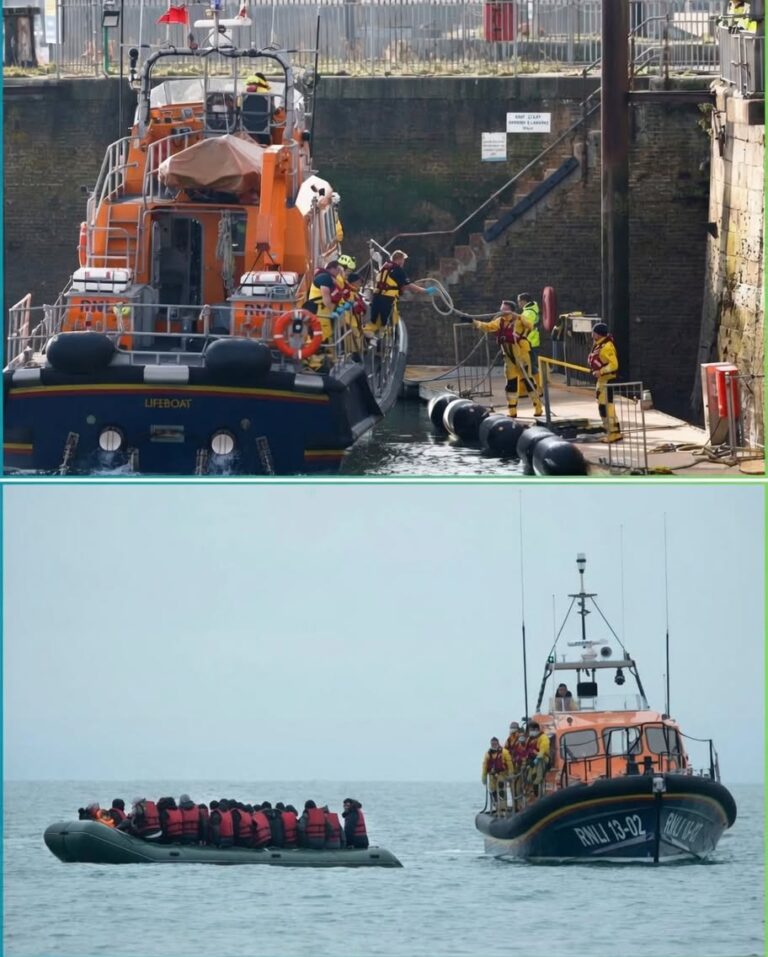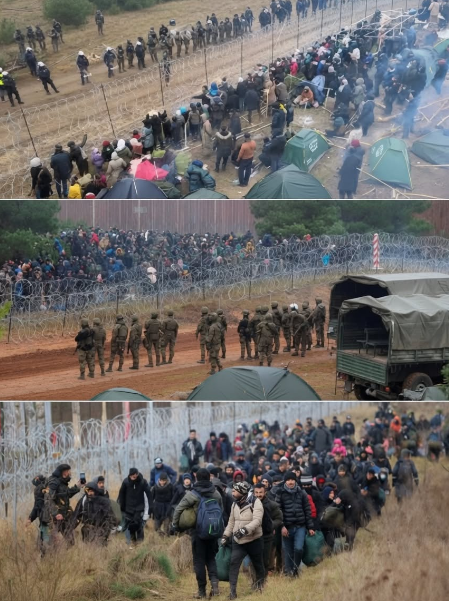
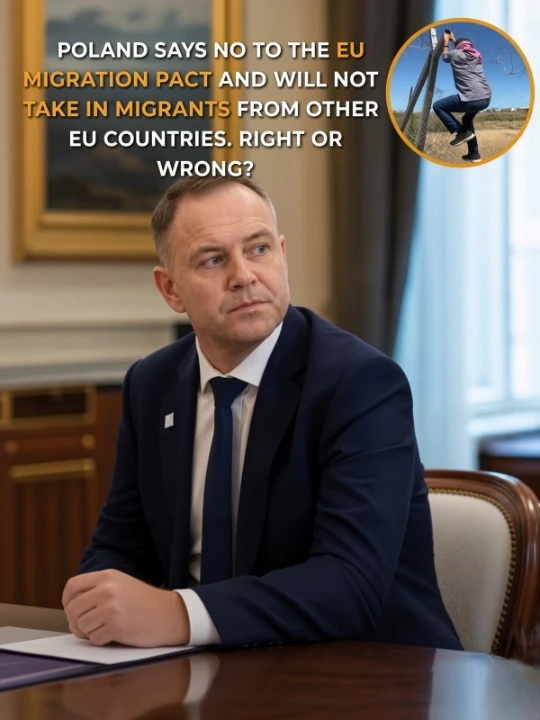
POLAND IS DRAWING A LINE. THEY’RE SAYING NO TO THE EU’S MIGRATION REDISTRIBUTION PLAN, ARGUING THEY’VE ALREADY DONE MORE THAN THEIR FAIR SHARE SINCE THE WAR IN UKRAINE BEGAN. BRUSSELS ISN’T HAPPY ABOUT IT.
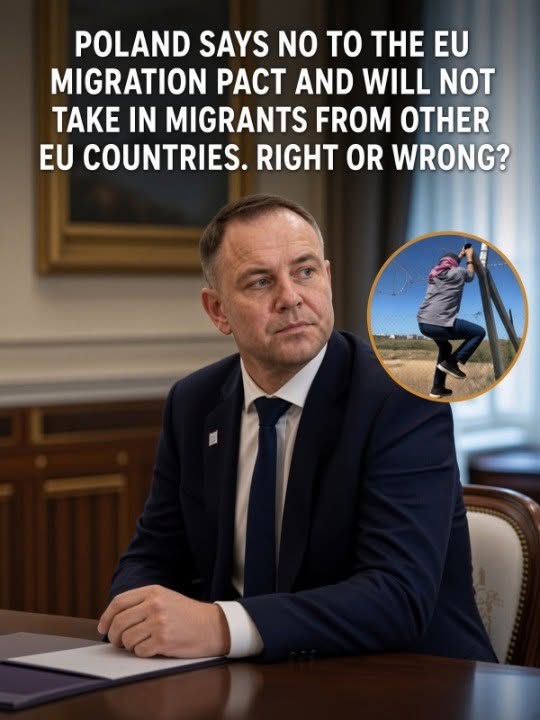
Poland Draws the Line: The EU Migration Fight Enters a New Era
Poland is drawing a line in the sand—and Brussels is watching closely.
At the heart of the confrontation is one of Europe’s most explosive political questions: Can a European Union member state demand an exception from a common migration system after already carrying an enormous refugee burden, or does EU law require every member to contribute according to the same rules?
For Warsaw, the argument is straightforward. Poland says it has already shouldered an extraordinary responsibility since Russia’s full-scale invasion of Ukraine. Millions of Ukrainians have crossed into Poland since the beginning of the war, creating enormous pressures on housing, schools, healthcare, public services, and the labor market.
The scale is difficult to dismiss.
As of June 30, 2026, Poland was hosting about 961,170 people from Ukraine under temporary protection, representing 21.8% of the EU total. Only Germany was hosting more.
That reality forms the foundation of Warsaw’s argument.
Polish officials and supporters of the government’s position ask a politically powerful question: If Poland has already become one of Europe’s largest hosts of displaced people, why should it also be expected to accept asylum seekers relocated from other parts of the European Union?
Brussels has a very different answer.
The EU’s new Pact on Migration and Asylum entered into application on June 12, 2026. It establishes a permanent solidarity mechanism designed to ensure that member states facing migration pressure are not left to manage the burden alone.
Under the system, solidarity is mandatory—but relocation itself is not necessarily mandatory.
That distinction is crucial.
The EU framework allows member states to fulfill their contribution through different forms of support, including relocating asylum applicants, making financial contributions, or providing other forms of assistance. The Commission calculates a country’s indicative “fair share” using factors including population and GDP.
In other words, the argument is not simply about whether Poland must “take migrants.”
The deeper issue is whether Poland must participate in the European solidarity mechanism at all—and, if so, how its enormous contribution to hosting Ukrainians should be taken into account.
That is where the politics become explosive.
Warsaw believes its Ukrainian refugee burden should matter.
Brussels insists that European rules must function as European rules.
And both sides can make a powerful case.
For Poland, the Ukrainian crisis is not an abstract humanitarian problem happening somewhere else on the continent. It is unfolding directly across its eastern border.
Poland has become a frontline state in Europe’s response to Russia’s war. It has hosted hundreds of thousands of Ukrainians under temporary protection while also supporting Ukraine militarily and politically.
The social consequences are real.
Schools have had to accommodate displaced children. Municipal governments have had to expand services. Housing markets have faced additional demand. Healthcare systems have absorbed new patients. Polish citizens have also experienced changes in labor markets and public spending.
The Polish government has begun reducing some of the extraordinary support measures introduced after Russia’s invasion. According to the European Commission, Poland is gradually phasing out certain special assistance programs for Ukrainians, while temporary protection remains available through March 2027 under current arrangements.
From Warsaw’s perspective, this makes the idea of an additional migration obligation particularly difficult to sell politically.
But Brussels sees the problem differently.
The European Union is not simply a collection of 27 independent countries that cooperate when convenient. Membership means accepting common laws and shared responsibilities.
The new migration pact was negotiated precisely because the old system was considered inadequate. The EU wanted a framework that could distribute pressure more fairly, strengthen external borders, accelerate asylum procedures, and prevent individual countries from being overwhelmed.
The pact therefore represents a fundamental principle: migration affecting one member state can become a European responsibility.
The European Commission describes the new framework as a balance between responsibility and solidarity. It includes stronger screening at external borders, clearer responsibility rules, crisis mechanisms, and financial and operational assistance.
From this perspective, allowing every heavily burdened country to declare itself exempt could undermine the entire system.
If Poland receives an exception because it hosts Ukrainians, what happens when another country demands an exception because it has received thousands of asylum seekers by sea?
What happens when Greece points to its external border?
When Italy points to Mediterranean arrivals?
When Germany points to its existing asylum population?
And what happens if several countries conclude that their domestic political circumstances justify refusing participation?
The solidarity mechanism could gradually become voluntary again.
That is precisely what Brussels wants to avoid.
Yet Poland’s argument cannot simply be dismissed as selfishness.
There is a genuine difference between hosting Ukrainian citizens under the EU’s Temporary Protection Directive and receiving asylum applicants through a relocation mechanism. The legal categories are different, the circumstances are different, and the administrative responsibilities can be different.
But from the perspective of a Polish town, school, hospital, or taxpayer, the distinction may feel less important.
People still need housing.
Children still need classrooms.
Public services still need money.
Local governments still have finite capacity.
That creates the central political dilemma.
Should European solidarity be calculated according to legal categories—or according to the total burden a country is already carrying?
Poland wants the latter principle to matter much more.
Brussels is trying to make the former system work.
The timing makes the confrontation especially significant because the migration pact has only just entered its operational phase. The European Commission itself acknowledges that implementation is a complex process requiring substantial legal and administrative work by both EU institutions and national governments.
The Commission reported in July that member states had already made progress implementing the new responsibility rules, while emphasizing that further work remained necessary.
That means Europe is not watching a settled system being challenged.
It is watching a new system being tested for the first time.
And Poland’s resistance could become an important precedent.
If Warsaw successfully negotiates meaningful recognition for the burden it has carried since the Ukraine war began, other countries may seek similar treatment.
If Brussels refuses to compromise and pursues legal enforcement, the confrontation could become another major test of the relationship between national sovereignty and EU law.
That question has haunted the European project for years.
How much authority should Brussels possess?
How much freedom should national governments retain?
When does European solidarity become an obligation—and when does it become an unfair demand imposed on countries already under enormous pressure?
There are no easy answers.
The humanitarian argument for solidarity is powerful. No individual EU country should be left alone to manage a major migration crisis. The EU’s external borders affect the entire bloc, and asylum systems can quickly become overwhelmed when arrivals are concentrated in a small number of countries.
But the Polish argument is equally powerful politically: solidarity should recognize solidarity already provided.
A country that has hosted nearly one million Ukrainians cannot reasonably expect its citizens to view itself as having contributed nothing to Europe’s refugee response simply because those people arrived under a different legal framework.
The danger is that both sides could turn a complicated policy question into a zero-sum political battle.
Warsaw could portray Brussels as an unelected bureaucracy attempting to dictate national policy.
Brussels could portray Warsaw as a government demanding the benefits of European membership while rejecting European responsibilities.
Neither description captures the entire reality.
The real challenge is to build a system in which European countries share responsibility without pretending that every country starts from the same position.
Perhaps that means creating clearer credits for countries hosting large numbers of displaced Ukrainians.
Perhaps it means allowing greater flexibility in how solidarity contributions are fulfilled.
Perhaps financial and logistical support should play a larger role where relocation creates significant political or administrative difficulties.
The EU already recognizes that solidarity can take different forms.
The question is whether that flexibility will be enough to satisfy Poland.
Because this dispute is about more than migration.
It is about the future of European integration.
Poland is effectively asking whether the EU can recognize national circumstances without destroying common rules.
Brussels is asking whether common rules can survive if every country believes its circumstances are exceptional.
That is the collision now taking place.
And Europe should pay attention.
Because the question facing Poland today may eventually confront almost every EU member state:
When the burden becomes too heavy, does European solidarity mean sharing it—or does it mean recognizing that some countries have already carried more than their share?
The answer will determine not only Poland’s migration policy, but potentially the credibility of Europe’s entire new asylum system.
The gates of Europe may be changing.
But the deeper battle is over who decides what happens behind them—and whether 27 nations can still agree on what it means to stand together.