“NATIONWIDE SHUTDOWN: Ireland Pushed to the Brink as Mass Working-Class Protests Threaten to Dissolve Government!”
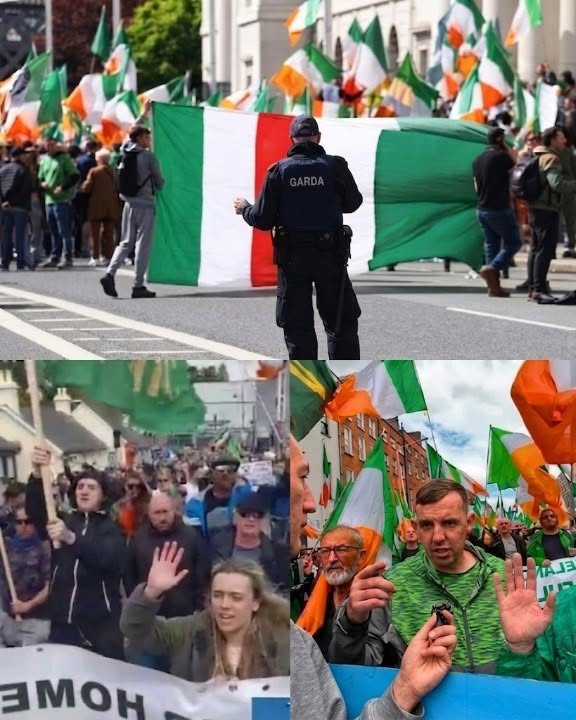
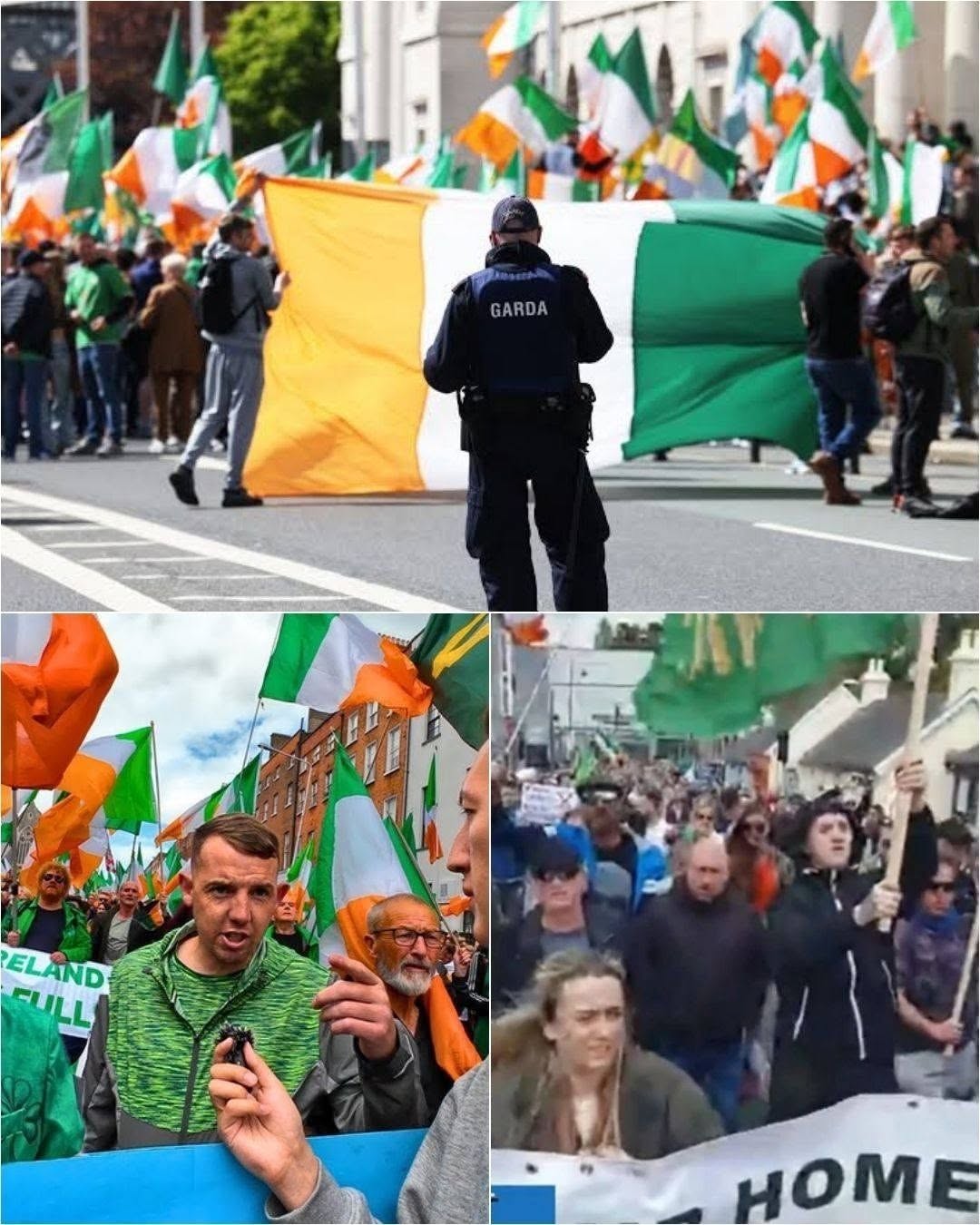
Ireland Faces Growing Protest Pressure as Claims of a Nationwide Shutdown Fuel Political Tensions
Ireland is facing renewed political and social pressure amid reports of large-scale demonstrations, transport disruption and growing public anger over economic policy. But dramatic claims that the country has been brought to a complete standstill — or that the government is on the verge of collapse — require stronger evidence before they can be treated as established fact.
Ireland has become the focus of intense political discussion after reports emerged of widespread protests involving working-class communities, transport blockades and demands for the government to resign.
Some online accounts have described the situation in extraordinary terms, claiming that hundreds of thousands of people have taken to the streets and that national infrastructure has effectively stopped functioning.
Others have gone further, suggesting that the unrest could force the current administration from office.
If accurate, such developments would represent one of the most serious episodes of political instability in modern Irish public life.
However, the scale of the claims means they must be examined carefully.
A large protest can be politically significant without amounting to a nationwide shutdown. Transport disruption in several cities can create severe inconvenience without paralyzing an entire country. And anger directed at the government does not automatically mean that the administration is about to collapse.
The political reality depends on verified turnout, the duration of the protests, the extent of infrastructure disruption and, crucially, whether the government still retains sufficient parliamentary support.
Why Economic Anger Can Escalate Quickly
The reported protests appear to be linked to dissatisfaction over economic thresholds and the wider cost of living.
That is a powerful source of political anger.
When wages fail to keep pace with housing, energy, transport and food costs, people can feel that official economic indicators no longer reflect their daily experience.
Government thresholds — whether involving taxation, welfare eligibility, housing support or other benefits — can become particularly controversial when they determine who qualifies for assistance.
A household just above a cutoff may receive little or no support despite facing almost the same financial pressure as a household just below it.
That can create a strong sense of unfairness.
Working-class communities are often especially exposed to such pressures because a larger share of household income may be spent on essentials.
If protest organizers have successfully connected these grievances to a broader argument about government legitimacy, demonstrations could grow quickly.
Protest Is Not the Same as Government Collapse
One of the most dramatic claims surrounding the unrest is that protesters are demanding the immediate collapse of the administration.
Calls for a government to resign are common in large demonstrations.
Actually forcing a government from office is far more complicated.
Ireland’s political system operates through parliamentary confidence.
A government can face severe public opposition and still remain in office if it retains enough support in the Dáil.
To bring down an administration, political pressure would normally need to translate into a loss of parliamentary backing, the breakdown of a coalition, a successful confidence challenge or another constitutional route leading to an election.
Street protests can contribute to that process.
They can pressure governing parties, influence coalition partners and change public opinion.
But protest size alone does not automatically dissolve a government.
That distinction is important when evaluating claims that Ireland is “on the brink.”
How Significant Are the Blockades?
Reports that protesters have blocked transport hubs are politically and economically important if confirmed.
Transport disruption can rapidly magnify the impact of a protest because it affects people who are not directly participating.
Roads, rail stations, ports and distribution networks are particularly sensitive points.
A small number of organized blockades can create disproportionate disruption.
This can strengthen protesters’ leverage.
It can also create public backlash.
People who sympathize with a movement’s economic concerns may become less supportive if they cannot get to work, attend medical appointments or move goods.
The strategic question for protest organizers is therefore whether disruption increases political pressure faster than it erodes public sympathy.
Governments face a similar dilemma.
Allowing prolonged blockades can make authorities appear weak.
Heavy-handed intervention can produce images that further energize the movement.
“Hundreds of Thousands” Needs Independent Verification
The claimed protest turnout is central to understanding the story.
Crowd estimates are notoriously difficult.
Organizers, police, journalists and political opponents can produce very different figures for the same demonstration.
A claim that hundreds of thousands participated nationwide may be plausible in a broad movement across multiple cities, but it should not be repeated as fact without corroboration.
Independent estimates, aerial footage, transport data and reporting from several locations would provide a more reliable picture.
The geographic spread matters as much as the raw number.
A huge protest concentrated in Dublin tells a different political story from sustained demonstrations across Cork, Galway, Limerick, Waterford and smaller towns.
Likewise, a one-day mobilization is different from prolonged disruption lasting several days.
Why Working-Class Identity Matters
The description of the movement as “working-class” also deserves careful attention.
That label can reflect genuine social composition, but it can also be used politically.
If the protests are being driven primarily by lower- and middle-income households concerned about living costs, housing and benefits, the movement may tap into a broad sense of economic insecurity.
But large demonstrations often attract a wider coalition.
Trade union members, small-business owners, pensioners, students and politically unaffiliated citizens may participate for different reasons.
Understanding who is protesting helps explain whether the movement is narrowly focused or capable of reshaping national politics.
A broad coalition is usually more difficult for a government to dismiss.
The Government’s Response Will Be Critical
How the Irish government responds could determine whether tensions escalate or ease.
A defensive response may reinforce protesters’ belief that leaders are disconnected from ordinary households.
Targeted economic concessions could reduce pressure, but they could also encourage further demands.
Calling an early election would be a much more consequential step.
Governments often try to separate legitimate economic concerns from disruptive or unlawful tactics.
That can be politically effective if the public views blockades as excessive.
It can backfire if voters believe authorities are using law-and-order arguments to avoid addressing the underlying problem.
The tone of official statements therefore matters.
So does the substance.
If the controversy centers on economic thresholds, the government may face pressure to explain how those thresholds were set, who is excluded and whether reforms are possible.
Ireland’s Broader Economic Contradictions
Ireland presents a particularly interesting backdrop for this kind of unrest.
The country has often been associated with strong headline economic performance, foreign investment and a successful technology and pharmaceutical sector.
Yet macroeconomic strength does not automatically produce affordability for every household.
Housing costs, rents and uneven access to services can create a gap between national prosperity and individual experience.
That gap can become politically explosive.
People may hear that the economy is performing well while simultaneously struggling to secure housing or manage everyday expenses.
When official success and personal experience diverge sharply, public trust can erode.
Could the Protests Spread Further?
The answer depends on whether the movement can sustain participation and maintain a clear set of demands.
Large demonstrations often peak quickly if there is no organizational structure behind them.
Others grow because each government response becomes a new mobilizing issue.
Transport blockades can also encourage similar action elsewhere if protesters believe disruption is producing results.
On the other hand, public fatigue can set in.
Businesses can begin to push back.
Commuters may lose patience.
And divisions within the movement can emerge over tactics.
For that reason, talk of a permanent national shutdown is premature unless disruption proves both widespread and sustained.
A Serious Political Moment — But Not Yet Proof of Collapse
The reported unrest should not be dismissed if large numbers of citizens are indeed protesting against economic policy.
Mass demonstrations can signal deep dissatisfaction and can force governments to change course.
They can also alter electoral politics long after the streets have cleared.
But the language of national collapse should be used carefully.
A country can experience severe protests without its institutions failing.
A government can be deeply unpopular without immediately losing office.
And transport disruption can be serious without amounting to total paralysis.
The more responsible conclusion is that Ireland may be facing a significant test of political legitimacy and economic trust.
If the protests are as broad as claimed, the government will need to respond not only to the disruption but to the grievances driving it.
If the scale has been exaggerated, that too will become clear as independent reporting develops.
For now, the key questions are straightforward: how many people are actually protesting, how much of the country is genuinely disrupted, what exact economic policies have triggered the anger, and whether parliamentary support for the government is beginning to fracture.
Those facts — not the most dramatic social-media headline — will determine whether Ireland is facing a major political crisis or a powerful but more limited protest movement.