“ABOLISH THE HOUSE OF LORDS” — THE CLAIMS ABOUT SADIQ KHAN AND ANAS SARWAR SPARK A FRESH POLITICAL ROW
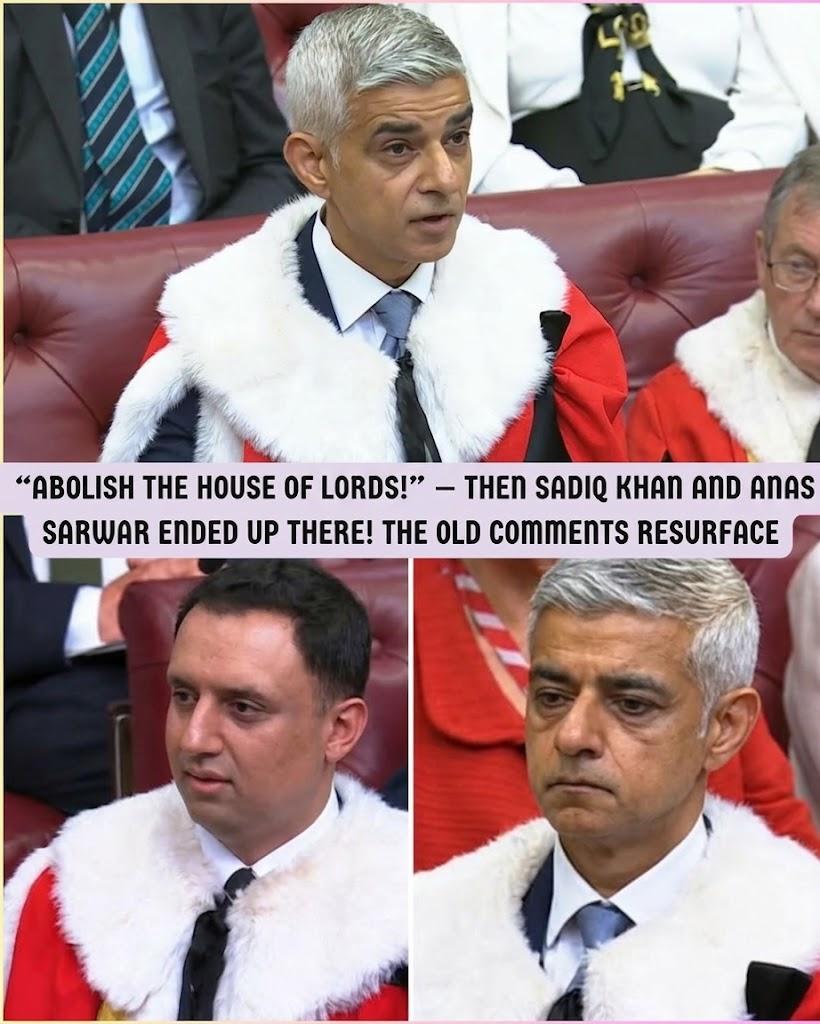
A political controversy is gaining attention over claims that Sadiq Khan and Anas Sarwar once backed the abolition of the House of Lords, only to later become members of the chamber themselves.
The allegation has been widely framed online as an example of politicians allegedly changing their position once circumstances changed. But the story requires careful examination: the specific claims about what Khan and Sarwar said, when they said it, and whether either actually became a member of the House of Lords need to be established from authoritative records before they are presented as fact.
Without that context, a provocative social-media claim can quickly turn into something very different from the underlying political story.
The House of Lords debate
The House of Lords has long been one of the most controversial institutions in British politics.
Unlike the elected House of Commons, members of the Lords are not generally elected by voters. The chamber currently consists largely of life peers, alongside a small number of hereditary peers and bishops.
Supporters argue that the Lords provides Parliament with specialist expertise and an additional opportunity to scrutinise legislation. Its members include people with backgrounds in law, business, science, medicine, public service, academia, the armed forces and many other fields.
Critics, however, question the democratic legitimacy of an unelected chamber exercising legislative powers.
Calls to reform or abolish the Lords have therefore appeared repeatedly throughout modern British political history.
The debate is not limited to one political party. Politicians across the political spectrum have at different times supported different models, ranging from relatively limited reform to complete abolition.
Why the accusation is politically powerful
The phrase “abolish the House of Lords” carries considerable political force.
For critics, a politician who argues that the chamber should disappear and later accepts a peerage could potentially face accusations of inconsistency.
But there is an important distinction between abolishing the existing House of Lords and opposing membership of a reformed second chamber.
A politician could, for example, support replacing the current Lords with an elected senate or another democratic institution. In that situation, becoming a member of the existing chamber would not necessarily prove that the politician had abandoned the principle of reform.
That is why the exact wording of previous statements matters.
Was the politician calling for complete abolition?
Were they advocating reform?
Were they discussing Labour Party policy at a particular point in time?
And did their position subsequently change?
Those questions cannot be answered simply by comparing an old quotation with a later appointment.
The Sadiq Khan question
Sadiq Khan has spent much of his political career in elected office, including as a Labour Member of Parliament and later as Mayor of London.
His political career has also placed him at the centre of numerous debates about constitutional reform, London government and the relationship between elected institutions and Westminster.
Claims circulating online about Khan and the House of Lords should therefore be checked against his actual public statements and official parliamentary records.
In particular, it is important to establish whether a quotation attributed to him calling for the Lords to be abolished was referring to complete abolition, reform of the chamber, or a broader discussion about constitutional change.
That distinction is crucial.
Political statements are often shortened dramatically when they are reposted online. A comment made during a discussion about replacing the Lords with another institution can later appear as though someone simply demanded that the chamber disappear.
The Anas Sarwar question
Anas Sarwar presents a similar issue.
As a senior Scottish Labour politician, Sarwar has been involved in debates about constitutional questions, devolution and the future of the United Kingdom.
Claims about his alleged opposition to the House of Lords should likewise be examined in their original context.
If a politician supports reforming or replacing the Lords, that is not necessarily identical to opposing every possible form of second chamber.
Likewise, membership of the House of Lords would not automatically establish that a person had abandoned a previous position unless there is clear evidence showing that their views had changed.
This is why political controversies involving apparently contradictory statements need more than a headline.
Principles versus political reality
The wider issue is familiar in Westminster.
Politicians regularly campaign for institutional reform while simultaneously operating within the institutions they want to change.
A politician may enter Parliament while arguing that Parliament itself needs reform.
A politician may campaign for changes to the electoral system while standing for election under the existing system.
Similarly, someone can criticise the House of Lords while continuing to participate in the political system surrounding it.
Whether that represents hypocrisy, pragmatism or simply a change in circumstances is ultimately a matter for voters and observers to assess based on the evidence.
The strongest way to examine such controversies is therefore to compare what was actually said with what happened later.
Why the Lords remains controversial
The constitutional argument surrounding the Lords is much larger than any individual politician.
Supporters of abolition say democratic legitimacy should rest primarily with elected representatives. They argue that legislation should ultimately be scrutinised by institutions whose members are directly accountable to voters.
Supporters of the current or a reformed Lords take a different view.
They argue that an upper chamber can provide detailed scrutiny that complements the elected Commons. Because members do not face elections in the same way as MPs, they may also be able to examine legislation with greater independence from short-term electoral pressures.
The question is therefore not simply whether the Lords is “good” or “bad”.
It concerns a fundamental constitutional choice:
Should Britain’s second chamber remain appointed, become elected, be substantially reformed, or be abolished altogether?
Different political parties and politicians have proposed different answers over the years.
What would abolition actually mean?
Abolishing the House of Lords would be a major constitutional change.
It would require decisions about what replaces it — if anything.
If Britain moved to a fully unicameral Parliament, the House of Commons would become the country’s sole parliamentary chamber.
If a new second chamber were created, difficult questions would immediately arise.
Should its members be elected?
How would elections work?
Should every part of the UK receive equal representation?
Should the chamber represent nations and regions?
Should members have the power to block legislation or merely delay it?
What should happen to the specialist expertise currently found among Lords members?
These questions demonstrate why constitutional reform is considerably more complicated than simply removing one institution.
The importance of checking the record
The controversy surrounding Khan and Sarwar demonstrates another increasingly important issue in modern politics: the speed at which political claims spread online.
A short post can combine an old quotation, a later political development and an accusation of hypocrisy in only a few sentences.
But the chronology may be incomplete.
A statement may have been taken out of context.
A politician’s position may have changed.
Or the underlying claim may simply be inaccurate.
That is why official parliamentary records, Hansard, government announcements and the House of Lords’ own membership records are the appropriate places to establish the facts.
The bigger political question
Regardless of the claims surrounding individual politicians, the debate over the House of Lords is unlikely to disappear.
Britain continues to face questions about how its constitutional institutions should operate and how much power should belong to elected representatives.
For critics of the Lords, the chamber remains an example of an outdated political system that should be replaced.
For supporters, it remains an important mechanism for detailed legislative scrutiny and independent expertise.
And for politicians who have previously advocated reform, their credibility will inevitably be tested by how consistently they apply those principles when circumstances change.
The most important question, therefore, is not simply whether a politician once used the words “abolish the House of Lords.”
It is what exactly they meant, whether their position subsequently changed, and what evidence exists to demonstrate that change.
That distinction matters — particularly when a provocative political claim is being shared thousands of times online.
Note: I do not have live web-search access in this response, so I have not independently verified the specific allegations that Sadiq Khan and Anas Sarwar both called for abolition and subsequently became Lords members. The article therefore treats those points as claims requiring verification rather than established facts.