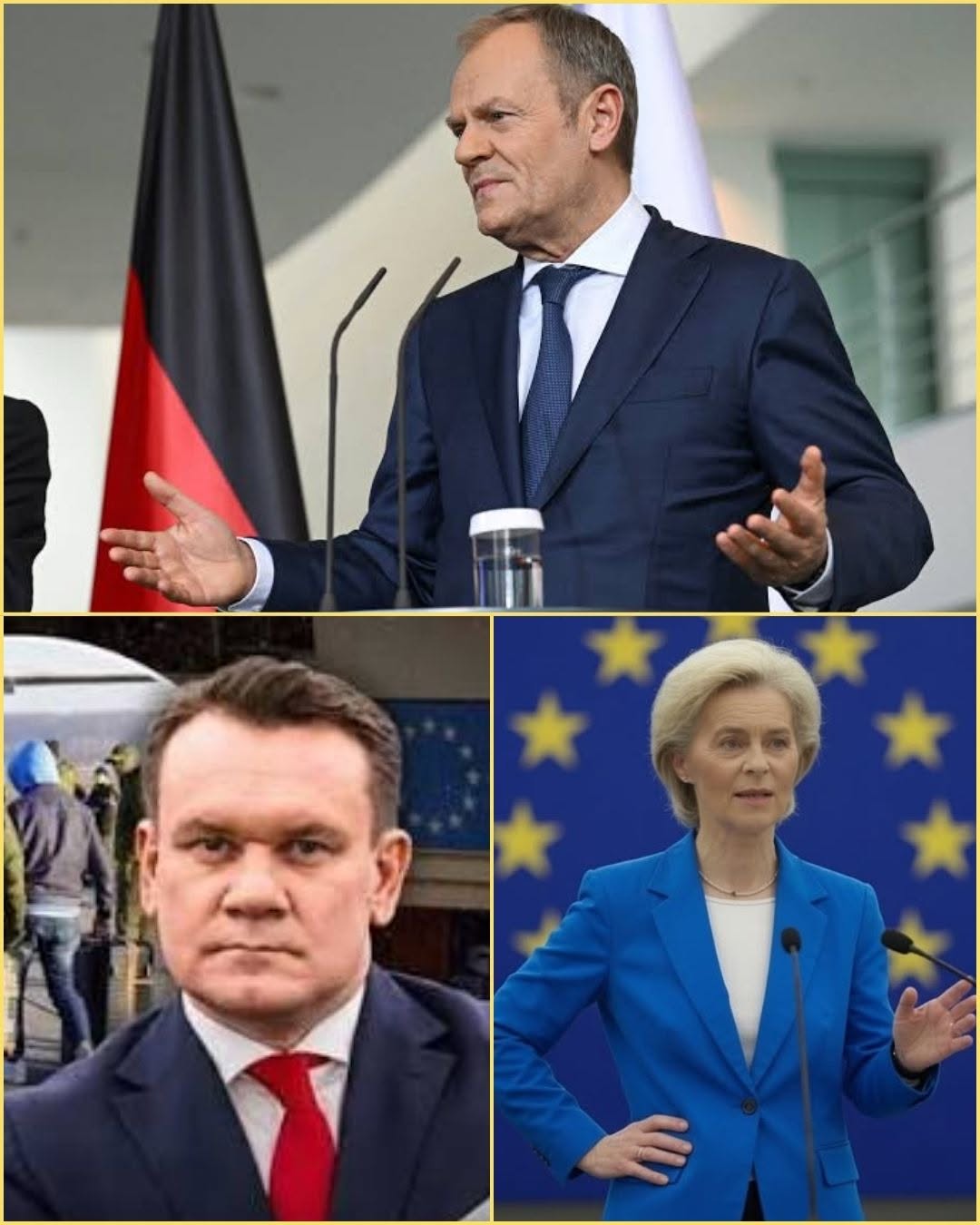
WHY IS POLAND REFUSING TO FOLLOW THE REST OF EUROPE? While many European nations continue wrestling with the consequences of large-scale migration, Poland has chosen a dramatically different course. The country’s leaders point to low crime rates, economic growth, and strong social cohesion as evidence that their approach is working. Critics strongly disagree, arguing that the narrative oversimplifies a far more complicated reality. Yet as images from the border circulate globally, more people are beginning to ask what exactly makes Poland’s model so different. Behind the headlines lies a deeper story about national identity, integration, and competing visions for Europe’s future. What is really driving Poland’s refusal to change course?
WHY IS POLAND REFUSING TO FOLLOW THE REST OF EUROPE?

Why Poland Refuses to Follow the Rest of Europe on Migration
Poland has become one of Europe’s most closely watched countries in the migration debate because it has chosen a path that looks very different from the one taken by many Western European states.
While countries such as Germany, France, Sweden, Italy, and the United Kingdom continue arguing over asylum backlogs, integration pressure, border control, and public safety, Poland’s leaders have presented their model as proof that stricter control can preserve social cohesion. Supporters point to Poland’s low-crime image, economic growth, strong national identity, and firm border policy. Critics argue that this version of events is too simple, ignores humanitarian concerns, and overlooks the reality that Poland itself has become a major host country for migrants and refugees — especially from Ukraine.
The truth is more complicated than either side usually admits.
Poland has not rejected all migration. It has rejected a particular model of migration: large-scale, irregular, culturally contested migration entering through asylum routes that many Poles believe Western Europe failed to control.
The Historical Reason: Poland Never Had the Same Migration Experience
One reason Poland thinks differently about migration is history.
For much of the post-war period, Poland was not a major destination country for migrants from Africa, the Middle East, or South Asia. Under communism and during the early decades after 1989, Poland was more often a country people left than a country people moved to. Millions of Poles worked abroad, especially after joining the European Union.
That means Poland did not develop the same kind of post-colonial migration relationship seen in Britain, France, the Netherlands, Belgium, or Portugal. Western Europe’s migration systems were shaped by empire, guest-worker programmes, colonial ties, labour shortages, family reunification, and asylum movements across several decades.
Poland’s political memory is different. Its national identity was shaped by occupation, partitions, resistance, Catholic tradition, Soviet domination, and the struggle to preserve language and sovereignty.
So when Western European leaders speak about multiculturalism as a historical reality, many Polish politicians and voters hear something else: a model they did not choose and do not want imposed on them.
The Security Reason: Belarus Changed Everything
Poland’s migration debate cannot be understood without the Belarus border crisis.
Since 2021, Poland and the EU have accused Belarus, backed by Russia, of pushing migrants toward the Polish frontier as a form of “hybrid warfare.” Polish officials argue that this is not ordinary migration but a hostile operation using vulnerable people as political pressure against the EU.
That is why Poland has built barriers, deployed security forces, expanded surveillance, and restricted access to asylum applications at the Belarus border. The European Union Agency for Asylum notes that Poland extended restrictions on the right to submit applications for international protection at the Polish-Belarusian border, a measure in place since March 2025.
The Associated Press has also reported that Poland’s border with Belarus has become heavily fortified, with drones, barriers, and thousands of soldiers and guards involved in border protection, while Poland frames the situation as part of a broader security challenge linked to Belarus and Russia.
For Poland’s leaders, this is the central point: if a hostile state can move people toward the border and force Poland to process every arrival under ordinary rules, then migration becomes a weapon. Supporters of Poland’s policy say the country is not rejecting refugees because of who they are; it is refusing to let Belarus and Russia exploit asylum law as a geopolitical tool.
Critics respond that even if Belarus is acting cynically, the people at the border may still include genuine asylum seekers. They argue that being manipulated by a hostile state does not erase a person’s right to ask for protection.
That is the moral and legal clash at the heart of Poland’s position.
The Political Reason: Polish Voters Reward Toughness
Poland’s political class has learned that a tough migration line is popular.
Both conservative and centrist governments have moved toward stricter policies. Even when political parties disagree on many domestic issues, migration from Belarus, irregular crossings, and EU relocation schemes have often produced a broad national consensus: Poland should control who enters and should not be forced to accept migration quotas designed elsewhere.
This is why Poland has often resisted EU-level pressure for shared asylum responsibility. To many Poles, “solidarity” means defending Europe’s eastern border and hosting Ukrainians fleeing war, not accepting redistribution formulas from Brussels.
Poland’s government has also presented tougher visa and work-permit controls as proof that it has “regained control” over immigration. The Interior Ministry said Poland issued 16,000 work visas to foreign nationals in the first quarter of 2026, eight times fewer than in the same period of 2022, while also reporting fewer student visas, fewer work permits, and more successful deportations.
That message is politically powerful because it sounds like order after years of European disorder.
The Ukrainian Exception
Critics of Poland’s anti-migration image often point out something important: Poland has accepted huge numbers of Ukrainians.
The European Union Agency for Asylum’s 2026 Poland overview states that approximately 1.5 million Ukrainian nationals were living in Poland under temporary protection and related arrangements.
That fact complicates the claim that Poland is simply “anti-migrant.” Poland has hosted one of the largest Ukrainian refugee populations in Europe. Polish families, cities, schools, employers, churches, charities, and local governments absorbed large numbers of people after Russia’s full-scale invasion of Ukraine.
But many Poles see Ukrainian migration differently from irregular migration through Belarus or from asylum routes associated with the Middle East and Africa. Ukrainians are neighbours. Many share cultural, historical, geographic, and religious proximity with Poland. Many entered legally, joined the labour market, and were seen as victims of a war Poland itself views as an existential security threat.
This does not mean all Ukrainians integrated easily or that there were no tensions. But politically, the Ukrainian case reinforced Poland’s preferred distinction: refugees from a neighbouring war through an organised legal route are one thing; irregular migration encouraged by Belarus is another.
The Crime and Social Cohesion Argument
Supporters of Poland’s model often point to safety and social cohesion. They argue that Poland has avoided some of the integration problems seen elsewhere in Europe because it did not allow large parallel communities to develop through uncontrolled migration.