POLAND’S BRUTAL REJECTION: THE “FORTRESS” SLAMS THE GATE ON MASS MIGRATION AS EUROPE WATCHES IN SHOCK!
“Fortress Poland”: Warsaw’s Hard-Line Border Strategy Ignites a Fierce European Battle Over Migration, Security and Sovereignty
WARSAW — Poland is drawing one of Europe’s hardest lines on irregular migration, turning its eastern frontier into the center of an extraordinary confrontation over national security, asylum rights and how far a democratic government can go when it believes migration itself is being used as a geopolitical weapon.
The rhetoric surrounding Poland’s border strategy has become explosive.
Supporters portray Warsaw as building a “fortress” capable of protecting the country from uncontrolled migration and foreign interference. Critics warn that increasingly restrictive measures risk preventing vulnerable people from accessing protections guaranteed under European and international law.
But descriptions circulating online of Poland simply closing its borders to a “massive influx of Muslim migrants” obscure a far more complicated reality.
The Polish government’s security argument is principally about irregular entry and the situation along its eastern frontier, rather than a legal prohibition on migrants because they are Muslim.
Religion and immigration status are not interchangeable.
And that distinction is crucial to understanding what has become one of Europe’s most important border disputes.
Poland Says This Is No Ordinary Migration Crisis
Poland’s eastern border has occupied a unique place in Europe’s migration debate since the crisis involving Belarus began.
Warsaw and other European governments have accused the Belarusian authorities of facilitating migrant movements toward the EU frontier as part of a deliberate effort to pressure and destabilize neighboring countries.
That accusation transformed the political conversation.
If people are independently fleeing hardship and seeking asylum, governments face one set of humanitarian and legal responsibilities.
If a hostile foreign government is deliberately directing migration toward another country’s border to create political instability, authorities argue they face an additional national-security problem.
Polish leaders have increasingly framed the eastern frontier through precisely that security lens.
For supporters of Warsaw’s approach, this is why ordinary descriptions of the situation as simply another refugee crisis are inadequate.
They see a hybrid confrontation.
And they believe Poland has the right to respond accordingly.
The “Fortress” Takes Shape
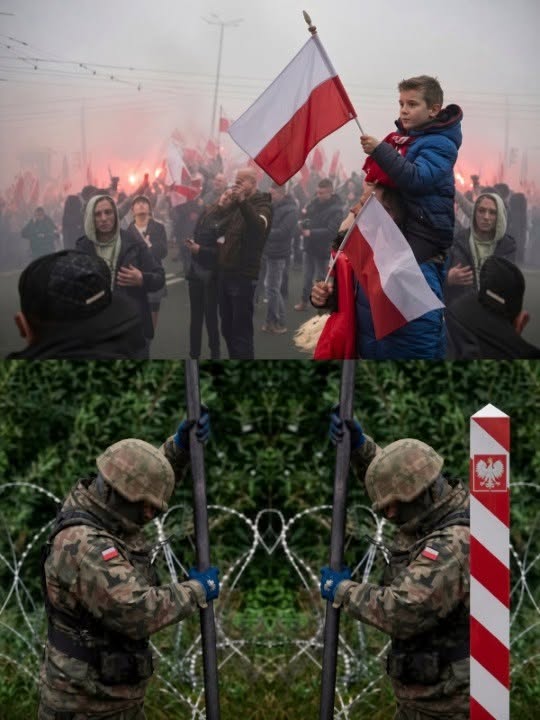
Poland has invested heavily in strengthening its border.
Physical barriers, surveillance technology, security personnel and expanded military involvement have all become part of a strategy designed to make unauthorized crossings more difficult.
The political message behind those measures is unmistakable:
The Polish state intends to control its own frontier.
For many supporters, that principle should be obvious.
Every sovereign country, they argue, must be capable of deciding who enters its territory. Without effective border enforcement, immigration rules become increasingly difficult to sustain and public confidence in legal migration can deteriorate.
Poland’s defenders also point to the criminal networks involved in moving migrants across borders.
Smuggling operations can exploit vulnerable people, charge enormous sums and expose migrants to dangerous conditions.
Strong borders, supporters argue, are therefore not inherently anti-migrant.
They can also be part of destroying the business model that profits from irregular migration.
But Can Asylum Be Suspended?
This is where the controversy becomes considerably more difficult.
Poland has pursued measures allowing restrictions on the ability to lodge applications for international protection under specified circumstances at the border.
The government has defended such steps as necessary when migration is allegedly being deliberately instrumentalized by an external actor.
Critics see a dangerous precedent.
The right to seek asylum does not mean that every applicant is entitled to remain permanently. A claim can be examined and rejected when it does not satisfy the legal requirements for protection.
But humanitarian organizations argue that people should have meaningful access to a process capable of determining whether they genuinely face persecution or serious danger.
A government cannot necessarily know the answer merely by looking at a crowd approaching a border.
Among economic migrants can be refugees.
Among adults can be trafficking victims.
Among people without documents can be individuals fleeing governments that would never willingly provide them with the paperwork necessary to escape.
That is why due process becomes so important.
Why Religion Is the Wrong Legal Test
The description of Poland’s policy as a rejection of “Muslim migrants” introduces another contentious issue.
European countries can enforce immigration laws.
They can secure borders.
They can investigate national-security threats.
They can reject asylum applications that fail to meet legal standards and remove people when the law permits.
But those powers should not be confused with a blanket right to exclude individuals simply because they belong to a particular religion.
A Muslim migrant is not automatically an illegal migrant.
An illegal border crossing does not automatically prove someone is an extremist.
And a refugee claim does not automatically guarantee permission to stay.
Those are separate questions.
The distinction matters because Europe’s security debate can quickly become a cultural debate.
The Cultural Argument
Some supporters of Poland’s restrictive migration policies openly frame the issue in terms of preserving national identity and social cohesion.
Poland has historically been more culturally and religiously homogeneous than several Western European countries that experienced decades of large-scale immigration.
For some Poles, the experiences of countries such as France, Germany, Sweden and Britain have become warnings about the difficulties that can accompany rapid demographic change.
They point to controversies involving integration, segregated communities, religious extremism and pressure on public services.
Critics respond that using the most serious problems in Western Europe to judge migrants collectively is unfair and potentially discriminatory.
Millions of Muslims live peacefully across Europe.
They work, raise families, run businesses and participate in democratic societies without posing any threat to national security.
A government can therefore debate the scale and conditions of immigration without declaring an entire religion incompatible with the nation.
That difference separates legitimate border policy from collective suspicion.
Brussels Faces a Difficult Problem
Poland’s approach also exposes a deeper contradiction inside the European Union.
The EU depends on strong external borders because much of the bloc allows extensive internal freedom of movement.
Once a person enters the Schengen area, movement between participating countries can be considerably easier than crossing the EU’s external frontier.
That gives countries on the bloc’s outer borders enormous responsibility.
Poland can consequently argue that protecting its frontier also protects Europe.
But the European project is simultaneously built around legal commitments, including fundamental rights and refugee protections.
The result is an unavoidable tension.
Europe wants borders strong enough to resist deliberate destabilization.
It also wants asylum protections meaningful enough to protect genuine refugees.
Achieving both simultaneously is far more difficult than political slogans suggest.
Security Versus Humanity Is a False Choice
The most sustainable answer may ultimately require rejecting the idea that Europe must choose between border control and humanitarian obligations.
It needs both.
A state that cannot control its border will struggle to maintain a credible immigration system.
But a state that abandons individual assessment risks treating desperate civilians as interchangeable with smugglers, extremists or hostile governments.
Poland can strengthen its frontier.
It can confront Belarusian pressure.
It can deploy security forces against illegal crossings.
It can prosecute smugglers and investigate genuine security threats.
And when legal procedures determine that individuals have no right to remain, authorities can pursue lawful removal.
But none of those principles require treating Muslims collectively as a threat.
Likewise, defending asylum protections does not require Europe to accept unlimited or uncontrolled migration.
Europe Is Watching Poland
This is why Poland has become such an important test case.
If Warsaw demonstrates that aggressive border enforcement can dramatically reduce irregular migration while surviving legal scrutiny, other European governments will pay attention.
If its measures result in serious rights violations or prevent genuine refugees from accessing protection, the criticism will intensify.
Either way, Poland is forcing Europe to confront questions it can no longer avoid.
What happens when migration is allegedly weaponized by another government?
How much emergency power should a border state receive?
Who decides when a security crisis justifies restrictions on ordinary asylum procedures?
And how does Europe preserve its cultural and political stability without making religion or ethnicity a substitute for individualized legal judgment?
Those questions will outlast the current confrontation.
The language of “Fortress Poland” captures only half of the story.
A fortress has walls.
A democracy also has laws.
Poland’s real challenge is proving that it can defend the first without weakening the second — securing its borders against genuine threats while preserving the legal principles that separate national defense from collective exclusion.