Rupert Lowe Calls for Benefits Ban on Foreign Nationals and Removal of Migrants Unable to Support Themselves, Triggering Commons Clash


The Great Yarmouth MP argued that Britain should stop foreign nationals from claiming welfare and remove migrants who cannot financially support themselves. Ministers rejected both his interpretation of welfare statistics and the principle behind his proposal, exposing a wider dispute over immigration, eligibility for public funds and the meaning of “foreign national” in Britain’s benefits system.
A highly charged exchange in the House of Commons has reopened one of the most contentious questions in British politics: who should be allowed to receive taxpayer-funded benefits, and should a migrant’s inability to support themselves ever become grounds for removal from the country?
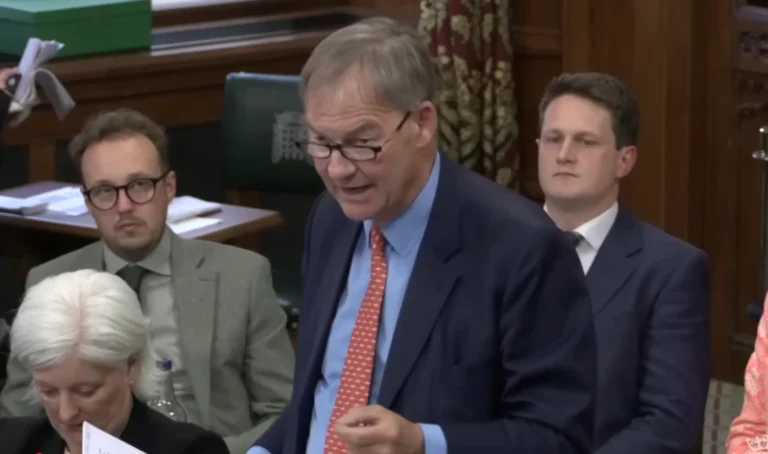
Rupert Lowe, the MP for Great Yarmouth and currently a member of Restore Britain, confronted the government over the amount of Universal Credit associated with households containing foreign nationals. He argued that Britain should prohibit foreigners from receiving benefits and remove migrants who are unable to support themselves financially.
The exchange was real, although some of the dramatic language now circulating online — including claims of a parliamentary “bombshell” or a revelation that government officials were unable to answer him — goes beyond what the parliamentary record shows.
Hansard records Lowe telling the Commons on 27 April 2026 that £10.1 billion of £61.2 billion in Universal Credit expenditure in 2024 had been “gifted to foreign nationals.” He then asked whether Britain should “ban all foreigners from claiming any benefits” and remove migrants who could not financially support themselves. (Hansard)
The minister answering him, Work and Pensions Minister Andrew Western, did not accept either the proposal or Lowe’s interpretation of the numbers.
Western said the figure Lowe cited substantially overstated what had actually been paid directly to foreign nationals because the underlying statistics covered households containing a foreign national. A household counted in that category could also contain a British or Irish citizen who was the claimant or beneficiary. (Hansard)
That disagreement matters because it changes what the £10.1 billion figure can legitimately be said to represent.
It also reveals a much bigger argument about Britain’s immigration and welfare systems — one that is considerably more complicated than the slogan “benefits for foreigners” suggests.
What Rupert Lowe Actually Said
The confrontation came during Work and Pensions questions in the Commons.
According to the official parliamentary transcript, Lowe said:
“A staggering £10.1 billion of the £61.2 billion spent on universal credit in 2024 was gifted to foreign nationals.”
He then proposed what he described as a straightforward solution: foreigners should be prevented from claiming benefits, migrants unable to support themselves should be removed, and the savings should effectively remain with British taxpayers. (Hansard)
That is an unusually broad proposal.
It is important to distinguish it from the existing debate about illegal immigration.
Lowe was not merely saying that people with no lawful immigration status should be barred from Universal Credit. That is largely already the position under current law.
His wording covered all foreigners, potentially including people legally resident in Britain who had worked, paid National Insurance and taxes, established families and later encountered unemployment, disability or financial hardship.
That breadth explains the government’s response.
Western said he “fundamentally” disagreed with excluding people who may have lived in Britain for years, contributed through taxation and then needed temporary help from a system into which they had paid. (Hansard)
This was not therefore an argument simply about illegal migrants obtaining benefits.
It was an argument over whether nationality itself should determine access to much of Britain’s welfare system.
The £10.1 Billion Figure Requires an Important Qualification
The headline number is politically powerful.
£10.1 billion sounds enormous.
But the way such statistics are defined determines what they actually tell us.
Western challenged Lowe’s interpretation directly. He said the figure had been derived from households containing a foreign national and could therefore include households where the actual Universal Credit recipient was British or Irish. (Hansard)
This creates an important distinction between two claims:
Claim A: £10.1 billion went directly to foreign nationals.
Claim B: £10.1 billion was associated with households in which at least one foreign national was present.
Those claims are not equivalent.
Consider a hypothetical household containing a British citizen, a foreign-born spouse and British children.
If Universal Credit is recorded against that household, describing the entire payment as money “given to foreigners” could create a misleading impression about who actually qualified for and benefited from the support.
Likewise, nationality does not necessarily reveal how long somebody has lived in Britain or how much they have contributed in taxes.
A foreign citizen may have lived and worked legally in the UK for decades.
Another person may have recently acquired British citizenship.
Those individuals could appear very differently in nationality-based statistics despite having similar histories of residence and taxation.
That does not mean the cost associated with non-UK nationals is irrelevant.
It means the statistic must be described accurately.
Who Can Actually Claim Benefits in Britain?
A major source of confusion in the immigration debate is the assumption that arriving in Britain automatically gives someone access to the welfare state.
That is not generally how the system works.
In an official parliamentary answer published on 11 August 2026, the government stated that all claimants must meet residency requirements and possess an immigration status qualifying them for taxpayer-funded benefits. (Câu hỏi – Tuyên bố Nghị viện)
Most non-UK nationals granted permission to live in Britain have a condition known as No Recourse to Public Funds, commonly shortened to NRPF.
That condition prevents access to many mainstream welfare benefits.
The government told Parliament that NRPF restrictions are commonly removed when an individual receives indefinite leave to remain or settled status, often after approximately five years, although individual immigration routes differ. (Câu hỏi – Tuyên bố Nghị viện)
Even then, receiving settled status does not automatically produce a benefit payment.
The person must still satisfy the normal eligibility rules applicable to the relevant benefit.
Residency tests can also apply.
Some contribution-based benefits operate differently because entitlement can depend on National Insurance contributions rather than simply immigration status.
The result is a much more complex system than either “foreigners receive benefits” or “foreigners cannot receive benefits.”
Some can.
Many cannot.
And eligibility depends heavily on immigration status, residence, contribution history and the particular benefit involved.
Illegal Migrants Are Already Barred From Mainstream DWP Benefits
This is another critical distinction.
People living in Britain without valid immigration status are already prohibited from accessing mainstream Department for Work and Pensions public-fund benefits.
The government confirmed that position in response to a written parliamentary question from Lowe himself in June 2025. (Câu hỏi – Tuyên bố Nghị viện)
A separate government answer in December 2025 said people without lawful immigration status, including asylum seekers and refused asylum seekers, cannot receive mainstream public-fund benefits through the ordinary DWP system. (Câu hỏi – Tuyên bố Nghị viện)
That means a proposal to stop people who are illegally present from receiving Universal Credit would not represent the creation of an entirely new principle.
They are already excluded.
However, the asylum system is different.
Asylum Support Is Not the Same as Universal Credit
People awaiting a decision on an asylum claim may receive accommodation and limited financial support from the Home Office.
That is often described politically as “benefits,” but it is legally and administratively separate from the mainstream welfare system.
The government explicitly made this distinction in its December 2025 parliamentary answer.
It said people with pending asylum applications may receive asylum support from the Home Office, but that this is separate from ordinary welfare benefits administered by the Department for Work and Pensions. (Câu hỏi – Tuyên bố Nghị viện)
This distinction is important because asylum seekers are generally restricted in their ability to work.
If a person cannot legally work while an asylum claim is being processed, some form of subsistence system is necessary unless the government intends to leave them entirely without accommodation or food.
That does not mean the present arrangements are beyond criticism.
Governments can change accommodation models, payment levels, employment permissions and the speed at which claims are decided.
But debates about asylum support and debates about Universal Credit should not be treated as if they involve exactly the same population.
The Government Has Already Tightened Self-Sufficiency Rules
Interestingly, part of the principle behind Lowe’s argument — that people able to support themselves should do so — is also present in government policy.
In April, ministers described reforms allowing asylum support to be withheld in certain circumstances from individuals who have permission to work and should therefore be capable of supporting themselves.
The government specifically pointed to some people who originally entered Britain on work or student visas after declaring that they possessed sufficient resources but subsequently entered the asylum system.
Ministers said people legally able to work should be expected to maintain themselves where reasonably possible. (Hansard)
The disagreement with Lowe is therefore partly about scale.
The government supports means testing and restrictions based on immigration status.
Lowe is proposing something much broader: nationality-based exclusion and removal of migrants unable to finance themselves.
What Would “Ban All Foreigners From Benefits” Mean?
Implementing such a policy would require answering questions that a short Commons exchange cannot resolve.
Would an Italian nurse who had spent 25 years working for the NHS be excluded if she lost her job?
Would an American engineer with indefinite leave to remain become ineligible despite paying British taxes for decades?
Would the foreign spouse of a British citizen receive nothing even if the couple had British children?
What about refugees granted lawful protection?
What about Commonwealth citizens with longstanding residence?
Would contribution-based benefits be included?
Would nationality or immigration status determine eligibility?
And what would happen when someone had paid substantial National Insurance contributions but remained a foreign citizen?
These questions demonstrate why immigration and welfare law are normally organised around legal status and residence rather than simply passports.
A complete nationality-based prohibition would represent a significant departure from that approach.
Supporters could argue that citizenship should carry stronger economic privileges and that welfare expenditure should principally benefit citizens.
Opponents could argue that people who have lawfully worked and paid taxes should retain access to at least some support regardless of whether they have completed the citizenship process.
Those are different political philosophies rather than factual questions that statistics alone can settle.
Deportation Raises an Even Larger Legal Question
The second half of Lowe’s proposal is potentially more consequential.
He called for migrants incapable of financially supporting themselves to be removed from Britain.
Again, the meaning depends on exactly which migrants are included.
Britain already removes people who lack permission to remain, subject to legal safeguards and practical obstacles such as obtaining travel documents or identifying a country willing to accept them.
Home Secretary Shabana Mahmood told Parliament in February that removals of illegal migrants since the government took office had increased by 31%, forced returns by 45%, and deportations of foreign criminals by roughly one third. (Hansard)
The government has therefore not adopted a policy of allowing everyone who arrives or remains illegally to stay.
The more controversial proposition is whether legal residents should lose their right to remain because they become financially dependent.
That would be a very different system.
Temporary Hardship Versus Permanent Dependency
One of the central policy difficulties is distinguishing temporary financial difficulty from long-term dependency.
A worker may spend 15 years paying taxes and then be made redundant.
A person can become disabled.
A spouse can die.
A business can collapse.
An economic recession can eliminate jobs.
Someone may have contributed considerably more in taxation than they ever receive in benefits.
If inability to support oneself automatically triggered removal, governments would need rules determining when financial hardship became sufficient to cancel residency.
Would unemployment for three months qualify?
Six months?
A year?
Would disabled migrants be treated differently?
Would pensioners be affected?
Would children be separated from parents?
Would families containing both British and foreign citizens be split?
Those questions are not minor administrative details.
They determine what the policy would actually mean in practice.
Lowe’s Position Is Part of a Broader Immigration Programme
The Commons intervention was not an isolated comment.
Lowe’s political position has increasingly centred on reducing immigration and greatly expanding removals.
His current parliamentary affiliation is Restore Britain. Parliament records that he joined Restore Britain in March 2026 after previously sitting as an independent and, before that, representing Reform UK. (Nghị viện Vương quốc Anh)
That distinction matters because some social-media posts still describe him as a Reform UK MP.
That is no longer accurate.
Lowe was elected as a Reform UK MP in July 2024, became independent in March 2025 and joined Restore Britain in March 2026. (Nghị viện Vương quốc Anh)
Restore Britain has subsequently advocated a much broader programme of removals.
Reporting on the party’s policies says it has used the term “remigration” and proposed deporting some legally resident foreign-born people when they receive benefits or occupy social housing. (The Guardian)
That places the welfare proposal within a wider political project rather than treating it merely as a technical reform of Universal Credit.
Lowe Has Repeatedly Raised the Welfare Question
His focus on foreign-national welfare claims also predates this Commons exchange.
In November 2025, Lowe tabled parliamentary questions asking whether non-UK nationals should face minimum periods of lawful residence and tax contribution before gaining access to non-contributory benefits. (Nghị viện Vương quốc Anh)
He also sought information about people whose immigration status had ceased to make them eligible for public funds and how they were removed from benefit systems. (Nghị viện Vương quốc Anh)
An Early Day Motion dealing specifically with welfare benefits for foreign nationals was among motions associated with him in the same period. (Nghị viện Vương quốc Anh)
The April intervention therefore represented a harder expression of a subject Lowe had already been pursuing.
Why Ministers Reject the Blanket Approach
The government’s argument rests on several principles.
First, lawful migrants and illegal migrants should not be treated as one population.
Second, many migrants already have no access to public funds.
Third, people with settled status may have spent many years contributing financially.
Fourth, household-level statistics should not automatically be described as payments directly to foreigners.
Western emphasised precisely that contribution argument when responding to Lowe.
He referred to people who may have lived in Britain for years and paid into the system for decades before requiring help. (Hansard)
This reflects a broader conception of welfare as a social-insurance mechanism rather than a privilege based exclusively on citizenship.
Lowe’s proposal reflects a different conception in which nationality should play a much stronger role.
Supporters Ask a Different Question
For those sympathetic to Lowe’s argument, the central issue is not necessarily whether every recipient is an illegal migrant.
Their question is whether Britain should operate an immigration system in which significant numbers of non-citizens eventually become dependent on public expenditure.
From that perspective, immigration policy should select people likely to make a positive economic contribution, and continued residence could reasonably depend on self-sufficiency.
Advocates may also argue that limiting welfare eligibility creates incentives for migrants to work and reduces the fiscal cost of migration.
This reasoning has influenced immigration systems well beyond Britain.
Many countries impose waiting periods or restrictions before new migrants obtain access to particular public programmes.
Britain itself already does this through NRPF and residency requirements.
The real dispute is therefore about where those limits should end.
Critics Say Nationality Alone Is Too Crude
Critics of blanket restrictions counter that passport status does not provide a reliable measure of economic contribution.
A foreign citizen earning £100,000 and paying large amounts of tax may contribute substantially more to public finances than a British citizen who is economically inactive.
A pensioner born overseas may have paid British taxes for 40 years.
A migrant household may contain British-born children.
And many foreign nationals work directly in public services, including healthcare and social care.
From this perspective, differentiating entirely by nationality could create significant inequities between residents who make similar contributions.
There is also a broader economic issue.
If Britain wants skilled workers to relocate here, migrants will consider not only salaries and taxes but also the security available if they lose a job, have children or become ill.
Very restrictive welfare eligibility could therefore influence Britain’s ability to attract workers.
The Fiscal Question Remains Legitimate
None of these complications mean governments should ignore welfare costs linked to migration.
Understanding the fiscal impact of immigration is a legitimate policy task.
But credible analysis has to account for both sides of the ledger.
Migrants can receive public services and benefits.
They can also pay income tax, National Insurance, VAT, council tax and other taxes.
Some migrant populations are net fiscal contributors.
Others may impose net costs.
Results differ considerably according to age, earnings, employment rate, family structure, immigration route and length of residence.
Consequently, a single gross welfare-spending number does not show whether migration as a whole represents a net cost or benefit to the Treasury.
A complete analysis would require comparing benefits and public-service costs with tax contributions.
The Word “Foreign” Also Conceals Major Differences
Another problem with the debate is the enormous diversity inside the category “foreign national.”
It can include:
a recently arrived student;
a French banker who has lived in London for two decades;
a Ukrainian refugee;
an Australian doctor;
an Indian software engineer;
a spouse of a British citizen;
a person with indefinite leave to remain;
or someone who has lived almost their entire adult life in Britain but never applied for citizenship.
Those individuals have radically different immigration histories and economic circumstances.
Treating them as a single category may be politically convenient, but it can obscure the practical effects of policy.
What About Small-Boat Arrivals?
The image accompanying the claim prominently shows migrants travelling in a small boat.
That visual can create the impression that Lowe’s Universal Credit figure is principally about people who crossed the English Channel illegally.
The available evidence does not establish that.
Someone arriving irregularly and making an asylum claim cannot simply begin claiming Universal Credit.
As the government has repeatedly confirmed, people without qualifying immigration status are excluded from mainstream DWP public funds. (Câu hỏi – Tuyên bố Nghị viện)
They may instead receive Home Office asylum support while their claim is processed.
A person granted refugee status can subsequently acquire broader rights.
But that is legally different from saying people step off small boats and immediately obtain ordinary welfare benefits.
That distinction is frequently lost in political advertising and viral graphics.
Britain Is Already Increasing Deportations
The argument is also taking place while the government attempts to demonstrate tougher enforcement.
Mahmood told Parliament in February that almost 60,000 illegal migrants had been removed since Labour entered government, while forced returns and deportations of foreign criminals had also increased. (Hansard)
Those are government figures and should be understood within the period and definitions used by the Home Office.
Nevertheless, they complicate claims that Britain has no removal system or that ministers categorically oppose deportation.
The government position is that people without a right to remain should increasingly be removed.
The dispute with Lowe is over how much further that principle should extend.
The Legal and Practical Barriers to Mass Removal
Even after Parliament changes immigration law, removing large numbers of people presents practical challenges.
Authorities must determine identity.
Travel documents may be required.
Countries of origin have to accept returnees.
Flights, escorts and detention capacity cost money.
Appeals must be processed.
Human-rights obligations may apply.
Some people cannot safely be returned to countries where they face persecution or serious harm.
Others have British partners or children, introducing family-life considerations.
These issues do not mean deportations cannot happen.
They mean the scale, timetable and cost of large removal programmes cannot be inferred simply from the number of people a politician says should leave.
Would Ending Benefits Necessarily Save the Full Amount?
There is also an economic question surrounding the assumption that every pound removed from the welfare budget becomes an equivalent saving for taxpayers.
That does not always happen.
If a family loses welfare support but remains legally in Britain, costs can emerge elsewhere.
Homelessness may place pressure on councils.
Children may require safeguarding.
Emergency healthcare remains necessary.
Charities may absorb part of the burden.
People may turn towards informal or illegal employment.
If the government instead removes people from the country, detention and deportation have direct fiscal costs.
That does not prove that restrictions are economically ineffective.
It demonstrates why savings calculations should account for consequences across government rather than looking at only one budget.
Citizenship Versus Contribution
Behind the numbers lies a philosophical disagreement about what the welfare state is for.
One view says citizenship should create a privileged economic relationship between an individual and the state.
Under that approach, citizens contribute collectively and should receive benefits that foreigners cannot automatically access.
Another view places greater weight on residence and contribution.
A person who has legally lived, worked and paid taxes in Britain for many years may reasonably expect assistance during hardship even if they have not obtained a British passport.
The current British system sits between those principles.
Nationality matters.
Immigration status matters.
Residence matters.
Contributions matter.
And the rules differ depending on the benefit.
Lowe wants the system moved substantially towards citizenship.
The government rejects that blanket approach.
The Political Language Can Obscure Those Choices
Online versions of parliamentary exchanges often transform genuine policy disagreements into entertainment.
Politicians “destroy” ministers.
Opponents are “silenced.”
Statistics are described as “bombshells.”
Routine disagreement becomes “chaos.”
The official transcript of this exchange does not show a government minister unable to respond.
It shows a clear disagreement.
Lowe presented a £10.1 billion figure and advocated comprehensive restrictions.
Western rejected the interpretation of that figure and argued that people who had lived and contributed in Britain for many years should not automatically be denied support because they remained foreign citizens. (Hansard)
That disagreement is significant enough without additional embellishment.
What Can Be Verified
Several elements of the circulating story are supported by the parliamentary record.
Lowe did call for foreigners to be prevented from claiming benefits.
He did call for migrants unable to support themselves to be removed.
He cited a figure of £10.1 billion connected with Universal Credit.
And a government minister did directly reject both his proposal and his interpretation of that statistic. (Hansard)
Several additional points are equally important.
People without valid UK immigration status are already barred from mainstream DWP benefits. (Câu hỏi – Tuyên bố Nghị viện)
Asylum seekers can receive separate Home Office support but are not simply eligible for ordinary Universal Credit. (Câu hỏi – Tuyên bố Nghị viện)
Most migrants initially enter Britain subject to restrictions on access to public funds, and settled migrants still have to satisfy ordinary eligibility requirements. (Câu hỏi – Tuyên bố Nghị viện)
And Lowe should currently be described as a Restore Britain MP, not a Reform UK MP. Parliament records his affiliation with Restore Britain beginning on 20 March 2026. (Nghị viện Vương quốc Anh)
The Debate Britain Has Not Resolved
The argument will continue because it sits at the intersection of several increasingly important political pressures.
Britain wants to control immigration.
It needs workers in parts of its economy.
It wants people entering through work routes to support themselves.
It maintains a welfare system based partly on residence and contribution rather than citizenship alone.
It is trying to remove more people who have no legal right to stay.
And it faces continuing pressure over the cost of public services.
Lowe’s answer is unusually simple: welfare should be reserved far more heavily for British citizens, while migrants who cannot support themselves should leave.
The government’s answer is more conditional: illegal migrants should not receive mainstream welfare and should increasingly be removed when they have no right to remain, while lawful long-term residents who have contributed to Britain should not automatically lose access to support merely because they hold a foreign passport.
Those positions represent materially different visions of immigration and citizenship.
The £10.1 billion statistic has helped bring that disagreement into public view, but it does not settle it.
The figure cannot safely be described simply as £10.1 billion “handed to foreign nationals” without explaining the household methodology challenged by the minister. Nor does it demonstrate that illegal migrants are receiving billions of pounds through Universal Credit.
At the same time, the existence of eligibility restrictions does not eliminate legitimate questions over how much welfare expenditure is associated with foreign nationals, how quickly migrants should qualify for support and whether contribution requirements should become stricter.
Those are choices Parliament can debate.
But understanding them requires separating three populations that are repeatedly blurred together in political discussion: illegal migrants, asylum seekers and legally resident foreign nationals.
Their rights are different.
Their access to benefits is different.
Their legal status is different.
And policies designed for one group can have very different consequences when applied to another.
That is what makes the Commons confrontation more consequential than the viral headline surrounding it.
It was not simply a dramatic argument over one £10.1 billion number.
It was a disagreement about a much larger principle: whether Britain’s social safety net should primarily follow citizenship, or whether long-term lawful residence and economic contribution should continue to give non-citizens a route to support when they need it.