Angela Rayner Faces Questions Over Political Donations and Britain’s “Welfare Versus Warfare” Debate — But the Viral Claims Need Separating From the Evidence
An increasingly heated argument over political donations, offshore corporate structures, welfare spending and defence has placed Angela Rayner at the centre of another political confrontation. Yet several of the most dramatic claims circulating online go considerably further than the evidence currently available.
A television interview involving Angela Rayner has become the latest flashpoint in a much wider argument about money, political influence and the choices Britain faces over public spending.
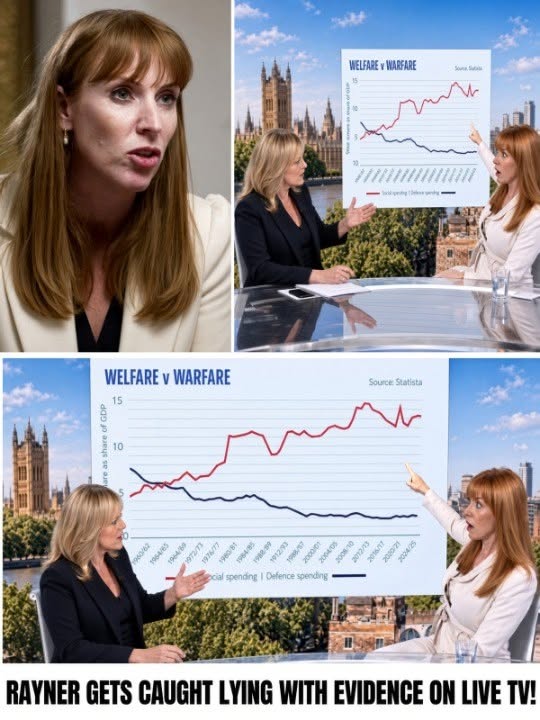
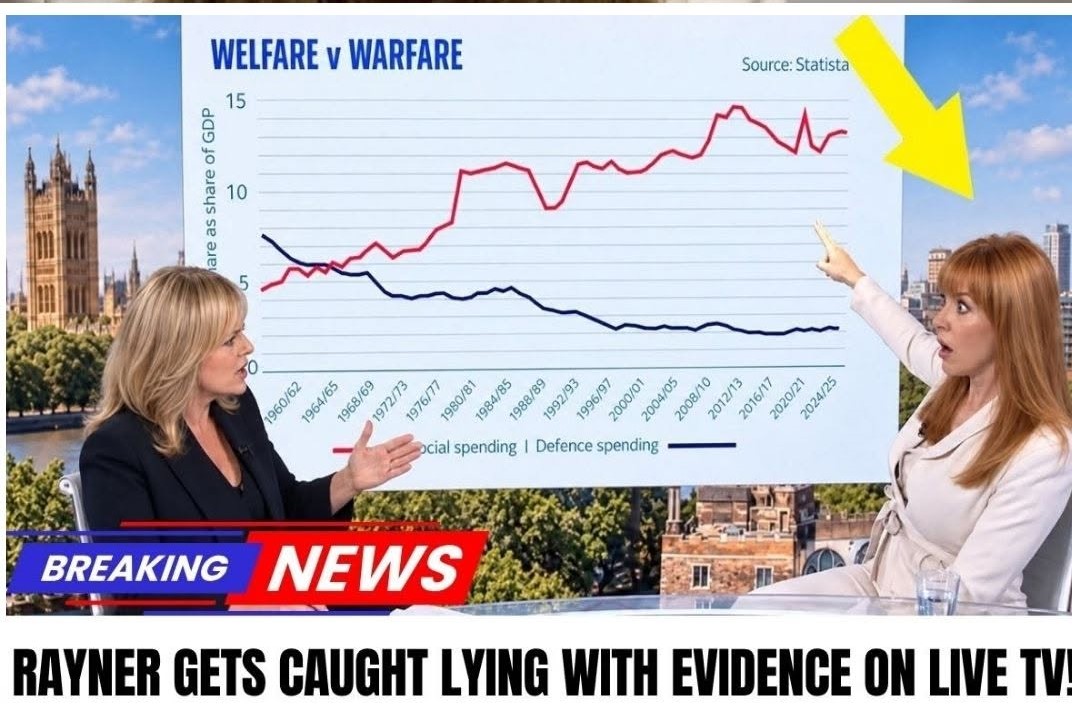
Online descriptions of the exchange have portrayed it in spectacular terms: Rayner supposedly “froze” when challenged about a £4 million donation linked to the Cayman Islands, repeatedly avoided answering the same question and was then confronted with a graph showing decades of rising welfare spending and falling defence expenditure.
Those descriptions make for powerful social-media copy. They do not, however, provide enough evidence on their own to establish that Rayner was “caught lying”, as the text attached to the circulating image claims.
What can be established is more complicated — and potentially more important.
There really was a £4 million donation to Labour from Quadrature Capital before the 2024 general election. Parliamentary evidence published in 2026 describes Quadrature as a UK-based firm with a parent company registered in the Cayman Islands and notes that its ultimate beneficial owners are UK citizens. (Quốc hội Vương quốc Anh)
That fact has become politically significant because Labour politicians have recently been questioning the influence of extraordinarily wealthy donors on British politics, particularly following very large donations to Reform UK.
It has therefore provided opponents with an obvious counterargument: if Labour is concerned about billionaires, overseas connections and the source of political money, should exactly the same standards be applied to Labour’s own donors?
That is a legitimate question.
But it is different from establishing wrongdoing.
And the distinction between those two propositions lies at the heart of this controversy.
The £4 Million Donation at the Centre of the Argument
Quadrature Capital donated £4 million to Labour ahead of the 2024 general election. The donation has attracted renewed attention as Parliament considers tougher rules intended to protect British elections from foreign financial influence.
Written evidence submitted to Parliament this year specifically used Quadrature as a case study. It described the company as UK-based while noting that its parent company is registered in the Cayman Islands. The same evidence said its ultimate beneficial owners are British citizens and suggested that the company would remain capable of making political donations under the proposed reforms. (Quốc hội Vương quốc Anh)
That detail matters enormously.
Calling the money simply a “Cayman Islands donation” risks giving readers an incomplete impression. A corporate parent being registered in the Cayman Islands is not the same thing as demonstrating that a political donation was secretly made by a foreign individual or that it was unlawful.
No reliable evidence located for this article establishes that Labour’s £4 million Quadrature donation was illegal.
The political criticism is instead principally about consistency.
Reform UK MP Richard Tice made essentially that argument in Parliament in July. During a Commons debate on foreign interference, he referred directly to the “Cayman Islands hedge fund Quadrature” and its £4 million contribution to Labour while challenging ministers over their approach to political donations. (Hansard)
The government response did not declare the Quadrature contribution improper. Minister Samantha Dixon said parties that comply with the rules being introduced would continue to be able to operate within the political system. (Hansard)
The episode illustrates why the current argument is more difficult than a straightforward accusation of foreign interference.
British political financing rules have historically focused heavily on whether a donor qualifies legally to make a contribution. Critics argue that increasingly international corporate structures make that test inadequate for determining where political money ultimately originates.
Others warn against treating every company with overseas operations, investors or corporate entities as effectively foreign. In a globalised economy, many perfectly legitimate British businesses have complicated international structures.
The dispute is therefore partly about where Britain should draw the line.
Why Angela Rayner Is Being Challenged Now
The timing explains much of the intensity.
Rayner has recently become a prominent voice in the debate over large political donations after Reform UK received enormous contributions from wealthy cryptocurrency entrepreneurs.
In an ITV interview published on September 13, Rayner said the government was considering further changes to political-finance rules. She argued that democracy needed protection from foreign interference and raised concerns about extremely wealthy individuals acquiring disproportionate political influence. (ITVX)
Similar comments were made in an interview with LBC, where Rayner said British democracy should be safeguarded against foreign influence and questioned whether a small number of billionaires should wield enormous financial power in elections. (LBC)
Those comments inevitably exposed Labour to scrutiny of its own funding.
Political parties routinely attack one another over donors. A party demanding stricter restrictions can expect opponents to examine whether its previous contributions would satisfy the principles it now advocates.
The issue became particularly significant because Reform UK’s fundraising has changed the scale of the debate.
Recent reporting says Reform received extraordinarily large donations from cryptocurrency billionaires Christopher Harborne and Ben Delo. Current reports describe both men as British citizens, although their residency histories have become relevant to proposed restrictions governing political donations. (Financial Times)
Earlier this year Delo publicly disclosed a £4 million donation to Reform. At that point he was reported to have been based in Hong Kong and preparing to return to Britain. (The Guardian)
By September, reporting said he had made another £4 million contribution. Reform said it was confident that the donation complied with the relevant requirements. (The Guardian)
The wider controversy has subsequently expanded dramatically as still larger donations have been reported.
That has turned what might once have been an obscure debate about electoral law into a major political issue.
The Central Consistency Question
The strongest criticism of Rayner does not require alleging illegality.
It can instead be expressed as a policy question.
If politicians argue that overseas connections or complicated international financial structures can undermine public confidence in political donations, how should those principles apply to companies supporting their own parties?
That question applies across the political spectrum.
Labour can argue that there is an important legal and substantive distinction between a permissible donation from a UK company whose ultimate owners are British and prohibited foreign money entering British politics.
Its opponents can respond that legal permissibility does not necessarily resolve broader questions of transparency or political influence.
Both arguments deserve examination.
The difficulty comes when political rhetoric collapses those distinctions.
“Linked to the Cayman Islands” does not mean “illegal foreign donation.”
“Legal donation” does not necessarily mean that the political-finance system could not benefit from reform.
And advocating new restrictions does not automatically prove hypocrisy merely because a party previously accepted donations that complied with existing law.
Those are separate questions.
Was Rayner Actually “Caught Lying”?
There is another problem with the viral framing.
The image supplied with the claim contains the words:
“RAYNER GETS CAUGHT LYING WITH EVIDENCE ON LIVE TV!”
But an image caption is not evidence that a lie occurred.
Establishing that a politician lied requires considerably more than showing that an interviewer challenged them or that a graph appeared on screen.
At minimum, it would require identifying the specific factual statement, determining whether that statement was false, and establishing the evidence contradicting it.
A disagreement over interpretation is not necessarily a lie.
An incomplete answer is not necessarily a lie.
Refusing to answer a question is not itself a lie.
Nor does being confronted with an uncomfortable statistic automatically demonstrate deception.
The available material does not allow the stronger viral allegation to be established.
The safer description is that Rayner has faced scrutiny over whether Labour’s criticism of large or internationally connected political donors can be reconciled with its own fundraising history.
That is already a substantial political issue without adding claims that have not been demonstrated.
Then There Is the Graph
The second part of the viral narrative concerns a chart labelled “WELFARE V WARFARE.”
The graphic appears to compare social spending as a share of GDP with defence spending over several decades.
Its underlying argument is easy to understand.
Britain once devoted a much larger percentage of national income to defence. Over subsequent decades, defence expenditure fell while spending on the welfare state and other social programmes increased.
At the broadest level, the historical decline in defence spending as a percentage of GDP is real.
According to the House of Commons Library, defence spending as a proportion of Britain’s economy declined for decades before stabilising more recently. (House of Commons Library)
The Library also notes that this percentage measure should not be confused with the absolute amount Britain spends on defence.
That distinction is essential.
A falling share of GDP does not necessarily mean the cash defence budget falls every year.
GDP itself changes.
Inflation changes.
Definitions change.
And different datasets can include different categories of expenditure.
For example, the Commons Library reports that real-terms UK defence spending fell by 22% between 2009/10 and 2016/17, from £61.5 billion to £48 billion when measured in 2025/26 prices. But spending subsequently increased, reaching £62 billion in 2025/26. (House of Commons Library)
So a graph showing a long-term decline in defence’s share of GDP can be broadly compatible with a more recent increase in real defence expenditure.
Both can simultaneously be true.
That is exactly why political graphics require context.
Britain Is Actually Increasing Defence Spending
Any implication that Britain’s defence budget is simply continuing an uninterrupted collapse would also be incomplete.
The government is currently planning substantial increases.
The Commons Library says the UK spent £62 billion on defence in 2025/26 and that Ministry of Defence spending is planned to reach £79.1 billion in cash terms by 2029/30. (House of Commons Library)
Under the government’s Defence Investment Plan, an additional £15 billion is planned for defence between 2026/27 and 2029/30 on top of allocations made in the 2025 Spending Review. Total planned expenditure over those four years is approximately £298 billion. (House of Commons Library)
Adjusted for inflation, planned MOD expenditure in 2029/30 would be approximately £11.1 billion higher than in 2025/26, according to Commons Library calculations. (House of Commons Library)
Britain is therefore not currently pursuing a simple policy of reducing defence expenditure.
Quite the opposite.
The government is attempting to increase it.
The more difficult question is how large that increase should be and where the money should come from.
The NATO Factor Has Changed the Debate
That question has become much more urgent because NATO’s expectations have changed.
The UK spent an estimated 2.3% of GDP on defence in 2025/26 under the NATO definition, according to the latest figures cited by the Commons Library. (House of Commons Library)
The government’s current Defence Investment Plan expects the figure to increase to approximately 2.7% in 2027/28 and remain around that level for the following two years. (House of Commons Library)
Meanwhile, NATO allies agreed in 2025 to a new target of 3.5% of GDP for core defence expenditure by 2035, alongside broader security-related commitments.
The Commons Library notes that the government’s current plan does not specify exactly how Britain will move from its spending level at the end of this decade to 3.5% by 2035. (House of Commons Library)
That gap is where the welfare argument enters.
Increasing defence by another percentage point of GDP represents tens of billions of pounds.
Unless economic growth generates sufficient additional revenue, governments broadly have four options: raise taxes, borrow more, reduce spending elsewhere, or combine those approaches.
That makes social expenditure politically impossible to ignore.
Is Britain Really Choosing “Welfare Over Warfare”?
The phrase is memorable.
Economically, however, it simplifies a much more complicated allocation problem.
Social expenditure includes programmes serving very different populations and purposes.
State pensions, disability support, unemployment assistance, housing support and other payments cannot simply be treated as a single discretionary pot that governments can remove without consequences.
There are also demographic pressures.
An ageing population increases pension and health costs even without governments deliberately making welfare more generous.
Likewise, defence expenditure is not simply determined by political ideology.
Security threats, military technology, personnel costs, international commitments and equipment replacement cycles can all dramatically change what governments need to spend.
The argument is therefore not merely:
welfare or defence?
It is:
How much defence capability does Britain require, what social commitments should the state maintain, how quickly can the economy grow, what level of taxation is acceptable, and how much borrowing can the public finances sustain?
Those questions do not fit neatly onto a two-line television graph.
The Welfare Bill Is Nevertheless a Serious Fiscal Issue
That does not mean concerns about welfare expenditure are imaginary.
Recent reporting indicates that the UK welfare bill is expected to rise substantially during the remainder of the decade. One projection cited in current political reporting puts spending at roughly £315 billion in 2024/25 and above £400 billion by the end of the decade. (The Times)
That trajectory has generated debate inside Labour as well as among opposition parties.
Government ministers have argued that increasing employment can reduce some welfare expenditure while strengthening the tax base.
That is significantly different from simply cutting benefit rates.
If somebody moves from long-term economic inactivity into employment, the Treasury can benefit twice: expenditure may fall while tax receipts rise.
But achieving that outcome is considerably more difficult than announcing it.
Some benefit recipients cannot work.
Others can work only with substantial health, childcare or employment support.
Some face weak local labour markets.
And reductions in welfare payments can create costs elsewhere — including housing insecurity, pressure on councils and greater demand for public services.
Consequently, the fiscal effect of a welfare reform cannot always be calculated merely by looking at the headline amount removed from one departmental budget.
The Scale of Britain’s Spending Problem
The broader public-finance picture makes the argument particularly difficult.
The 2025 Spending Review planned day-to-day departmental expenditure to increase from £517.5 billion in 2025/26 to £583.9 billion by 2028/29. The Commons Library calculated that as average real growth of approximately 1.2% annually. (House of Commons Library)
More than half of that increase was allocated to health, while education and defence accounted for much of the remainder. (House of Commons Library)
Capital spending was also planned to increase, from £131.3 billion in 2025/26 to £151.9 billion in 2029/30, with roughly half of the increase directed towards defence. (House of Commons Library)
This demonstrates why slogans about simply “choosing defence” or “choosing welfare” can be misleading.
Governments are simultaneously funding hospitals, schools, pensions, local authorities, infrastructure, policing, debt interest and the armed forces.
Increasing one large category eventually creates pressure somewhere else.
Economic Growth Could Change the Equation
There is one variable that political arguments frequently underestimate: economic growth.
If Britain’s economy grows substantially, government revenues can rise without necessarily increasing tax rates, and spending can increase while remaining stable as a percentage of GDP.
If growth remains weak, every major spending commitment becomes harder.
Recent economic data offer some improvement.
The Commons Library reported last week that UK GDP grew an estimated 0.4% in the three months from May to July 2026 compared with the previous three-month period. GDP also increased by an estimated 0.4% in July compared with June. (House of Commons Library)
Services, which represent roughly four-fifths of the economy, expanded during the period, while construction and production declined. (House of Commons Library)
Whether that improvement develops into sustained productivity and economic growth will matter enormously for both welfare and defence.
A richer Britain has more room for both.
A stagnating Britain faces increasingly painful choices.
Political Donations Raise a Different Kind of Question
The donation controversy is connected to the spending argument politically, but analytically they should remain separate.
One concerns who finances political parties.
The other concerns what governments do with taxpayers’ money.
The concern surrounding mega-donors is that extremely wealthy individuals or corporations may obtain disproportionate political access or influence.
There is an important distinction between influence and corruption.
A large donation can raise questions about influence without proving that a donor purchased a specific policy.
Evidence of a donation is not evidence of a corrupt transaction.
That principle should apply equally whether the recipient is Labour, Reform UK, the Conservatives, Liberal Democrats, Greens or another political organisation.
Reform’s Fundraising Has Intensified the Debate
Reform UK’s increasingly successful fundraising operation has transformed the scale of the issue.
Earlier in 2026, reports showed Reform substantially out-raising its major rivals during particular reporting periods. (The Guardian)
Harborne, an aviation and cryptocurrency investor who has been based in Thailand, had already made several multimillion-pound contributions. A March report said another £3 million contribution took his Reform donations over the preceding period considerably higher. (The Guardian)
Delo’s donations then added another major source of financing.
The controversy has now contributed to demands from Labour MPs, unions and campaigners for tighter donation limits. But there are disagreements over how a cap would work, particularly because Britain’s political parties rely on very different funding models. (The Guardian)
Labour historically receives significant union support.
Other parties rely more heavily on wealthy individuals.
A poorly designed cap could therefore affect parties unevenly.
Supporters of limits argue that this is not a reason to tolerate unlimited billionaire donations.
Opponents warn that complicated rules can be circumvented through multiple companies, associated organisations or other structures.
Rayner herself has cited potential loopholes when discussing why a simple numerical ceiling might not be sufficient. (ITVX)
The Offshore Question Is More Complicated Than It Appears
The Cayman Islands reference attached to Quadrature Capital illustrates another recurring problem in political debate.
“Offshore” can describe many different arrangements.
A business may have an offshore parent company for tax, investment or corporate-structuring reasons.
That does not by itself demonstrate tax evasion, criminality or foreign political control.
At the same time, campaigners concerned about transparency argue that offshore structures can sometimes make ownership and financial flows harder for the public to understand.
Both propositions can be true.
The appropriate question is therefore not simply whether the words “Cayman Islands” appear somewhere in a company’s structure.
Investigators would need to determine who ultimately controls the donor, where the donated money was generated, whether the entity was carrying on genuine business activity in Britain and whether all legal requirements governing political donations were satisfied.
The parliamentary evidence discussing Quadrature explicitly raises questions about whether political-finance legislation adequately addresses companies with international structures. But it also says Quadrature is UK-based and identifies its ultimate beneficial owners as British citizens. (Quốc hội Vương quốc Anh)
That nuance is crucial.
Why “Gotcha” Interviews Often Produce More Heat Than Light
Television political interviews reward confrontation.
Interviewers have limited time.
Politicians arrive with prepared messages.
The interviewer tries to force a direct answer.
The politician attempts to broaden or reframe the question.
The interviewer interrupts.
The politician repeats a talking point.
Clips are then extracted and circulated online.
A twenty-minute discussion can become a twenty-second video captioned as a “humiliation,” “meltdown,” “destruction” or “car crash.”
Those descriptions tell viewers how to interpret the exchange before they have examined it.
The underlying facts can become secondary.
In this case, there are at least three separate questions that should not be collapsed into a single accusation.
Was Labour’s Quadrature donation permissible under the law?
Should political-finance rules nevertheless be changed?
And has Labour applied its principles consistently when discussing donations received by rival parties?
Those questions can have different answers.
The Defence Graph Has the Same Problem
A chart can also be technically accurate while encouraging an oversimplified conclusion.
Imagine two lines.
One shows defence expenditure falling from the much higher percentages of GDP associated with the Cold War era.
The other shows social expenditure increasing as the welfare state expands and Britain’s population ages.
A viewer may naturally conclude that money was directly transferred from soldiers to welfare recipients.
But government finance does not operate quite so mechanically.
Britain’s economy became dramatically larger over the period.
The tax system changed.
The population changed.
Health expenditure changed.
Borrowing changed.
Debt-service costs changed.
Cold War military requirements changed.
Technology changed.
The labour market changed.
And the geopolitical environment changed.
The lines therefore represent the cumulative effects of many political, economic and demographic developments.
They are useful.
They are not a complete causal explanation.
Britain Did Reduce Defence After the Cold War
There is nevertheless an important historical story behind the chart.
For decades, Britain’s defence burden declined relative to the economy.
The Commons Library describes defence spending as a share of GDP as having fallen over the long term before stabilising more recently. (House of Commons Library)
After the Cold War, Britain and many European allies reduced military expenditure as governments expected a less threatening security environment.
That assumption has subsequently been challenged by Russia’s war against Ukraine, instability in the Middle East, growing concerns about China, cyber threats and renewed pressure on NATO members to improve readiness.
The debate has therefore shifted.
The question today is not primarily whether Britain should return to the exact spending patterns of the 1960s.
It is what capabilities Britain needs in the security environment of the late 2020s and 2030s.
And Britain Is Now Reversing Part of That Decline
The direction of current policy is significant.
The Defence Investment Plan anticipates approximately £79.1 billion in MOD spending by 2029/30. (House of Commons Library)
The Commons Library says that would represent a substantial real-terms increase compared with 2025/26. (House of Commons Library)
Additional resources are intended partly to improve training and the availability of ships and aircraft, strengthening Britain’s readiness for conflict. (House of Commons Library)
The government has also placed greater emphasis on military equipment and capital investment.
Recent increases have been weighted towards investment rather than ordinary day-to-day defence expenditure, according to parliamentary analysis. (House of Commons Library)
That matters because announcing a larger budget does not instantly produce more soldiers, ships or aircraft.
Defence procurement can take years.
Industrial capacity has to expand.
Personnel have to be recruited and trained.
Weapons and ammunition must be manufactured.
Infrastructure has to be maintained.
So even a rapid increase in money does not necessarily produce an equally rapid increase in military capability.
Where Will the Money Come From?
This may ultimately be the most important question raised by the entire controversy.
The government has identified funding for £10.3 billion of the additional £15 billion contained in its four-year defence package. According to the Commons Library, funding for the remaining £4.7 billion is expected to be addressed in the 2026 Budget. (House of Commons Library)
Much of the identified money is expected to come from reallocations across government and adjustments to existing funding arrangements. (House of Commons Library)
But Britain’s commitments extend beyond the four-year plan.
Moving towards NATO’s longer-term target will require still more resources.
That is why arguments about welfare, taxation and economic growth are unlikely to disappear.
The Real Debate Is About Britain’s Priorities
Political opponents will inevitably frame these choices differently.
Those seeking larger defence budgets can point to deteriorating international security and argue that national defence is the state’s most fundamental responsibility.
Those defending social expenditure can argue that national security also depends on economic stability, healthcare, housing and preventing severe poverty.
Fiscal conservatives may argue that government must reduce inefficient expenditure before considering higher taxes.
Others may argue that decades of weak investment have already damaged public services and that additional revenue is necessary.
Still others will place economic growth at the centre of the solution.
Those are competing political philosophies.
A historical chart cannot settle them.
Neither can an aggressive television interview.
What the Available Evidence Does — and Does Not — Show
Several facts can therefore be separated from the rhetoric.
Labour received a £4 million donation from Quadrature Capital before the 2024 general election.
Quadrature is described in parliamentary evidence as a UK-based company with a parent registered in the Cayman Islands and British ultimate beneficial owners. (Quốc hội Vương quốc Anh)
That donation has been raised against Labour in Parliament during arguments about foreign influence and political finance. (Hansard)
Rayner has recently argued publicly for stronger safeguards surrounding political donations amid controversy over exceptionally large contributions to Reform UK. (ITVX)
Britain’s defence spending as a share of GDP declined substantially over the long term, although defence spending has risen again in real terms in recent years. (House of Commons Library)
The government now plans further significant defence increases. (House of Commons Library)
And rising welfare expenditure presents genuine long-term fiscal pressures.
What has not been established by the material available is that the £4 million Labour donation was an illegal Cayman Islands donation, that Rayner personally accepted that money, or that the circulating image by itself proves she was “caught lying.”
Those stronger conclusions require evidence beyond a viral caption.
A Political Argument That Will Outlast One Interview
The significance of the episode therefore extends well beyond whether one politician performed well or badly during a television interview.
Britain is simultaneously confronting two difficult questions.
The first is democratic:
Who should be permitted to finance political parties, and how much influence should extremely wealthy donors be allowed to exercise through political contributions?
The second is fiscal:
How should Britain finance substantially greater defence requirements while maintaining an expensive welfare state and other public services?
Neither has an easy answer.
Stricter donation rules can restrict questionable influence but may also create loopholes or unintentionally privilege particular funding models.
Greater defence expenditure can improve military capability but requires resources that must ultimately come from taxation, borrowing, economic growth or spending reductions elsewhere.
Welfare reform can save money in some circumstances, but poorly designed cuts can simply transfer costs to families, councils, healthcare services or other parts of government.
And economic growth can ease almost every one of those pressures — but governments cannot simply command sustainable growth into existence.
That is the deeper story obscured by the language of television “destruction” and political “traps.”
The Quadrature donation deserves scrutiny. So do Reform UK’s increasingly large donations. So do Britain’s rules governing foreign-linked political finance.
Rayner’s arguments deserve examination against Labour’s own record, just as Reform’s defence of its donors deserves examination against the same legal and transparency standards.
And the extraordinary divergence between Britain’s long-term social and defence expenditure deserves serious discussion as the country confronts new security obligations.
But scrutiny works best when uncomfortable facts are separated from unsupported conclusions.
The £4 million contribution is real.
The Cayman corporate connection is real.
The long-term transformation in Britain’s spending priorities is real.
The renewed increase in defence expenditure is also real.
What those facts mean — and what Britain should do about political donations, welfare and defence — remains the subject of a political argument rather than something conclusively resolved by a viral image or a heated television exchange. (Quốc hội Vương quốc Anh)