DANNY DYER IGNITES A LIVE-TV FIRESTORM!

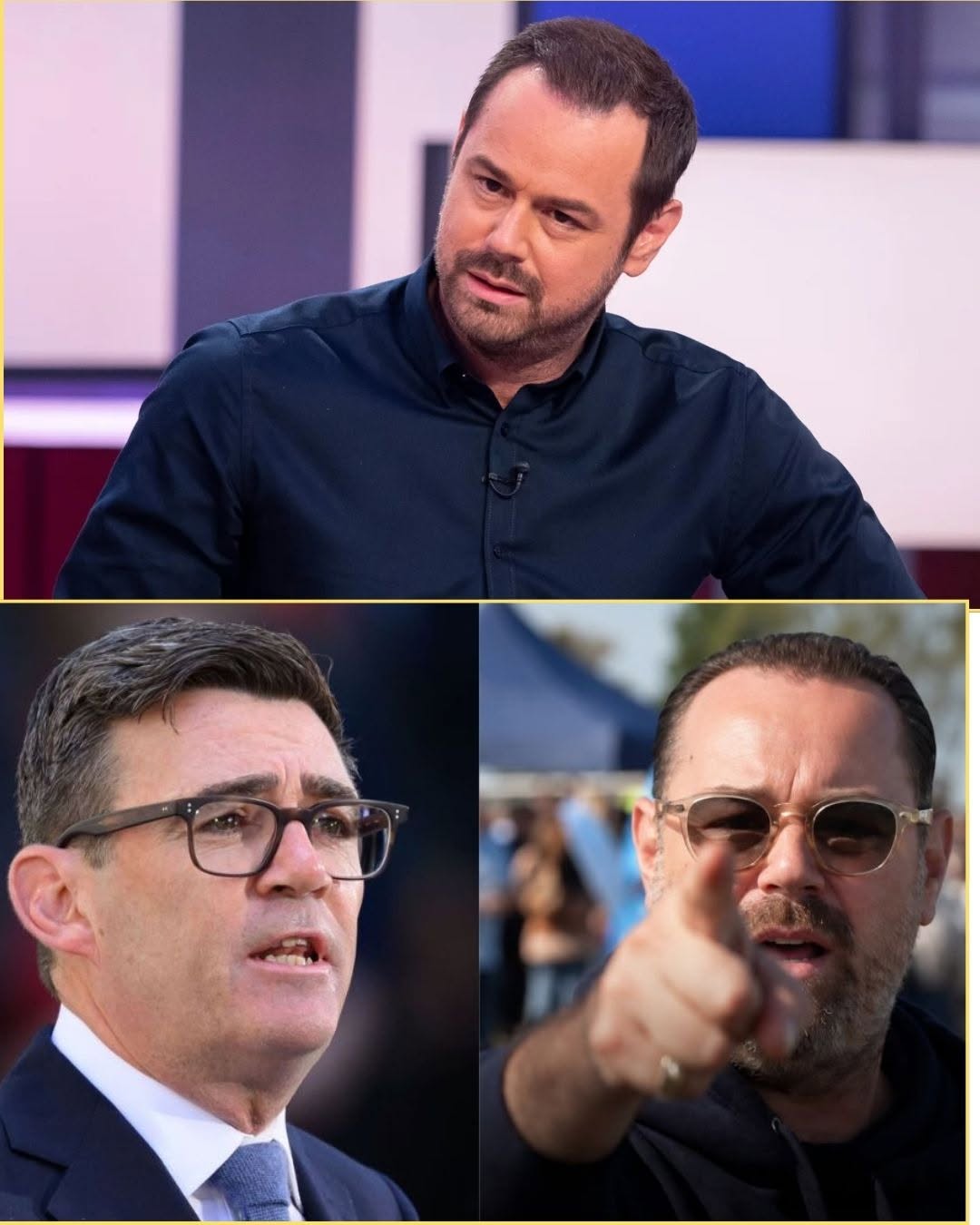
Danny Dyer’s Blunt BBC Interview Sparks Debate Over Burnham, Britain’s ‘Elites’ and Working-Class Anger
Actor Danny Dyer has once again placed himself at the centre of Britain’s political conversation after an unusually blunt BBC interview in which he questioned Prime Minister Andy Burnham’s leadership and accused the country’s “elites” of benefiting while ordinary people turn against one another.
The former EastEnders star was speaking during a Surfers Against Sewage demonstration in Leysdown-on-Sea, Kent, where protesters were calling for water companies to be brought back into public ownership.
Dyer attended the event alongside his daughter Dani Dyer and singer Becky Hill.
What might otherwise have been a conventional celebrity appearance at an environmental campaign quickly became something very different when BBC political reporter Michael Keohan asked Dyer whether he had a message for the prime minister.
Dyer’s response was so heavily filled with profanity that, according to The Independent, the BBC could not broadcast the interview normally. Keohan later shared the footage on X, where the exchange attracted wider attention.
But behind the language was a broader argument about political leadership, living costs, public services and class — themes Dyer has repeatedly discussed in previous interviews.
Dyer Questions Burnham’s Leadership
Asked about the prime minister, Dyer initially responded that he did not know who the prime minister was.
After Burnham was identified, Dyer questioned who he was politically and argued that voters had not directly chosen him to become prime minister. The remarks reflected frustration rather than a detailed constitutional argument, but they touched on a familiar controversy surrounding changes of prime minister between general elections.
Under Britain’s parliamentary system, voters elect MPs rather than directly electing a prime minister. A governing party can therefore change its leader without automatically holding another general election.
Burnham has previously ruled out calling an early election, saying that the government should continue implementing the manifesto on which Labour won the previous election.
Dyer nevertheless framed the leadership change in much more direct terms.
His criticism was not presented as support for a rival political party. Instead, it formed part of a broader argument that Britain’s political system had become disconnected from ordinary voters.
That distinction matters because Dyer has criticised politicians from several parties over the years rather than maintaining a consistent partisan allegiance.
‘The Elites’ Become the Bigger Target
The comments attracting perhaps even more attention concerned what Dyer described as Britain’s “elites.”
Dyer argued that ordinary people were being encouraged to blame each other for social and economic problems when their attention should instead be directed toward those with greater political and economic power.
The language closely resembles views he expressed in an interview earlier this year, when he said working-class communities had become deeply divided while powerful people remained insulated from many of the problems affecting them.
Dyer has also previously argued that Britain needs greater working-class representation in politics.
Speaking to Time Out in 2025, he said political leaders had repeatedly disappointed voters and argued that the country’s elites appeared to be “looking after each other.” He pointed to pensioners struggling with heating bills, young people unable to afford homes and wages failing to keep pace with household expenses.
Those earlier comments provide useful context for the latest interview.
The BBC exchange was provocative, but Dyer’s argument was not created spontaneously for one viral moment. Class and political representation have been recurring subjects in his public comments.
Water Bills Provided the Immediate Context
The location of the interview is also significant.
Dyer was not appearing at a party-political rally. He was attending an environmental protest associated with Surfers Against Sewage.
The organisation has campaigned extensively over sewage pollution and the structure of Britain’s water industry.
Dyer connected that subject to the wider pressures facing households, questioning why people were paying increasing water bills while continuing to hear reports about pollution and inadequate infrastructure.
His frustration therefore combined several issues: the cost of utilities, environmental performance, political accountability and public distrust.
These are separate policy questions, and describing them collectively as evidence that “elites” are exploiting the public represents Dyer’s political interpretation rather than an independently established conclusion.
But the argument helps explain why the clip resonated beyond the immediate environmental protest.
Not Dyer’s First Political Intervention
Anyone familiar with Dyer’s public career will recognise the pattern.
Although primarily known as an actor, he has repeatedly made headlines with unusually direct political commentary.
During the political turmoil surrounding Brexit, Dyer famously criticised former Conservative prime minister David Cameron for calling the EU referendum and then leaving office.
He subsequently criticised Keir Starmer while Starmer was prime minister.
In a 2024 Big Issue interview, Dyer said he did not trust Starmer and questioned whether Labour was still representing working-class voters.
He became even more critical the following year, describing Starmer as a “non-entity” and arguing that Britain needed leaders from more ordinary working-class backgrounds.
That history makes it difficult to interpret Dyer’s latest comments simply as an attack on Burnham personally.
The prime minister has changed, but Dyer’s broader complaint has remained remarkably consistent: he believes Britain’s political class is too distant from the everyday experiences of many voters.
Why the Clip Triggered Such a Reaction
Part of the answer is Dyer’s communication style.
British political interviews normally operate within fairly predictable boundaries. Politicians choose their language carefully, interviewers challenge them, and public figures generally avoid language that cannot be broadcast before the watershed.
Dyer does almost the opposite.
His political interventions are informal, emotional and frequently filled with profanity.
That can make relatively familiar political arguments suddenly appear more dramatic.
Concerns about declining trust in politicians, the cost of living, housing affordability and working-class representation are hardly new. What distinguishes Dyer is the way he expresses them.
Supporters often interpret that style as authenticity.
Critics may regard it as simplistic, excessively confrontational or lacking the policy detail required to address the problems he identifies.
Both reactions help explain why relatively short Dyer interviews can generate considerably more attention than carefully prepared political statements.
What Did the BBC Actually Do?
Some online descriptions have suggested that the BBC deliberately shut down Dyer’s criticism or attempted to suppress his political comments.
The available evidence does not establish that.
The practical problem was considerably simpler: much of Dyer’s answer contained language unsuitable for conventional BBC television broadcasting.
The interview therefore did not appear as a normal televised exchange. But the BBC reporter who conducted it subsequently shared the footage publicly on X.
That makes claims of a coordinated attempt to hide the remarks difficult to reconcile with the fact that a BBC journalist himself published the clip.
The exchange nevertheless illustrates the increasingly blurred boundary between television broadcasting and social media.
An interview that may be unusable on a traditional news bulletin can now reach a large audience online within minutes.
Celebrity Intervention or Wider Political Warning?
The more interesting question is what significance, if any, should be attached to Dyer’s comments.
He is an actor, not an elected representative or political analyst.
His statements therefore should not be treated as evidence that his interpretation of Britain’s economic or political problems is necessarily correct.
But celebrities can articulate frustrations already present among sections of the public, and Dyer’s repeated emphasis on class, housing, public services and distrust of political institutions reflects debates occurring well beyond entertainment.
His criticism also cuts across conventional party lines.
He attacked Conservative leadership during the Brexit era, criticised Starmer after Labour returned to government and has now questioned Burnham.
The consistent thread is less about party affiliation than about Dyer’s belief that political power has become detached from working-class communities.
Whether that diagnosis is persuasive remains a matter for public debate.
What can be established is that the latest controversy was not simply manufactured from an invented television confrontation.
Dyer did give the BBC an unusually explicit political response. He questioned Burnham’s leadership, criticised powerful “elites” and argued that ordinary people were being divided against one another. The BBC reporter subsequently made the footage available online.
But some of the more dramatic interpretations surrounding the clip go further than the evidence.
There is no clear indication that the BBC attempted to silence Dyer because of his political views, nor does his criticism establish that a coordinated elite effort exists to deliberately divide the public.
Those are interpretations surrounding the exchange.
What the interview does demonstrate is something simpler: Danny Dyer remains willing to express political frustration in language very different from Westminster’s carefully managed vocabulary — and that continues to make even a brief encounter with a BBC microphone capable of becoming a national talking point.