Nigel Farage and Rupert Lowe: Could Former Rivals Really Find a Way Back Together?
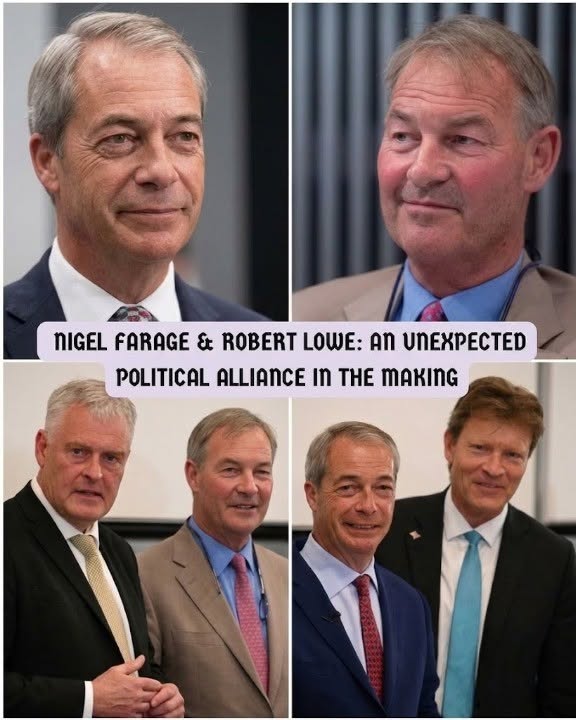
Nigel Farage and Rupert Lowe: Could Former Rivals Really Find a Way Back Together?
A remarkable attempt at reconciliation between Nigel Farage and his former Reform UK colleague Rupert Lowe has reopened questions about whether two increasingly separate forces on the British right could eventually cooperate. Lowe publicly offered an “olive branch” and Farage briefly appeared willing to discuss it. But weeks later, their relationship again looked deeply fractured — demonstrating just how difficult any genuine alliance would be.
For much of the past year, Nigel Farage and Rupert Lowe have looked more like political enemies than potential partners.
Once colleagues inside Reform UK, their relationship deteriorated spectacularly after Lowe’s suspension from the party in 2025 and his subsequent departure.
Lowe eventually established Restore Britain, creating a new political organisation competing for some of the same voters Reform hopes to attract.
That made what happened in August particularly striking.
Rather than intensifying his attacks on Farage, Lowe publicly offered to work with him.
His message was essentially that their personal disagreements should no longer prevent cooperation if their political objectives overlapped sufficiently.
For a brief period, a Reform-Restore partnership suddenly appeared conceivable.
But the apparent reconciliation did not last long.
Lowe Extends an Olive Branch
On August 2, Lowe published a video directly addressing Farage.
He argued that the political right was divided and that competition between Reform and Restore could ultimately damage both parties.
Lowe said there could be sufficient common ground for cooperation and called for previous personal disagreements to be put aside.
But this was not an unconditional peace offer.
Lowe attached five substantial policy conditions.
They included a programme of large-scale deportations of people in the country illegally, much tougher restrictions on legal migration, welfare reductions, a referendum on restoring capital punishment and a commitment that former Conservative ministers would not enter a future government formed through such an alliance.
He also proposed restrictions involving the burqa, religious slaughter, cousin marriage and sharia councils.
These were not minor negotiating points.
They represented an attempt to establish the political direction that any cooperation would have to take.
Farage Appeared Willing to Talk
Farage’s initial response was cautious.
He did not accept Lowe’s conditions.
But neither did he immediately close the door.
Farage said he was approaching the proposal with an “open mind” and indicated that he was prepared to have a conversation if Lowe genuinely wanted negotiations.
Reports at the time said Farage had reached out following Lowe’s public offer.
For supporters hoping to see the two movements reunited, that was significant.
The possibility of cooperation also raised obvious electoral questions.
Britain’s first-past-the-post system can punish parties competing for similar voters.
If Reform and Restore both field candidates in the same constituency, they can divide support that might otherwise consolidate behind one candidate.
That does not mean their voters are interchangeable.
But it creates a strategic incentive to at least consider cooperation.
Greater Manchester Changed the Conversation
The immediate political backdrop was the Greater Manchester mayoral election.
Restore Britain’s candidate Marlon West secured 8.7% of first-preference votes, while Reform’s Sian Astley received 21% and finished second behind Labour’s Bev Craig.
Restore’s result demonstrated that Lowe’s party could attract a meaningful share of the electorate even while competing directly with Reform.
For Restore, that provided evidence it could not simply be ignored.
For Reform, it highlighted the potential cost of having another party targeting overlapping groups of dissatisfied voters.
Lowe’s argument was therefore partly ideological but also mathematical.
If two parties repeatedly compete for similar votes, both can lose seats they might otherwise have had a chance to contest more effectively.
Then the Personal Conflict Returned
Any suggestion that the two men had suddenly repaired their relationship quickly proved premature.
Within hours of the initial exchange, Lowe accused Farage of “outright lying” about private discussions between them.
Nevertheless, Lowe continued to say Restore remained open to cooperation.
By September, Farage’s position had hardened considerably.
In a BBC interview reported on September 2, Farage appeared to rule out reconciliation.
He accused Lowe of having a “very vindictive motivation” and argued that some people around Restore Britain were using language reminiscent of the 1930s.
Farage also suggested that Restore’s presence could ultimately help the Conservatives by dividing voters opposed to Labour.
That was a very different message from the cautious openness expressed a month earlier.
What Actually Separates Them?
Immigration is one area where Reform and Restore have substantial overlap, but the degree and details of their policies can differ.
Lowe has sought to position Restore as a harder-line alternative.
His conditions for cooperation illustrate that strategy particularly clearly.
Farage, meanwhile, is trying to build Reform into a broader national political organisation capable of attracting voters who previously supported Conservatives, Labour or did not vote at all.
That requires a different strategic calculation.
A policy that energises one section of the electorate can repel another.
The question facing Farage is therefore not simply whether he personally agrees with Lowe on individual issues.
It is whether adopting Restore’s conditions would help or hinder Reform’s attempt to build a wider electoral coalition.
Money Changes the Equation
The balance between the two parties has also changed because Reform now possesses financial resources almost unimaginable during its earlier years.
The party has recently received a combined £72 million from cryptocurrency billionaires Ben Delo and Christopher Harborne.
Farage plans to use the money to dramatically professionalise Reform’s campaigning infrastructure, including hundreds of new campaign staff and a much larger national organisation.
Restore is operating on a substantially smaller scale, although it has begun attracting significant financial support of its own.
In September, technology entrepreneur Simon Galbraith donated £500,000 to Lowe’s party, its largest publicly known contribution at that point.
That means both organisations have reasons to believe they can continue independently.
And that can make compromise harder.
Cooperation Does Not Necessarily Mean Merger
Another important distinction is frequently lost in discussion of a possible alliance.
Reform and Restore would not necessarily have to merge.
Political cooperation could take several forms.
They could agree not to compete against each other in selected constituencies.
They could cooperate on particular parliamentary votes.
They could coordinate around specific policies while remaining separate organisations.
Or they could reach no agreement at all.
Lowe’s August intervention opened a conversation about those possibilities.
It did not create a formal coalition.
Could They Still Work Together?
The answer remains uncertain.
There are obvious strategic incentives.
Both parties appeal to voters dissatisfied with the established political system. Both emphasise immigration and national sovereignty. Both argue that Britain’s political institutions require major change.
But there are equally obvious barriers.
Lowe’s conditions are substantial.
Farage has rejected the idea of abandoning members of his existing team simply to secure an agreement.
Most importantly, the personal relationship between the two men remains deeply damaged.
Farage’s September comments suggest that the brief period of reconciliation has, at least for now, given way to renewed rivalry.
Rivals, Partners — or Both?
The most accurate description of the relationship is therefore neither “new alliance” nor permanent separation.
It is a political rivalry containing a strategic dilemma.
Lowe has demonstrated that he is prepared to discuss cooperation if Reform moves towards his political conditions.
Farage briefly demonstrated that he was willing to listen.
But neither side has agreed to the other’s terms, and their public dispute subsequently intensified again.
That leaves a fascinating question hanging over Britain’s changing political landscape.
If Reform and Restore discover that competing against each other costs both of them influence, political necessity could eventually push Farage and Lowe back towards the negotiating table.
For now, however, the handshake remains hypothetical.
The two men share parts of the same political territory — but they remain rivals fighting over who should control it.