Poland’s Border Crackdown Divides Europe as Security,Migration, and Humanitarian Concerns Collide
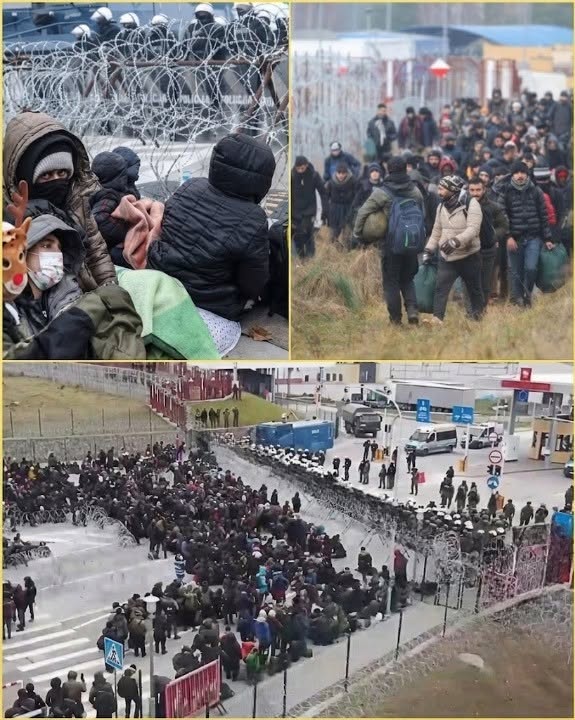
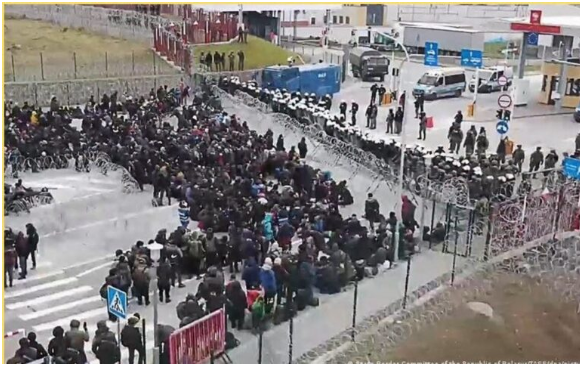
Poland’s increasingly robust approach to securing its eastern border has once again placed the country at the center of one of Europe’s most contentious political debates. Images of long lines of migrants gathered near border fences, rows of riot police standing behind razor wire, and heavily fortified crossing points have circulated widely across social media, reigniting discussions about immigration, national sovereignty, humanitarian obligations, and the future of European border policy. Supporters describe Poland’s strategy as a necessary defense against irregular migration and external pressure, while critics argue that stronger enforcement must always remain consistent with international humanitarian law and the rights of asylum seekers. The debate has become one of the defining political issues facing Europe.
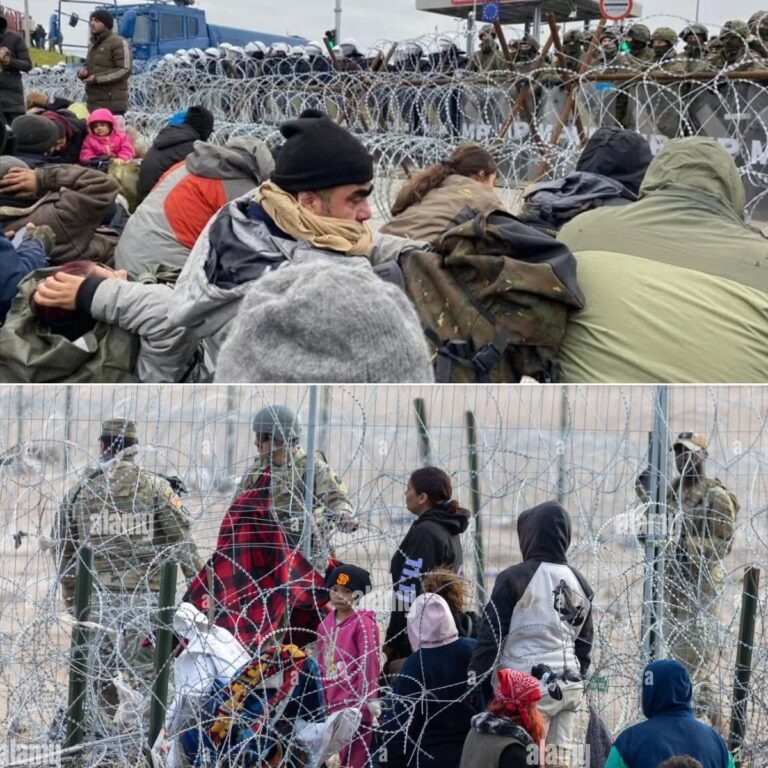
The photographs accompanying many online discussions show large groups of migrants assembled near border barriers, extensive coils of razor wire, and Polish security personnel positioned along the frontier. These scenes reflect the migration pressures that have affected Poland’s border with Belarus in recent years. However, images alone cannot fully explain the circumstances of each individual crossing attempt, the legal status of those present, or the broader geopolitical factors contributing to the situation. Understanding the issue requires examining both the security concerns raised by Polish authorities and the humanitarian questions highlighted by international organizations.
The current border tensions largely trace back to the migration crisis that developed along the Belarus-European Union frontier beginning in 2021. Poland, Lithuania, and Latvia accused the Belarusian government of deliberately encouraging or facilitating the movement of migrants toward EU borders in response to European sanctions imposed on Minsk. Belarus rejected those accusations, while the European Union characterized the situation as a form of hybrid pressure designed to destabilize neighboring member states. The resulting crisis transformed Poland’s eastern frontier into one of Europe’s most closely watched border regions.
In response, Poland significantly strengthened its border security infrastructure. Authorities constructed extensive steel fencing, installed advanced surveillance systems including cameras and motion sensors, expanded patrols by the Border Guard, military personnel, and police, and introduced legal measures intended to reduce irregular crossings. Government officials argued that these actions were necessary to protect both Poland’s national security and the integrity of the European Union’s external border.
Supporters of Poland’s approach contend that every sovereign nation has both the right and the responsibility to control its borders. They argue that effective border management discourages human trafficking, disrupts organized smuggling networks, and maintains public confidence in legal immigration systems. From this perspective, allowing uncontrolled irregular crossings would undermine lawful migration procedures and place additional pressure on public services, housing, and border authorities.
Many advocates also argue that Poland’s eastern border is not solely a national frontier but one of the principal external borders of the European Union and the Schengen Area. Consequently, they believe Poland’s efforts contribute to the security of neighboring EU member states by helping regulate entry into the wider European single-travel area. Supporters often describe the border measures as part of a broader European responsibility rather than an exclusively domestic policy.
Critics, however, emphasize that border security measures must remain consistent with international refugee law and humanitarian obligations. Organizations including the United Nations High Commissioner for Refugees (UNHCR), the International Organization for Migration (IOM), and various human rights groups have repeatedly stressed that individuals seeking asylum should have access to fair and individualized procedures. They argue that security concerns should not eliminate legal protections available under international conventions.
Humanitarian organizations have also expressed concern about conditions experienced by migrants stranded near the border, particularly during periods of severe winter weather. Reports over recent years have described individuals lacking adequate shelter, food, medical care, and access to legal assistance while attempting to cross or while remaining in border regions. Polish authorities have maintained that responsibility for many of these humanitarian conditions lies with Belarus, which they accuse of facilitating and exploiting the migration crisis.
Migration has become one of the defining political issues across Europe over the past decade. Governments continue to face the challenge of balancing humanitarian responsibilities toward refugees with public expectations regarding border security, immigration control, and national sovereignty. Different countries have adopted varying approaches depending upon their legal systems, political priorities, and geographic circumstances. Poland has consistently favored stronger external border enforcement compared with some other European governments.
The debate extends beyond the immediate border itself. Supporters of stricter migration controls argue that clearly enforced immigration laws discourage dangerous irregular journeys organized by criminal smuggling networks. They contend that maintaining credible legal immigration pathways depends upon effectively addressing unauthorized entry. According to this view, predictable enforcement protects both national security and the integrity of asylum systems.
Opponents caution that people arriving at Europe’s borders often include individuals fleeing armed conflict, political persecution, or severe humanitarian crises. They argue that border enforcement should not prevent genuine refugees from accessing international protection where they meet legal criteria. Human rights advocates therefore encourage governments to distinguish carefully between economic migration, irregular migration, and legitimate asylum claims.
The European Union has attempted to develop common approaches to migration management, although member states frequently disagree on burden-sharing, asylum procedures, border enforcement, and relocation mechanisms. Countries situated along the EU’s external borders often argue that they bear disproportionate responsibility for managing migration pressures, while inland member states have expressed differing views regarding responsibility-sharing and solidarity.
Public opinion within Poland generally reflects the broader European divide. Many citizens support stronger border controls, viewing them as essential for protecting national security and maintaining public order. Others acknowledge the importance of secure borders while also expressing concern about ensuring humane treatment for vulnerable individuals seeking protection. These differing perspectives have shaped domestic political debates and election campaigns.
The images accompanying online discussions often emphasize razor wire, police lines, and large groups of migrants gathered near border crossings. Such photographs accurately illustrate the visible security presence but cannot by themselves explain the individual circumstances of those depicted. Some individuals may be seeking asylum, others may be attempting irregular entry, and still others may have different legal statuses entirely. Determining these distinctions requires formal immigration procedures rather than assumptions based solely on visual evidence.
The broader geopolitical dimension also remains significant. European officials have repeatedly argued that migration can be exploited as a political instrument during periods of international tension. The EU has accused Belarus of encouraging migration flows for political purposes, allegations that Belarus has denied. These geopolitical disagreements have added an additional layer of complexity to an already sensitive humanitarian and security issue.
Border enforcement technologies have likewise evolved considerably. Poland has invested in surveillance systems, drones, thermal imaging, electronic monitoring, and physical barriers designed to detect unauthorized crossings more effectively. Supporters argue that technological improvements allow authorities to manage borders more efficiently while reducing risks for both officers and migrants. Critics respond that technological advances should be accompanied by equally robust safeguards protecting fundamental rights.
The issue has also influenced broader European discussions concerning migration reform. The European Union has continued negotiating measures intended to strengthen external border management, improve asylum processing, accelerate returns for individuals without legal permission to remain, and enhance cooperation with neighboring countries. These reforms remain politically sensitive because member states continue to differ over how responsibilities should be distributed.
International law recognizes both the right of sovereign states to control their borders and the obligation to provide access to asylum procedures for individuals meeting applicable legal standards. Balancing these two principles often presents governments with difficult policy decisions, particularly during periods of increased migration pressure. Courts, international organizations, and national legislatures continue to examine how these obligations should operate in practice.
Political leaders across Europe frequently cite Poland’s experience when discussing their own border policies. Some view the Polish model as an example of firm border management that other countries should emulate. Others argue that effective migration policy must combine secure borders with expanded legal migration pathways, humanitarian protections, and international cooperation addressing the root causes of displacement.
Ultimately, Poland’s border strategy illustrates the broader challenge confronting Europe as migration continues to shape political debate. The competing priorities of national security, humanitarian responsibility, international law, and democratic accountability rarely produce simple solutions. Supporters and critics may disagree strongly about the appropriate balance, but both acknowledge that migration will remain one of Europe’s most significant public policy issues for years to come.
As the debate continues, verified information remains essential. Images of border barriers and large crowds capture only one part of a far more complex story involving geopolitics, international law, humanitarian concerns, domestic politics, and the future of European cooperation. Understanding these events requires careful attention to official reporting, legal developments, and the experiences of all those directly affected, rather than relying solely on emotionally charged social media narratives.