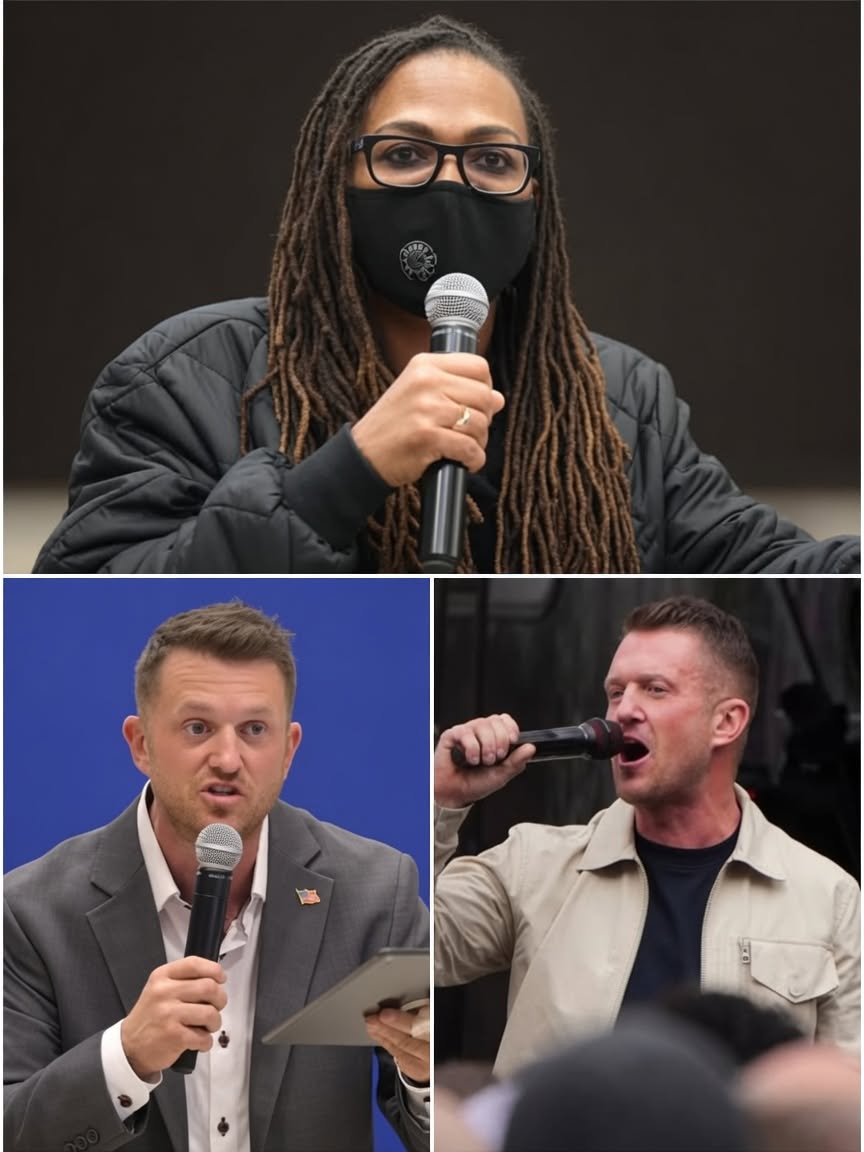
LIVE PUBLIC CONFRONTATION INVOLVING TOMMY ROBINSONSPARKS ONLINE DEBATE, BUT KEY CLAIMS REMAINUNVERIFIED

A dramatic social media post claiming that a Muslim protester “broke down in tears” after a heated verbal exchange with British activist Tommy Robinson has circulated widely online, attracting significant attention and provoking intense debate across multiple platforms. While the story has been shared alongside emotionally charged headlines and short video clips, many of the central claims remain unverified, making it difficult to establish exactly what occurred before, during, and after the reported confrontation. As with many viral incidents involving politically and religiously sensitive topics, experts caution that isolated footage and sensational descriptions can easily create misleading impressions when presented without broader context.
TENT GRA
ERI E OF
Tommy Robinson, whose real name is Stephen Yaxley-Lennon, has long been one of the United Kingdom’s most controversial political activists. He has built a large online following through criticism of Islamist extremism, immigration policy, multiculturalism, and what he describes as institutional failures by British authorities. His supporters argue that he raises concerns that mainstream politicians and media organizations are reluctant to discuss openly. Critics, however, accuse him of promoting anti-Muslim rhetoric, inflaming social tensions, and contributing to hostility toward Muslim communities. Because of his high public profile and deeply polarizing reputation, any public appearance involving Robinson often attracts both supporters and opponents.
According to posts circulating on social media, the latest incident allegedly took place during a public gathering where Robinson encountered individuals challenging his views. Viral captions claim that a Muslim participant became visibly emotional after Robinson criticized aspects of Islamic theology during a heated exchange. Some posts describe the moment as a decisive verbal victory for Robinson, while others portray the confrontation as evidence of growing tensions surrounding discussions of religion, freedom of speech, and identity politics in Britain. However, at the time of writing, there has been no independently verified evidence confirming many of these descriptions or demonstrating that the viral captions accurately reflect what happened.
Short video clips have become the primary source of information surrounding the alleged confrontation. Like many videos that rapidly gain popularity online, they typically present only a limited portion of the interaction. Without footage showing what occurred before the exchange began or after it concluded, viewers are left without the broader context necessary to fully understand the situation. Media researchers frequently warn that brief clips can omit important details, including earlier conversations, actions by multiple participants, or attempts by organizers to de-escalate tensions.
One of the most widely repeated claims is that a Muslim protester “started crying” after Robinson’s remarks. Yet emotional reactions are inherently difficult to interpret through edited footage alone. A person appearing distressed on camera may be responding to a variety of circumstances unrelated to the specific statements heard in a clip. Likewise, facial expressions, camera angles, editing choices, and selective narration can influence how audiences perceive events. Without direct statements from those involved or corroborating reporting from independent sources, conclusions about an individual’s emotions remain speculative.
The incident has nevertheless reignited broader debates surrounding freedom of expression and public criticism of religion. In liberal democracies such as the United Kingdom, individuals generally enjoy legal protections allowing them to express opinions about religious beliefs, political ideologies, and public policy. At the same time, speech that incites violence or constitutes unlawful harassment may fall outside those protections. Balancing robust public debate with protections against discrimination remains one of the most challenging issues facing democratic societies, particularly when discussions involve religion and identity.
Supporters of Robinson argue that public debate should allow criticism of all belief systems, including Islam, Christianity, Judaism, Hinduism, atheism, and secular ideologies. They maintain that no religion should be exempt from scrutiny and that restricting criticism risks undermining democratic values. Many also argue that open discussion is essential for addressing concerns about integration, extremism, terrorism, and social cohesion.
Conversely, many Muslim organizations and civil rights advocates distinguish between criticism of religious doctrines and language they believe unfairly stereotypes Muslim communities as a whole. They argue that while theological debate is legitimate, rhetoric portraying entire religious populations negatively can contribute to prejudice and increase social divisions. Numerous Muslim leaders have publicly stated over the years that disagreements about religion should remain respectful and focused on ideas rather than personal attacks directed at believers.
The rapid spread of emotionally charged content also illustrates how social media algorithms often reward dramatic narratives over careful reporting. Headlines using phrases such as “destroyed,” “humiliated,” “left in tears,” or “brutal verbal blows” are common across politically polarized online communities because they encourage users to click, comment, and share content. Communications researchers note that such language frequently exaggerates events and frames ordinary disagreements as decisive victories or defeats, regardless of what actually occurred.
Another challenge in assessing viral confrontations is the increasing prevalence of edited videos. Modern editing software allows creators to remove pauses, rearrange sequences, crop surrounding events, add captions, insert dramatic music, or selectively highlight audience reactions. These production choices can substantially influence viewers’ emotional responses. Independent journalists often seek longer recordings, multiple camera angles, eyewitness testimony, and official statements before drawing conclusions about controversial public incidents.
The broader political environment also helps explain why this reported confrontation has attracted widespread attention. Immigration, integration, religious identity, national security, and freedom of speech remain among the most contentious issues in British politics. Public figures associated with these debates often generate intense online engagement regardless of whether new developments significantly alter existing policy discussions. Viral confrontations therefore tend to become symbolic representations of larger political disagreements rather than isolated personal exchanges.
Tommy Robinson himself has remained a divisive figure throughout much of his public career. He has faced legal proceedings, public demonstrations both supporting and opposing him, and extensive media coverage. Some view him as a campaigner raising uncomfortable questions about extremism and public safety, while others argue that his activism fuels hostility toward Muslim communities and oversimplifies complex social issues. These sharply contrasting perspectives contribute to the intensity of reactions whenever his name trends online.
The Muslim community in Britain is itself highly diverse, encompassing millions of people from a wide variety of ethnic, cultural, linguistic, and theological backgrounds. British Muslims hold differing political opinions, varying religious interpretations, and a broad range of views on public policy. Consequently, incidents involving one individual should not be interpreted as representative of an entire religious community. Similarly, responses from one protest participant cannot reasonably be generalized to millions of believers.
Public debates concerning religion have historically produced passionate exchanges across many societies. Discussions involving theology, morality, history, or political influence often evoke deeply held personal convictions. Scholars of conflict resolution generally recommend that participants focus on evidence, remain respectful toward individuals even while criticizing ideas, and avoid inflammatory rhetoric that may escalate tensions unnecessarily.
Experts studying online misinformation also emphasize the importance of distinguishing verified facts from commentary. Viral captions frequently mix observable events with subjective interpretations. For example, whether two people argued may be observable if captured on video, while assertions about who “won” the debate or why someone appeared emotional remain matters of opinion unless directly confirmed by the individuals involved. Consumers of online media are therefore encouraged to separate factual reporting from emotionally persuasive framing.
Journalistic standards likewise require caution when reporting claims based primarily on social media. Responsible reporting generally seeks confirmation from multiple independent sources, examines original footage where available, verifies dates and locations, and contacts participants for comment before presenting disputed allegations as established fact. When such verification is unavailable, reputable news organizations typically describe claims as unconfirmed rather than presenting them as proven events.
The controversy also reflects broader questions about how public discourse should function in increasingly polarized societies. Democratic systems rely upon the ability of citizens to debate difficult issues openly, yet productive discussion becomes more challenging when conversations are dominated by insults, sensationalism, or assumptions about entire communities. Encouraging evidence-based discussion while rejecting personal hostility remains an ongoing challenge for political leaders, journalists, activists, and social media platforms alike.
Observers note that emotionally charged encounters often receive far greater attention than thoughtful conversations. Calm discussions involving nuanced arguments rarely generate the same level of online engagement as dramatic confrontations, creating incentives for content creators to emphasize conflict over complexity. This dynamic can distort public understanding by making exceptional incidents appear more representative than they actually are.
As of the time of writing, there is no publicly verified evidence confirming every element of the viral narrative describing this confrontation. Specifically, widely circulated claims regarding the emotional state of the Muslim participant, the precise wording used during the exchange, and the broader circumstances surrounding the event have not all been independently substantiated. Readers should therefore approach sensational headlines with appropriate caution and remain attentive to future reporting from credible sources that may provide additional context.
Ultimately, regardless of differing political or religious viewpoints, incidents like this underscore the importance of careful verification before accepting dramatic online claims as fact. Public debate surrounding religion, immigration, and national identity will likely remain a defining feature of contemporary British politics. Ensuring those debates are informed by reliable evidence, respectful dialogue, and accurate reporting is essential if meaningful public discussion is to take place in an increasingly fast-moving digital information environment.