Andy Burnham Under Fire as Carole Malone Raises Questions Over EU Policy, Pensions and Political Consistency
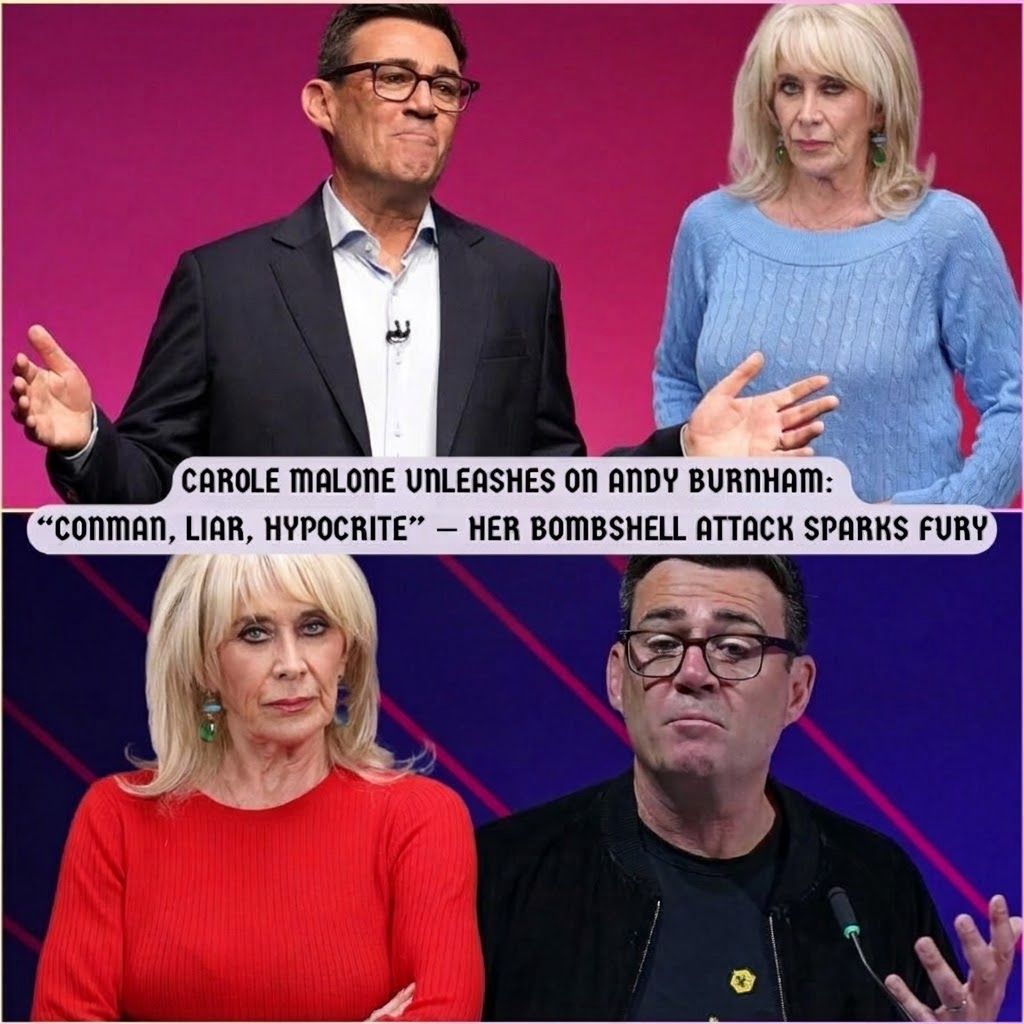
A fresh political row has erupted around Andy Burnham after columnist and broadcaster Carole Malone launched a highly critical attack on the Greater Manchester mayor and his political record.
Malone’s intervention focused on several areas of Burnham’s public statements and political positioning, including Britain’s relationship with the European Union, pension policy, government spending and his relationship with Prime Minister Keir Starmer. Her comments have added another layer to an already lively debate about Burnham’s political ambitions and the direction he could take in the future.
It is important, however, to distinguish between Malone’s commentary and established facts. Terms such as “conman”, “liar” and “hypocrite” are Malone’s characterisations rather than independently established findings.
Questions over Burnham’s EU position
One of the central issues highlighted by Malone is Burnham’s position on Britain’s relationship with the European Union.
The subject has become increasingly prominent in British politics since Brexit, particularly as debates continue over the UK’s economic relationship with the bloc and whether closer integration should be considered.
According to the argument presented by Malone, Burnham previously reassured voters during campaigning in Makerfield that he was not proposing that Britain should consider rejoining the EU. Malone then pointed to more recent comments attributed to Burnham in which he reportedly acknowledged that Britain could eventually “go all the way” and rejoin.
The apparent contrast has become a point of political discussion.
However, there is an important distinction between supporting closer relations with the European Union and advocating immediate British membership. Political positions can evolve, and statements made in different political circumstances can refer to different stages of Britain’s relationship with Europe.
Burnham’s comments therefore need to be considered in their full context, including the date, audience and precise wording.
The pension debate
Another issue raised by Malone concerns the future of the state pension and the so-called triple lock.
The triple lock is a mechanism under which the UK state pension generally rises each year by whichever is highest among average earnings growth, inflation or 2.5 per cent, subject to the way the policy is applied by the government of the day.
The policy has become one of the most politically sensitive areas of public spending. Supporters argue that it protects pensioners from inflation and ensures that the value of pensions does not fall behind wages. Critics have questioned its long-term cost and whether the same mechanism can remain sustainable as demographic pressures increase.
Malone’s criticism centres on what she presents as a contradiction between Burnham’s earlier political ambitions and his more recent comments about pension policy.
Any claim that Burnham has proposed ending or changing the triple lock should therefore be examined against his actual policy statements rather than relying solely on commentary.
Spending and borrowing
Malone also questioned what she sees as a lack of detailed answers on Britain’s wider financial challenges.
Among the issues mentioned are the cost of welfare benefits, military expenditure and national borrowing.
These are substantial areas of public policy involving billions of pounds of government spending. Decisions about them involve difficult trade-offs between taxation, public services, defence, welfare provision and debt management.
The figure of £330 billion cited in the criticism requires particular care because the total cost of benefits depends heavily on which benefits and accounting period are being included. A headline figure without a precise definition can therefore give an incomplete picture of government expenditure.
Similarly, discussions about defence spending cannot be separated from Britain’s wider security commitments, NATO obligations and the Government’s assessment of threats.
Burnham and Starmer
Malone’s criticism also touches on Burnham’s relationship with Keir Starmer.
Burnham and Starmer have occupied different positions within Labour politics, and their relationship has periodically attracted political attention. Burnham previously served as a Labour cabinet minister and later became Mayor of Greater Manchester, while Starmer became Labour leader and subsequently Prime Minister.
Malone argues that Burnham had spent a significant period criticising or challenging Starmer before later expressing appreciation for him during a party conference address.
Such developments are common subjects of political commentary, particularly within major parties where figures can disagree over policy while remaining members of the same political movement.
Whether that represents political inconsistency is ultimately an interpretation rather than a factual finding.
Personal grief and political speeches
Another controversial aspect of Malone’s criticism concerned Burnham’s decision to refer to personal family grief during a major political speech following the death of his father.
Political speeches frequently combine personal experiences with policy arguments. Politicians sometimes use family stories to explain their motivations, values or political outlook.
Whether such references are appropriate is largely a matter of political commentary and audience reaction.
Malone clearly regarded Burnham’s use of the subject as inappropriate, while others may interpret personal references differently.
The distinction is important because the underlying fact — that Burnham discussed personal bereavement — is separate from the question of whether doing so was politically appropriate.
Burnham’s broader political ambitions
At the heart of the controversy is a broader question about Burnham’s political future.
The former cabinet minister has built a significant political profile through his long period as Mayor of Greater Manchester. His political career has included service in Parliament, senior government positions and leadership contests within the Labour Party.
That history means his comments on national issues are regularly scrutinised, particularly when they concern major questions such as Brexit, public spending and the future direction of Labour.
The debate over Europe is especially significant because Britain’s relationship with the EU remains politically sensitive. Different Labour figures have adopted different positions over Brexit, while the party leadership has generally focused on improving the UK’s relationship with Europe without pursuing immediate re-entry into the EU.
Burnham’s remarks therefore attract attention not simply because of their content, but because of what they might indicate about his broader political outlook.
A debate over consistency
The latest controversy ultimately comes down to the question of political consistency.
Malone’s argument is that Burnham’s positions have changed significantly and that voters should scrutinise those changes closely. Her critics could respond that political circumstances evolve and that changing one’s position does not automatically demonstrate bad faith.
Both perspectives can be considered separately from the personal language used in the criticism.
The most useful way to assess the controversy is therefore to examine Burnham’s statements over time, compare them with his documented policies and identify where his positions have changed, remained consistent or been misunderstood.
What happens next?
The controversy surrounding Burnham is unlikely to disappear quickly. Questions about Britain’s relationship with Europe, pension policy, public spending and the country’s finances remain central to political debate.
For Burnham, the challenge is likely to be explaining how his current positions relate to statements he made previously.
For commentators such as Malone, the issue provides another opportunity to scrutinise his political record and ambitions.
Ultimately, the debate illustrates how quickly individual remarks can become part of a much larger political argument. Claims about changing positions need to be examined in their original context, while strongly worded commentary should be distinguished from independently verified facts.
As Britain continues to debate its relationship with Europe, the future of pensions and the balance between public spending and fiscal responsibility, figures such as Burnham will remain under close scrutiny.
The key question is not simply what Burnham has said recently, but how his current position compares with what he said before — and what policy proposals he would actually put forward if given greater national responsibility.