Harry Redknapp’s Migration Remarks Ignite Fierce Debate Over Britain’s Borders, Identity and Political Silence
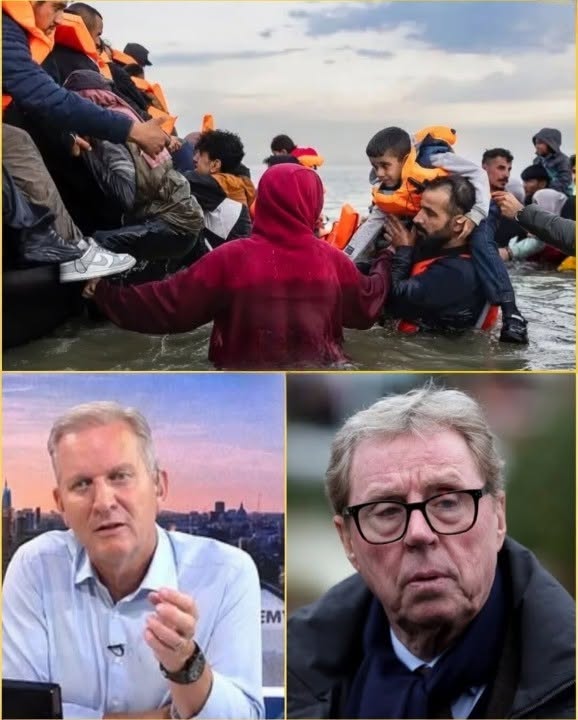
Harry Redknapp has spent much of his public life discussing football rather than immigration, border enforcement or national identity. Yet the former Tottenham Hotspur, Portsmouth and West Ham manager has now found himself at the centre of one of Britain’s most emotionally charged political conversations after delivering a blunt assessment of the country’s migration situation. His intervention has divided viewers, generated intense discussion online and raised a familiar but difficult question: when a well-known public figure speaks in uncompromising language about immigration, is he expressing concerns that politicians have failed to confront, or is he simplifying an extraordinarily complex national challenge?
The controversy followed Redknapp’s appearance on TalkTV, where he reacted to reports and footage concerning migrants attempting to enter the Spanish territory of Ceuta in North Africa. During the discussion, he claimed that Britain had become “overrun” by illegal migrants and spoke critically about changes he believed he had witnessed in Bournemouth, the coastal town with which he has long been associated. His description was immediately powerful, partly because Redknapp is not normally regarded as a professional political campaigner. He is better known as an outspoken football personality whose language is informal, emotional and direct.
That directness explains why the remarks gained attention so quickly. Supporters argued that Redknapp was articulating anxieties felt by people who believe that irregular migration has become poorly controlled and that public authorities are reluctant to acknowledge the scale of the problem. To them, his comments were not carefully rehearsed political messaging but the spontaneous frustration of someone describing what he genuinely believed he could see around him. They praised him for speaking without the cautious language normally used by ministers, civil servants and media commentators.
Critics, however, focused on the language he chose. The word “overrun” is not a neutral administrative term. It creates an image of invasion, loss of control and overwhelming numbers. Opponents argued that such rhetoric risks treating migrants as a single threatening group rather than distinguishing between asylum seekers, refugees, legal workers, international students, families, victims of trafficking and people entering the country without permission. They also questioned how anyone could determine a person’s legal status simply by seeing them in a town centre, hotel or public space.
That distinction matters because Britain’s migration debate frequently combines several separate issues. Legal migration refers to people entering under recognised routes for work, study, family reunion or humanitarian protection. Irregular migration includes individuals who enter without authorisation, remain after their visas expire or breach immigration conditions. Asylum is different again: international and domestic legal frameworks allow people to apply for protection, although the validity of each claim must be assessed. When these categories are blurred together, political debate may become emotionally powerful but factually confusing.
Redknapp’s defenders insist that concentrating too heavily on terminology can become a way of avoiding the underlying question. They argue that communities experience migration not as a collection of legal definitions but through visible changes in housing demand, school enrolment, access to health services, hotel accommodation, employment patterns and neighbourhood demographics. From this perspective, it is possible to reject hostility towards migrants while still believing that governments have allowed arrivals to exceed the capacity of local services and infrastructure.
Housing is particularly central to that argument. Britain already faces a serious shortage of affordable homes in many regions, and local councils frequently struggle to provide temporary accommodation for residents experiencing homelessness. In that environment, reports of asylum seekers being housed in hotels can produce resentment, especially when taxpayers are told that the system is expensive, slow and difficult to manage. Critics of government policy say the resulting anger is predictable because ministers have failed both to process claims efficiently and to explain clearly how accommodation decisions are made.
Those defending migrants respond that newcomers are often blamed for structural problems that existed long before their arrival. Britain’s housing shortage cannot be explained solely through immigration. Planning restrictions, inadequate construction, high land prices, reduced social housing stock and decades of inconsistent government policy have all contributed to the crisis. From this viewpoint, blaming migrants may provide a politically convenient target while allowing decision-makers to escape responsibility for deeper failures.
A similar disagreement surrounds the National Health Service. Some people believe rapid population growth places unavoidable pressure on GP appointments, hospital beds and maternity services. Others point out that migrants themselves work throughout the NHS and social care system, filling roles that might otherwise remain vacant. Both claims can contain elements of truth. Population growth can increase demand, while migration can simultaneously supply doctors, nurses, carers, cleaners and other essential workers. Serious policy therefore requires more than slogans about whether immigration is entirely beneficial or entirely harmful.
Redknapp’s intervention also demonstrates how migration has moved beyond party politics and entered popular culture. Football personalities, television presenters, business leaders and celebrities increasingly comment on questions that were once left primarily to elected officials. Their audiences may trust them precisely because they are not politicians. A retired football manager speaking in ordinary language can sometimes connect with millions of people more effectively than a minister presenting a detailed policy statement.
However, celebrity involvement creates its own risks. Famous individuals possess enormous platforms but may not have access to complete statistics, legal expertise or operational knowledge about border enforcement. A phrase delivered during a television conversation can travel across social media without the surrounding context. It may be transformed into headlines, political graphics and short video clips designed to provoke the strongest possible reaction. Within hours, a complicated discussion about migration can become a symbolic battle between those who believe Britain is being silenced and those who believe vulnerable people are being demonised.
The reaction to Redknapp also reflects a wider decline in public trust. Many voters no longer believe official promises that migration will be controlled, asylum applications processed quickly or small-boat crossings significantly reduced. Repeated government announcements have created expectations that have not always been matched by visible results. This gap between political rhetoric and public experience has allowed frustration to grow across different sections of the electorate.
For years, successive British governments have attempted to appear both firm and humane. They have promised secure borders while recognising obligations to protect people fleeing persecution. They have promoted skilled migration to support economic growth while promising to reduce overall numbers. They have condemned people-smuggling gangs while struggling to create a system capable of making rapid, enforceable decisions. The result has often been a policy framework that satisfies neither side.
Those demanding tougher action argue that a state unable to control entry into its territory will eventually lose public consent for immigration altogether. They support faster removals for people whose claims are rejected, stronger enforcement against illegal employment, tougher penalties for smugglers and new agreements with countries of origin. Some also want Britain to reconsider legal constraints that can delay deportations.
Opponents of that approach warn that speed must not replace fairness. Asylum decisions can involve people who have escaped war, political persecution, religious violence, forced marriage, torture or trafficking. Returning someone to danger after an inadequate investigation could have irreversible consequences. They argue that Britain must improve efficiency without abandoning due process, human rights or its international responsibilities.
The language used in the debate is therefore almost as important as the policy itself. Describing the system as broken may be a criticism of government. Describing a country as “overrun” can be understood as a description of lost control, but it can also be heard as a judgment about the people who have arrived. That ambiguity helps explain why Redknapp’s comments produced such sharply different reactions. His supporters heard honesty. His critics heard dehumanisation.
There is also a generational and regional dimension. Attitudes towards migration vary depending on where people live, what changes they have experienced and whether they believe they have benefited economically. Residents of prosperous, diverse cities may regard migration as a normal part of modern British life. People in coastal towns or deprived communities may feel that population change has occurred without sufficient investment in public services. Neither experience represents the whole country, but both influence the national debate.
Bournemouth itself has become symbolically important in coverage of Redknapp’s remarks because he presented it as an example of visible social change. Yet any assessment of a town must be handled carefully. A person’s emotional impression of a neighbourhood may be sincere without providing reliable evidence about immigration status, crime, employment or long-term demographic trends. The challenge for journalists and politicians is to take local concerns seriously while testing claims against verifiable information.
The argument is not simply between people who favour immigration and people who oppose it. Many Britons appear to occupy a more complicated position. They may support refugees, appreciate migrant workers and value a multicultural society while also demanding stronger border enforcement and lower overall numbers. They may object to inflammatory rhetoric while remaining deeply dissatisfied with government policy. Treating the public as divided into only two hostile camps risks misunderstanding the concerns of the political centre.
Redknapp’s remarks have therefore become bigger than Redknapp himself. They have opened a debate about who is permitted to discuss immigration, what language is acceptable and whether elite caution has created space for increasingly dramatic interventions. When mainstream institutions fail to communicate honestly, public frustration does not disappear. It often finds expression through celebrities, viral videos, protest movements and political outsiders.
The most constructive response would not be to declare Redknapp entirely courageous or entirely irresponsible. It would be to examine the conditions that gave his words such impact. Why do so many people believe Britain has lost control of its borders? Why do migrants and minority communities fear that they are being held responsible for every failure in housing, healthcare and public safety? Why has the government struggled to build a system that is both credible and compassionate?
Britain ultimately needs a migration policy that separates humanitarian protection from economic migration, accelerates decisions, removes individuals who have no lawful basis to remain and creates safe, controlled routes where appropriate. It also needs investment in housing, local government, healthcare and integration so that population change does not leave communities competing for scarce resources. Border control without administrative competence will fail. Compassion without enforceable rules will also lose public confidence.
Harry Redknapp may not possess the technical answers to those challenges, and he has not claimed to be an immigration expert. Nevertheless, the reaction to his comments reveals how powerful the issue has become. For some, he said what millions have been afraid to say. For others, he used language that risks deepening suspicion and division. Between those positions lies the real task facing Britain: building a system in which borders are controlled, lawful migrants are respected, refugees are protected and legitimate public concerns can be discussed without turning human beings into political weapons.
The controversy is unlikely to end with one television appearance. Migration remains connected to national identity, economic security, public services, international law and trust in government. Redknapp’s comments have merely brought those tensions back into the spotlight. The question now is whether Britain’s leaders can transform public anger into workable policy—or whether another explosive media debate will pass without resolving the failures that caused it.