Poland’s Eastern Border Returns to Focus as New Crossing Attempts Revive Debate Over Security, Asylum and EU Responsibility

Polish authorities say recent attempts to cross from Belarus were stopped, while the sharp fall in recorded attempts compared with 2025 is being cited by Warsaw as evidence that tougher border measures are working. Yet the continuing incidents are also renewing difficult questions about asylum rights, humanitarian obligations, national sovereignty and how the European Union should respond when migration becomes entangled with geopolitical confrontation.
Poland’s heavily fortified frontier with Belarus has once again become the focus of European migration politics after Polish border authorities reported a series of attempts by migrants to enter the country outside authorised crossing points in September.
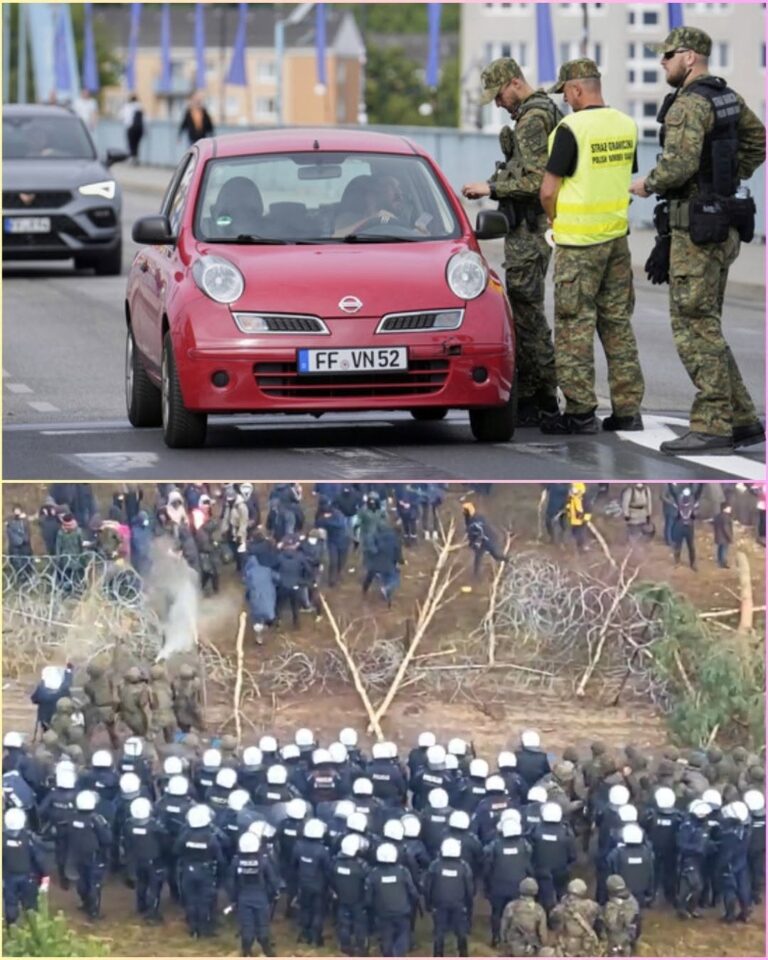
Images circulating online show soldiers, razor wire and groups of migrants near fortified border areas. Some accompanying social-media posts describe a dramatic new “border standoff” in which a large migrant group was turned back. The broad theme is consistent with real tensions on Poland’s eastern frontier, but the precise incident depicted in any individual photograph or viral post should not automatically be treated as established without information about where and when the images were taken.
What can be established from recent official Polish reports is that attempts to cross the Belarusian frontier have continued — although on a dramatically smaller scale than during the same period in 2025.
On September 8, Poland’s Border Guard said that more than 50 attempted unauthorised crossings had been recorded over several days in the area administered by the Narewka Border Guard post. According to the agency, most of those involved retreated further into Belarus after encountering Polish security personnel, while the remaining individuals were apprehended. (Straż Graniczna)
Two days later, the Podlaskie Border Guard reported another significant episode. Authorities said 24 attempted crossings were recorded on September 9, again around Narewka. According to the Border Guard, people attempting to enter Poland used ladders in an effort to overcome the border infrastructure. Most withdrew toward Belarus after encountering Polish patrols, while those who did not were detained. (Podlaski Oddział Straży Granicznej)
That official account is important because it provides a more precise description than some of the dramatic language accompanying images on social media. The Border Guard described attempted unauthorised crossings and interventions by Polish personnel; it did not, in the cited announcement, describe a mass breakthrough of the frontier.
Further incidents followed.
For the weekend of September 11–13, the Border Guard reported seven attempted crossings in areas covered by the Narewka and Michałowo posts. Some people attempted to cross over land, while others tried to use the Świsłocz River. Polish authorities said everyone involved retreated into Belarus after seeing patrols. (Podlaski Oddział Straży Granicznej)
Taken together, the episodes show that pressure has not disappeared from the frontier. But they also reveal something easily lost when dramatic photographs are shared without wider context: the number of recorded attempts has fallen enormously compared with last year.
According to Poland’s Border Guard, more than 430 attempted unauthorised crossings had been recorded in the Podlaskie region by September 10, 2026. During the equivalent period of 2025, the agency says the number exceeded 23,500. (Podlaski Oddział Straży Granicznej)
By September 14, the 2026 total had risen above 440 attempts. (Podlaski Oddział Straży Granicznej)
Those figures come from Polish authorities and therefore represent their official operational statistics. They support Warsaw’s argument that its present strategy has sharply reduced successful and attempted crossings along this particular route. They do not, by themselves, resolve broader disagreements over why migration has fallen, what happens to people prevented from crossing, or whether every aspect of Poland’s border and asylum policy complies with international and European legal obligations.
That distinction matters because the Poland-Belarus frontier is not simply another European migration route.
For several years, Poland and EU institutions have argued that Belarus has deliberately facilitated migration toward the borders of Poland, Lithuania and Latvia as a means of exerting political pressure on the European Union.
Belarus has rejected accusations that it is responsible for creating the crisis, while European officials have repeatedly characterised the phenomenon as the “instrumentalisation” of migrants.
As recently as August 9, 2026, the European Commission again accused Belarusian authorities of involvement in hybrid attacks on the EU’s external borders, specifically including what it described as the instrumentalisation of migrants for political purposes. (Enlargement and Eastern Neighbourhood)
That geopolitical dimension has fundamentally influenced Poland’s response.
Warsaw does not view the frontier solely through the traditional framework of immigration enforcement. Polish governments have increasingly presented it as a national-security boundary where migration, organised smuggling, Belarusian state activity and wider regional tensions intersect.
The war in neighbouring Ukraine and Belarus’s close relationship with Russia have further intensified those concerns.
For Polish authorities, therefore, a person approaching the barrier irregularly may be part of a migration movement, but the circumstances surrounding that movement may simultaneously be regarded as part of a broader security operation.
Critics of Poland’s approach argue that this security framing can obscure the individual circumstances of migrants themselves.
People reaching the frontier can have very different backgrounds. Some may be economic migrants. Others may have fled conflict or persecution. Some may have paid smugglers after being promised relatively easy access to Europe. Others may have been manipulated or transported toward the frontier by networks operating through Belarus.
International refugee law does not treat all such individuals identically, and determining whether someone qualifies for protection ordinarily requires examining the circumstances of the individual case.
That is where the controversy becomes considerably more complicated than the simple question of whether Poland has the right to defend its border.
Like every sovereign state, Poland controls entry into its territory. It is also an EU member state and a party to international agreements governing refugees and human rights.
Those two responsibilities — border enforcement and access to protection — have repeatedly collided along the Belarusian frontier.
A border transformed by crisis
The current situation has its roots in the migration crisis that began developing along Belarus’s borders with EU countries in 2021.
Thousands of people, many originating from countries in the Middle East, Africa and Asia, travelled to Belarus and subsequently attempted to enter the European Union.
Poland responded by deploying large numbers of border guards, police officers and military personnel.
A physical barrier was constructed along much of the frontier, incorporating fencing, surveillance technology and other security systems.
Additional razor-wire obstacles and electronic monitoring have since reinforced parts of the border.
The objective was straightforward: make unauthorised entry significantly more difficult and give Polish security personnel sufficient warning to intercept people approaching the frontier.
The dramatically lower number of recorded crossing attempts in 2026 suggests that conditions along this route have indeed changed substantially.
Polish Interior Minister Marcin Kierwiński said in April that during the first three months of 2026 Polish services had prevented every recorded attempt to enter illegally from Belarus. The government described that as a 100 percent prevention rate for the period. (Chính phủ Ba Lan)
The Border Guard made a similar claim in September, saying every recorded attempt in its Podlaskie area during 2026 had been prevented. (Straż Graniczna)
Such statistics are central to the Polish government’s argument that physical infrastructure combined with patrols, surveillance and legal changes has made the frontier significantly more secure.
Yet numbers alone cannot settle the political or legal debate.
A decline in crossings may indicate successful deterrence. It may also reflect changing migration routes, decisions by smugglers, developments in Belarus or other external factors. Several influences can operate simultaneously.
And behind every statistic are individuals whose circumstances are rarely visible in photographs of the frontier.
Poland’s controversial asylum restrictions
One of the most consequential elements of Poland’s strategy has concerned access to international protection.
In March 2025, Poland introduced a mechanism allowing the temporary territorial restriction of the right to apply for international protection at the Belarusian border under specified circumstances.
The government repeatedly extended that measure.
On May 21, 2026, Poland’s Interior Ministry announced another 60-day extension, saying Parliament had approved continuation of the restriction and describing it as necessary because of continuing security concerns at the Belarusian frontier. It was the seventh extension since the mechanism first took effect in March 2025. (Chính phủ Ba Lan)
The government argued that restricting asylum applications at this particular border discouraged people from using the Belarus route and reduced migration pressure.
Supporters of the policy contend that conventional asylum procedures were being exploited in circumstances deliberately engineered by an unfriendly neighbouring government.
From this perspective, allowing a state to create migration pressure and then requiring Poland to process everyone arriving through that mechanism could encourage further attempts.
Human-rights organisations and legal advocates have approached the issue differently.
Their concern is that measures designed to deter irregular migration must not prevent people with genuine protection claims from accessing procedures required under refugee and human-rights law.
The dispute therefore involves two principles that are sometimes presented as opposites but legally coexist: states possess authority over their borders, while people facing persecution may possess rights to seek protection.
Determining how those principles apply during an alleged state-sponsored migration operation has become one of Europe’s most difficult border-policy questions.
What does “turned back” actually mean?
The phrase can sound straightforward in a headline.
Operationally and legally, however, several very different events can be described that way.
Someone approaching a barrier may see Polish officers and voluntarily retreat before reaching Polish territory.
Someone may attempt to climb or damage the barrier and be physically prevented from entering.
A person may cross and subsequently be apprehended.
Another individual may present themselves to authorities and request protection.
Each scenario can involve different legal considerations.
This is why precise descriptions are especially important when reporting events along the Belarusian frontier.
For example, the Border Guard’s September 14 statement says that seven migrants attempting crossings during the preceding weekend withdrew into Belarus when they saw Polish patrols. (Podlaski Oddział Straży Granicznej)
That description is materially different from saying seven asylum seekers were formally processed by Polish authorities and subsequently expelled.
Similarly, the September 10 announcement says most people involved in the 24 attempts withdrew toward Belarus while the remaining individuals were detained. (Podlaski Oddział Straży Granicznej)
Those distinctions can disappear when an incident is compressed into a few words on social media.
The frontier is also an EU border
Although Polish officers physically guard the line, the Belarusian frontier is also part of the European Union’s external border.
Someone entering Poland without authorisation has entered the Schengen area unless subsequently detained or otherwise prevented from continuing.
That gives the Polish debate a European dimension.
Governments elsewhere in the EU have an interest in how Poland manages the frontier because irregular migration does not necessarily end in the country where a person first enters.
This helps explain why migration has repeatedly produced arguments over responsibility between EU governments.
Countries on the external frontier have often argued that they bear a disproportionate burden.
Governments farther from external borders have sometimes emphasised the need for common asylum standards and shared responsibility.
Others have resisted mandatory relocation schemes.
The EU’s migration framework has consequently tried to reconcile several competing objectives: securing external borders, processing asylum applications, returning people without a legal right to remain, assisting states facing unusually heavy pressure and distributing responsibility more broadly across the bloc.
Those reforms entered an important new phase in 2026.
The European Commission said in June that new migration and asylum rules entering application included accelerated procedures during crises, additional operational assistance for states under disproportionate pressure, emergency funding and mechanisms specifically intended to respond to the political instrumentalisation of migration. (Migration and Home Affairs)
The system also contains solidarity mechanisms allowing assistance to take different forms, including relocation or financial and operational contributions.
This means Poland’s experience is increasingly influencing European policy rather than existing outside it.
Sovereignty versus European coordination?
The political language surrounding the frontier frequently frames the question as a contest between Polish sovereignty and EU migration policy.
Reality is more complicated.
Poland retains responsibility for protecting its national border.
But that same boundary is simultaneously part of the EU’s external frontier, meaning its security affects other member states.
European Commission President Ursula von der Leyen highlighted precisely this connection in her September 16 State of the Union address, arguing that Europe’s external borders should be regarded as shared European borders and calling for a coordinated approach to security and migration. (Migration and Home Affairs)
The statement illustrates how European policy has evolved since the migration crisis of the mid-2010s.
Border security now occupies a much more prominent position in EU migration discussions.
At the same time, disputes continue over how enforcement should interact with asylum law and humanitarian protections.
Poland’s border is therefore becoming a test case for the emerging European approach.
Why Belarus matters
The involvement of Belarus distinguishes this situation from many other migration routes.
Migration across the Mediterranean, for example, often involves networks operating from politically unstable regions and dangerous maritime journeys.
The Polish-Belarusian route presents a different strategic problem because the EU alleges that a neighbouring government has actively helped create or exploit migration pressure.
If migration is deliberately facilitated by another state for geopolitical purposes, European governments face a difficult question.
Should they respond primarily through ordinary immigration procedures?
Or should the activity be treated partly as a hostile security operation?
Poland has moved decisively toward the second interpretation.
The European Commission has increasingly acknowledged the security dimension as well.
That does not eliminate humanitarian responsibilities, however.
Indeed, the central difficulty is that geopolitical manipulation and genuine human vulnerability can exist simultaneously.
A migrant can be exploited by smugglers or state actors and still have legitimate protection needs.
Those realities are not mutually exclusive.
What the falling numbers tell us
The most striking development in 2026 is therefore not that attempted crossings continue.
It is how dramatically their number appears to have fallen.
More than 23,500 attempts were recorded by Polish authorities during the comparable period of 2025, versus slightly more than 430 by September 10 this year. (Podlaski Oddział Straży Granicznej)
That represents an enormous shift.
Several possible explanations deserve consideration.
The reinforced physical barrier may simply be much harder to penetrate.
Electronic surveillance may allow patrols to respond more quickly.
The presence of Polish soldiers and Border Guard personnel may discourage attempts.
Changes to asylum procedures may reduce the perceived likelihood of successfully remaining in Poland.
Smuggling networks may also have redirected migrants toward alternative routes.
And conditions on the Belarusian side may have changed.
Establishing the relative contribution of each factor requires more evidence than crossing statistics alone provide.
Nevertheless, from Warsaw’s perspective, the decline supports the argument that its deterrence strategy has achieved its immediate operational objective.
Yet migration pressure can move
Europe’s experience over the past decade demonstrates that migration routes are rarely static.
When one pathway becomes more difficult, networks may search for another.
That creates what policymakers sometimes describe as displacement effects.
Stronger enforcement on one border can reduce pressure locally without necessarily reducing the number of people trying to reach Europe overall.
That is one reason European institutions increasingly emphasise cooperation beyond individual national borders.
Policies now encompass relations with countries of origin and transit, action against smuggling organisations, faster decisions on asylum applications, returns of people found not to qualify for protection and legal pathways for migration.
Border infrastructure represents only one part of that larger system.
The security forces themselves face unusual conditions
The Polish-Belarusian frontier is also challenging for the personnel deployed there.
Officers patrol forests, wetlands and river areas as well as fortified sections of the boundary.
They may encounter individuals attempting to climb barriers, cut fencing or cross waterways.
They must distinguish between routine migration attempts, smuggling operations and potentially organised provocations.
Authorities must simultaneously document encounters that could later become matters of legal or political scrutiny.
That environment creates considerable operational complexity.
A photograph showing soldiers beside coils of razor wire captures only a small part of that reality.
Migrants are not a single category
Public discussions can also become misleading when everyone approaching the border is treated as belonging to one homogeneous group.
Migration movements normally contain people with very different motivations and histories.
Economic opportunity may be the principal motivation for some.
Others may fear political persecution.
Some may be escaping conflict.
Families may travel with children.
Individuals may also receive inaccurate information from smugglers about what will happen after reaching an EU border.
Those distinctions matter because asylum law focuses on individual circumstances rather than simply nationality or route of arrival.
At the same time, governments argue that allowing irregular entry without effective controls can encourage smuggling and undermine public confidence in legal migration systems.
Both issues are part of the policy challenge.
What happens next?
For the moment, Poland’s eastern frontier appears far less active than it was during periods of intense migration pressure.
But the September incidents demonstrate that the route has not disappeared.
Polish authorities continue to patrol the region extensively, and sections of the border remain subject to exceptional security arrangements.
Official Polish border information in September also continued to list some Belarus crossing points, including Połowce and Sławatycze, as temporarily suspended for border traffic. (Granica)
Future developments will depend partly on Belarus.
If larger numbers of migrants once again begin approaching the frontier, Poland is unlikely to abandon the infrastructure and security strategy it has constructed over recent years.
The European response will also matter.
The EU’s revised migration rules now explicitly contemplate circumstances in which migration is deliberately used to destabilise a member state. (Migration and Home Affairs)
That gives countries such as Poland a stronger European framework for arguing that events on their borders cannot always be understood solely as conventional asylum situations.
Yet legal and humanitarian scrutiny will remain.
European governments must continue determining where legitimate border enforcement ends and obligations toward individuals seeking protection begin.
There is unlikely to be a simple formula capable of resolving every encounter.
A quieter border — but not a settled argument
The latest Polish figures therefore tell two stories at once.
The first is an operational story.
Crossing attempts recorded along this part of the Belarusian frontier have fallen dramatically compared with 2025, and Polish authorities say recent attempts have been prevented. (Straż Graniczna)
The second is a political and legal story that remains unresolved.
Europe is still debating how far governments should go to secure external borders, how asylum systems should operate during deliberately engineered migration pressure, what solidarity other EU countries owe frontline states and what safeguards must remain available to vulnerable individuals.
The photographs of soldiers, migrants and razor wire understandably attract attention.
But the larger story cannot be reduced to a single confrontation.
Poland’s Belarus frontier has become one of the places where three major issues of contemporary Europe intersect: national sovereignty, migration management and geopolitical security.
Warsaw’s current strategy is built around the argument that a state must retain effective control of its territory, particularly when authorities believe migration is being deliberately manipulated from across the border.
Humanitarian organisations and legal observers, meanwhile, continue to stress that border security does not eliminate the obligation to consider the rights and circumstances of individual migrants.
The European Union increasingly recognises both the need for stronger external-border management and the particular danger posed by the political instrumentalisation of migration.
That leaves policymakers with a difficult balance.
A border must be enforceable if immigration rules are to have practical meaning.
An asylum system must also remain capable of identifying people who genuinely require protection if international commitments are to have practical meaning.
And when a neighbouring state is accused of exploiting vulnerable people as an instrument of geopolitical pressure, those two responsibilities become considerably harder to separate.
For now, the available official evidence points to continued but greatly reduced crossing attempts on Poland’s border with Belarus, rather than a return to the scale of pressure seen in 2025.
Whether that represents a lasting transformation or merely another phase in a rapidly changing migration route remains uncertain.
What is clear is that every new incident at this frontier will continue to resonate far beyond the forests and barriers of eastern Poland.
Because the question facing Europe is no longer simply who crossed the border.
It is how democratic states can simultaneously protect their borders, uphold their legal obligations, resist geopolitical pressure and decide collectively who bears responsibility when all three challenges arrive at the same frontier.