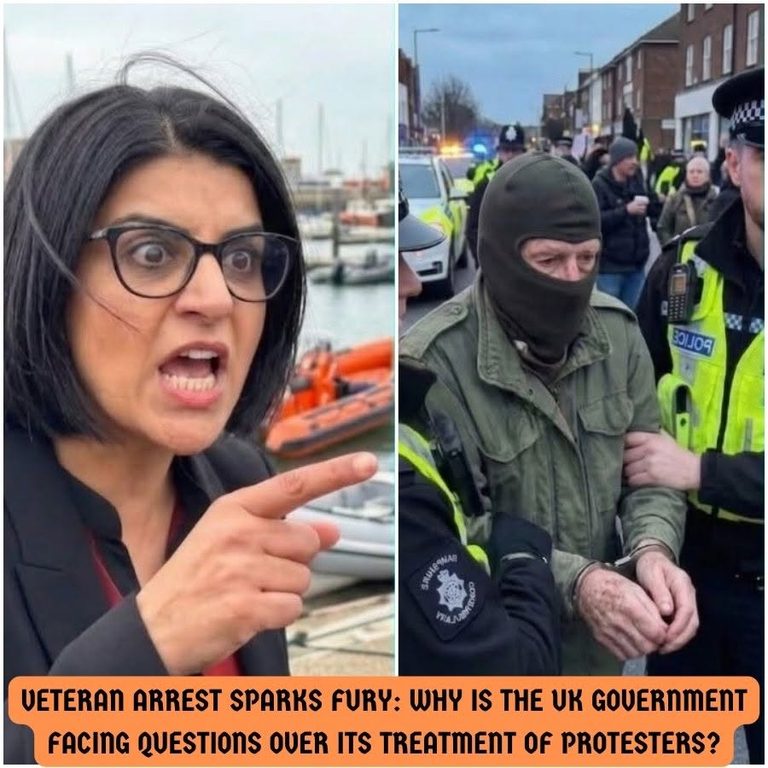
Portsmouth was plunged into a tense overnight stand-off after around 500 protesters gathered to stop coaches leaving a marina where 140 migrants had been brought ashore.

Portsmouth on Edge: Riot Police Face Protesters After 140 Channel Migrants Brought Ashore
PORTSMOUTH — A tense confrontation over Britain’s Channel migration crisis erupted on the streets of Portsmouth after hundreds of protesters gathered near a marina where approximately 140 migrants had reportedly been brought ashore, leading to an hours-long stand-off with police as demonstrators attempted to prevent coaches from leaving the area.
What began as a protest over the arrival of migrants rapidly developed into a major public-order operation.
Around 500 people were reported to have gathered near the waterfront, with crowds blocking the marina’s only access road and attempting to stop vehicles carrying the newly arrived migrants from departing.
As darkness fell, tensions intensified.
Police officers in protective equipment formed lines between demonstrators and vehicles. Shields were deployed as officers attempted to clear the route, while pepper spray was reportedly used during confrontations with members of the crowd.
For Portsmouth, a city whose identity has been shaped by the sea for centuries, the scenes represented something new and politically explosive.
The Channel migration crisis was no longer something happening primarily around Dover and Kent.
It had arrived directly on Portsmouth’s waterfront.
140 Migrants, One Marina — and a City Suddenly in the Spotlight
The confrontation followed the reported rescue of approximately 140 migrants from a vessel in the English Channel.
They were subsequently brought to the Portsmouth area, creating an unexpected challenge for local authorities.
News of their arrival spread quickly.
Protesters began gathering near the marina, and what might otherwise have been a relatively contained transfer operation became the centre of a much larger demonstration.
The crowd reportedly attempted to block coaches from leaving through the marina’s sole road connection.
That created an immediate operational problem.
Police needed to keep the route open, maintain public safety and prevent the confrontation from escalating — while demonstrators sought to make their opposition to the transfer impossible to ignore.
Videos and accounts circulating from the scene showed an increasingly tense atmosphere as officers and protesters confronted one another at close range.
Riot Police Move In
As the stand-off continued, police adopted increasingly robust crowd-control measures.
Officers equipped with shields moved against sections of the crowd in an attempt to restore access.
Pepper spray was reportedly deployed during some of the confrontations.
The situation illustrates the difficult position facing police whenever political protest turns into the physical obstruction of vehicles or infrastructure.
Peaceful protest is a fundamental democratic right.
But authorities also have a responsibility to keep roads accessible and protect individuals being transported through potentially hostile crowds.
The moment protesters attempt physically to prevent vehicles from moving, the situation can shift from political demonstration to public-order enforcement.
That appears to have been the critical point in Portsmouth.
For protesters, blocking the coaches was a dramatic way of demanding that authorities listen to their objections.
For police, clearing the route became a question of maintaining order.
The result was confrontation.
‘Portsmouth Is Not Set Up for This’
Perhaps the most politically significant development, however, was not what happened between protesters and police.
It was the warning reportedly issued by a senior policing figure that Portsmouth was “not set up” to deal with a new pattern of Channel arrivals.
That statement goes directly to the heart of a potentially much bigger problem.
For years, Dover and the Kent coast have been the places most closely associated with small-boat crossings.
Infrastructure, policing operations and government procedures have consequently developed around that geography.
But if changing rescue patterns mean migrants are increasingly brought ashore at other southern ports, local authorities could suddenly face responsibilities for which they were never designed.
Where will rescued migrants initially be processed?
Who provides security?
How quickly can transportation be arranged?
What happens when hundreds of protesters arrive?
And how much additional policing capacity will coastal cities need if such incidents become regular rather than exceptional?
Portsmouth could therefore represent more than a one-night confrontation.
It could be a warning about how Britain’s migration crisis is changing.
Why Were Migrants Brought to Portsmouth?
That question is likely to dominate the aftermath.
People rescued from the Channel must be taken somewhere safe.
Weather, vessel locations, operational requirements and the availability of ports can all influence where rescue operations end.
But bringing a significant group of migrants into a city not accustomed to receiving Channel arrivals can have consequences beyond maritime logistics.
Local police suddenly require additional resources.
Roads may need to be secured.
Processing and transport arrangements must be coordinated.
And, as Portsmouth demonstrated, political opposition can mobilize rapidly once information begins circulating online.
That creates a dilemma for national authorities.
If Channel crossings continue, relying on only a small number of established reception points may place enormous pressure on those locations.
Expanding the number of ports used for arrivals, however, risks spreading that pressure — and the accompanying political controversy — into new communities.
Protest, Anger and the Risk of Escalation
The Portsmouth scenes also highlight the increasingly combustible atmosphere surrounding immigration in Britain.
Many people who oppose illegal Channel crossings insist their frustration is directed toward government policy rather than individual migrants.
They argue that years of promises to “stop the boats” have failed to produce the control voters were repeatedly promised.
For them, demonstrations represent frustration with Westminster.
Others warn that protests outside locations where migrants are being transferred can easily become threatening to people who may have just experienced a dangerous sea journey.
There is also the danger that peaceful demonstrators become associated with violence or disorder caused by a smaller number of participants.
Those distinctions matter.
Someone peacefully demanding stronger border controls is not responsible for another person’s assault on a police officer.
Likewise, disagreement with immigration policy does not provide justification for violence against migrants or officers.
The challenge for authorities is preserving the right to protest while preventing demonstrations from becoming physical attempts to interfere with lawful operations.
The Small-Boats Crisis Moves Beyond Dover
Politically, this may be the most important aspect of what happened.
For years, the small-boats crisis has been geographically concentrated in the public imagination.
Dover became its symbol.
Images of Border Force vessels entering Kent were repeated endlessly across television screens and social media.
Portsmouth changes that image.
If arrivals increasingly affect Hampshire and other coastal areas, the politics of the crisis could spread with them.
Residents who previously experienced the issue primarily through national news may suddenly encounter police deployments, blocked roads and migrant transfers directly in their communities.
That could intensify pressure on the government to demonstrate that it has a coherent national strategy.
Police Caught in the Middle
The officers on the ground ultimately have little control over the political decisions behind the crisis.
They do not determine Britain’s asylum laws.
They do not negotiate returns agreements.
They do not decide the government’s immigration targets.
And they cannot prevent boats from departing the French coastline.
Yet when anger over those failures reaches the street, police are often the people standing between the competing sides.
Portsmouth demonstrated that reality vividly.
Officers faced an angry crowd while simultaneously attempting to secure a transport operation involving around 140 newly arrived people.
Every decision — whether to hold position, push the crowd back, use shields or deploy pepper spray — risked becoming part of the political controversy.
A Warning From the Waterfront
Eventually, the crowds will disperse and the coaches will move.
But the questions exposed by the Portsmouth stand-off will remain.
If the city is genuinely “not set up” for repeated Channel arrivals, what happens next time?
Will additional police be deployed?
Will the government designate new reception facilities?
Could other ports face similar demonstrations?
And most importantly, can ministers prevent an already divisive immigration debate from turning repeatedly into confrontations on Britain’s streets?
Portsmouth may have experienced only one turbulent night.
But the images emerging from the waterfront tell a much larger story.
Britain’s Channel crisis is no longer simply about boats crossing a stretch of water.
It is about what happens after they arrive — who receives them, where they are taken, how communities react and whether police can maintain order when national political frustration suddenly explodes at a local level.
Around 140 migrants were brought ashore. Hundreds of protesters came to stop the coaches. Riot police were deployed to clear the way.
And hanging over everything was a warning with implications far beyond Portsmouth:
If this becomes the new pattern of Channel arrivals, are Britain’s coastal cities actually prepared for what comes next?