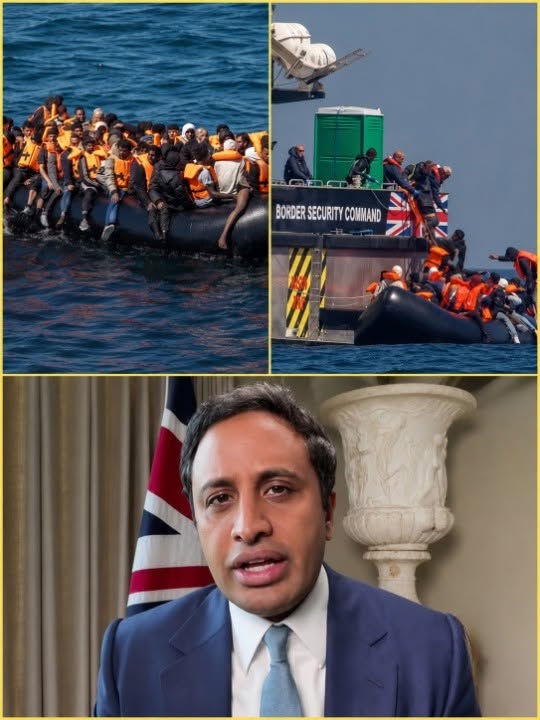
A Viral footage from Spain has reignited Britain’s heatedmigration debate, with Nigel Farage warning that Europe’s border pressures could have consequences for the UK.
Viral Spain Footage Reignites Britain’s Migration Debate as Farage Warns of Wider European Border Pressure
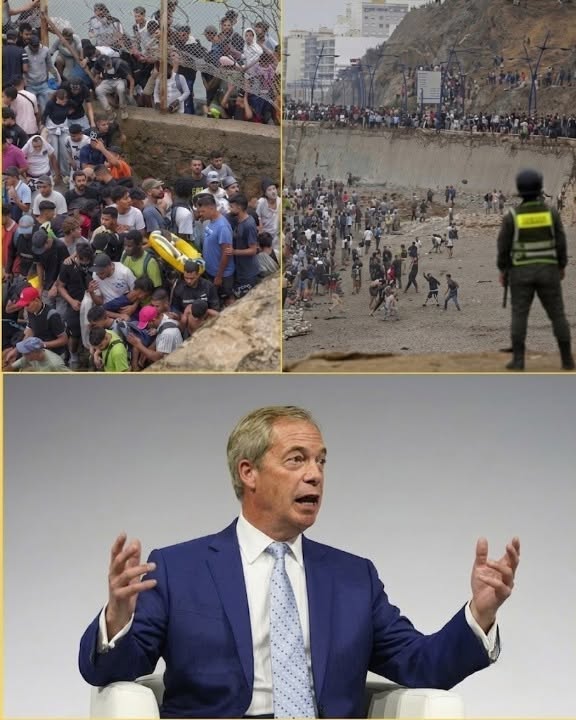
Viral footage from Spain has reignited Britain’s already heated migration debate after scenes from Ceuta, Spain’s North African enclave bordering Morocco, spread rapidly across social media and triggered warnings from Nigel Farage about the consequences for the UK.
The footage showed large numbers of people attempting to enter Spanish territory, with reports describing thousands crossing or trying to cross into Ceuta by land, sea and around border barriers. The scenes quickly became a political flashpoint across Europe, with politicians, commentators and members of the public arguing over border security, asylum policy, migration pressure and whether Europe’s current system is still capable of responding to sudden mass movements.
Farage, the Reform UK leader, seized on the footage as a warning. In remarks reported by Spanish outlet Demócrata, he said Europe needed to “wake up” and linked the crisis to Spain’s migration policies, including its regularisation policy for some undocumented migrants. He warned that border pressure in Spain could eventually have consequences for Britain, including through onward movement toward northern France and the Channel route.
The warning has divided opinion sharply. Supporters say Farage is highlighting a real European problem that mainstream leaders refuse to confront. Critics say he is using dramatic footage to stoke fear and make speculative claims about people moving from Spain to the UK.
What Happened in Ceuta
Ceuta is a Spanish autonomous city on the North African coast. Along with Melilla, it forms one of the European Union’s only land borders with Africa.
The latest crisis was extraordinary in scale. AP reported that tens of thousands of migrants entered Ceuta from Morocco between July 30 and July 31, creating a major humanitarian and political crisis. Spanish authorities deployed security forces and tightened controls, while many of those who entered later returned to Morocco.
The Financial Times reported that around 60,000 people attempted to enter Ceuta, many by swimming or moving around coastal barriers, with at least 57 reported deaths. The report said many had prepared for months, sharing route information and equipment advice on social media.
These figures explain why the footage caused such a shock. This was not a routine border incident. It was a sudden mass movement that overwhelmed local capacity and immediately raised questions about Spain’s border preparedness.
Why the Video Spread So Fast
Migration footage spreads quickly because it is visual, emotional and politically powerful.
For people already worried about immigration, the images appeared to confirm their fears: that borders can be overwhelmed and that governments are losing control.
For others, the footage showed desperation, poverty and human danger – people risking their lives because of inequality, instability and lack of opportunity.
That is why the same video can produce completely opposite reactions.
One viewer sees a security crisis.
Another sees a humanitarian crisis.
A third sees a failure of European policy.
All three interpretations are now shaping the debate.
Spain’s Position
The Spanish government has defended its response, arguing that control was restored quickly and that the situation was handled with Moroccan cooperation.
The Guardian reported that Spanish Prime Minister Pedro Sánchez said most irregular migrants had been returned or had gone back to Morocco, while also criticising other European governments for reacting with border restrictions and political pressure. European Commission President Ursula von der Leyen said the EU had offered Spain support from the beginning of the crisis.
Spain’s wider migration picture is more complicated than viral clips suggest. Europa Press reported that irregular migration to Spain from January 1 to July 15, 2026 was actually down 24.7% compared with the same period in 2025, although land entries into Ceuta rose sharply.
That matters because the viral footage shows a dramatic crisis in one place, but not the entire national trend.
Farage’s Argument
Farage’s argument is simple: what happens at Europe’s borders should concern Britain.
He says that if European countries fail to control irregular migration, the consequences will not remain local. In his view, people who enter Spain may eventually move north through Europe, with some attempting to reach France and then the UK by small boat.
This argument resonates with many Reform UK supporters because it connects Spain’s border crisis to Britain’s own Channel crossings crisis.
For them, Ceuta is not just a Spanish issue. It is a warning about what can happen when governments send what they see as the wrong message: enter illegally, and you may eventually be allowed to stay.
Farage has specifically criticised Spain’s regularisation policy, claiming it encourages further arrivals. However, AP’s fact focus noted that some claims around the Ceuta crisis were unsubstantiated and that Spain’s regularisation policy applies to people who arrived before January 1, 2026 and met residence requirements, not to new arrivals during the crisis.
That distinction is important. A political argument can still be made about incentives, but the policy should not be described as automatically applying to everyone shown in the viral footage.
Critics Push Back
Critics of Farage say his warning goes beyond the evidence.
They argue that most people involved in the Ceuta crisis did not reach mainland Spain, let alone northern France or Britain. AP reported that many voluntarily returned to Morocco after the incident and that the crisis remained primarily centred on Ceuta.
Critics also warn that social media clips can tum complex border events into panic narratives. Viral footage rarely explains who people are, why they moved, how many stayed, what legal process applies, or what happened afterward.
That does not mean the footage should be ignored. But it does mean political claims based on it should be tested carefully.
Why Britain Is Watching
Britain is watching because the UK’s own migration debate is already at boiling point.
Small boat crossings, asylum accommodation, deportation policy, human-rights law, border enforcement and Reform UK’s rise have all made immigration one of the defining issues in British politics.
For many voters, the footage from Spain becomes part of a wider European story: governments struggling to control borders while public anger rises.
For humanitarian groups, the same footage shows why Europe needs safer legal routes, faster asylum decisions and stronger international cooperation to prevent dangerous crossings and deaths.
The problem for policymakers is that both concerns are real.
Borders must be managed.
Lives must be protected.
Public trust must be rebuilt.
The Wider European Problem
Ceuta also shows that migration pressure does not affect every European country in the same way.
Spain faces pressure from Morocco, the Atlantic route and the Mediterranean. Italy faces arrivals across the central Mediterranean. Greece faces pressure through the Aegean and land borders. Poland and the Baltic states face pressure from Belarus and Russia-linked migration routes. Britain faces the Channel.
That means European migration policy cannot rely on one solution.
A border crisis in Ceuta is different from a small boat crossing in Kent. But both feed the same political question: can governments control irregular migration while still respecting asylum law and human rights?
That question is now shaping elections across Europe.
A Warning, but Not Proof of Collapse
The viral footage from Spain is a warning.
It shows how quickly a border point can become overwhelmed. It shows how social media can mobilise people, spread routes and amplify pressure. It shows how migration crises can immediately become political crises.
But it is not proof that Europe is collapsing, nor proof that the same scenes are about to happen in Britain.
The facts are more complicated.
Spain faced a sudden and severe crisis in Ceuta. Many people later returned to Morocco. National Spanish irregular arrival figures earlier in July were lower than the previous year, even as Ceuta entries rose sharply.
That complexity matters.
Without it, the debate becomes pure fear.
Conclusion: Spain’s Crisis Becomes Britain’s Argument
The viral footage from Spain has become a new weapon in Britain’s migration debate.
Nigel Farage says the scenes show Europe must wake up before border pressure reaches the UK. Supporters agree, arguing that Britain cannot treat continental migration crises as distant events.
Critics say the warning risks exaggerating the connection between Ceuta and the Channel, while ignoring the legal, humanitarian and local realities behind the footage.
The truth is that Ceuta does matter.
It matters because it shows the pressure on Europe’s external borders. It matters because it exposes the speed at which migration events become political flashpoints. And it matters because it reminds Britain that migration policy is no longer a purely national issue.
But the lesson should not be panic.
It should be seriousness.
Europe needs stronger border management, faster asylum systems, tougher action against smugglers, clearer communication with the public and humane treatment of people caught in dangerous movements.
Britain needs the same.
The footage from Spain may fade from social media feeds, but the debate it has reignited is not going away.