Border Pressures, Viral Footage, and the UK Migration Debate: Why Nigel Farage’s Warning Has Reignited a Divisive Political Discussion
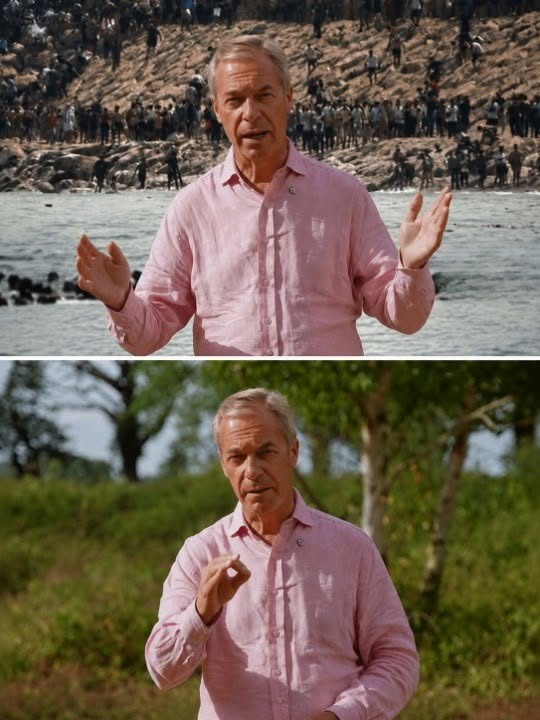
A dramatic video circulating widely on social media has once again placed migration and border security at the center of political debate across Europe. The footage, reportedly filmed near Spain’s borders, appears to show large groups of migrants attempting to enter European territory, prompting renewed discussion about the effectiveness of border controls, humanitarian responsibilities, and the long-term future of migration policy within the European Union. While the exact context and scale of every viral clip can be difficult to verify without official confirmation, the images have attracted millions of views and generated strong reactions from politicians, commentators, and members of the public. Among those responding most forcefully has been Reform UK leader Nigel Farage, who argues that the events shown in the footage reflect a much broader challenge facing Europe and, ultimately, the United Kingdom. His remarks have once again divided opinion, with supporters describing them as a realistic assessment of current migration trends while critics accuse him of overstating the situation and drawing conclusions that extend beyond the available evidence.

The viral footage has spread rapidly across multiple social media platforms, accompanied by a wide variety of captions, interpretations, and political commentary. Some posts claim that tens of thousands of migrants are attempting to cross European borders, while others argue that isolated incidents are being presented as evidence of a much larger crisis. As is often the case with highly shared online videos, individual clips provide only a limited snapshot of broader events. Experts on digital media frequently caution that viral content may lack important contextual information, including the exact date, location, or circumstances in which it was recorded. Nevertheless, the emotional impact of dramatic images can significantly influence public perception, particularly when they relate to topics that already generate intense political debate such as immigration, border security, and national sovereignty.
Spain has long occupied a unique position within Europe’s migration landscape due to its geographical location. As one of the European Union’s southern gateways, the country faces migration pressure through several routes, including the Mediterranean Sea, the Atlantic route toward the Canary Islands, and the land borders surrounding the Spanish enclaves of Ceuta and Melilla in North Africa. Over the past decade, migration flows along these routes have fluctuated considerably depending on conflicts, economic conditions, weather patterns, diplomatic agreements, and law enforcement efforts. At various times, Spanish authorities have reported sudden increases in arrivals, while in other periods crossings have declined substantially following international cooperation or enhanced border enforcement. Because these trends are influenced by many factors, experts generally caution against drawing sweeping conclusions from individual events or short-term increases.
The renewed attention generated by the footage quickly reached British politics, where migration has remained one of the country’s most contentious issues since the Brexit referendum. Nigel Farage argued that the images represent evidence of continuing failures within European border management and suggested that some migrants who first arrive in southern Europe may ultimately seek to travel onward toward the United Kingdom. His comments focused on what he described as weaknesses in current migration policies and questioned whether existing measures are capable of preventing irregular migration across multiple European countries. Farage also claimed that governments have repeatedly underestimated the scale of the challenge and warned that Britain should prepare for additional migration pressures in the future if broader European policies remain unchanged.
Supporters of Farage’s position argue that migration cannot be viewed solely as a humanitarian issue but must also be considered from the perspectives of national security, public finances, housing availability, healthcare capacity, education, and social cohesion. They contend that countries have both the legal authority and the responsibility to control their borders while maintaining orderly immigration systems. Many believe that allowing irregular migration to continue without stronger enforcement risks encouraging criminal smuggling networks, increasing pressure on public services, and weakening public confidence in government institutions. According to this perspective, preventing dangerous unauthorized crossings ultimately protects both migrants and destination countries by reducing incentives for people to undertake hazardous journeys organized by human trafficking networks.
Farage further argued that many politicians have failed to address public concerns honestly, suggesting that successive governments have relied on temporary measures rather than comprehensive long-term strategies. His supporters often point to rising numbers of small-boat crossings across the English Channel in recent years as evidence that existing policies have not achieved their intended objectives. They argue that despite increased funding, international agreements, and legislative reforms, the overall challenge remains unresolved. From this viewpoint, continued public frustration reflects not simply concem about immigration itself but also declining confidence in governments’ ability to implement effective border policies.
Critics strongly dispute many of Farage’s conclusions. They argue that migration is an extraordinarily complex issue driven by war, political instability, persecution, poverty, climate change, and economic inequality rather than solely by weaknesses in border enforcement. Human rights organizations emphasize that many migrants and asylum seekers are fleeing genuine danger and are entitled under international law to seek protection. Critics also caution against implying that all irregular migrants intend to travel to Britain or that individual viral videos accurately represent broader migration trends. They argue that public discussion should rely primarily on verified data from official sources rather than emotionally compelling online footage whose full context may not always be available.
The debate also highlights broader questions regarding the relationship between European Union member states. Under existing international agreements and European asylum frameworks, responsibility for processing asylum claims has often fallen disproportionately on countries located at the EU’s external borders, including Spain, Italy, Greece, and others. These nations have repeatedly argued that migration management should become a shared European responsibility rather than leaving frontline countries to shoulder the majority of arrivals. At the same time, governments farther north have expressed concerns about secondary migration, in which individuals move between European countries after first entering the continent elsewhere. These competing priorities have complicated efforts to establish common migration policies acceptable to all member states.
Farage has repeatedly advocated significantly stricter border enforcement, arguing that governments should focus on deterrence rather than processing increasing numbers of arrivals. Among the policies he has supported over time are stronger maritime enforcement, expanded deportation powers for individuals without legal permission to remain, faster asylum processing, greater international cooperation against people-smuggling organizations, and stricter eligibility criteria for those seeking long-term residency. He has also emphasized that reducing irregular migration requires addressing incentives that encourage dangerous crossings. Supporters describe these proposals as practical responses designed to restore confidence in border control, while opponents argue that some measures raise important legal, humanitarian, and operational questions.
The concept sometimes described as the “secret” to resolving migration challenges is, in practice, less mysterious than political rhetoric may suggest. Different political leaders propose different solutions based on their ideological perspectives. Some prioritize stronger enforcement, expanded detention capacity, and rapid removals of unsuccessful asylum applicants. Others emphasize legal migration pathways, international development assistance, conflict prevention, refugee resettlement programs, and cooperation with countries of origin and transit. Most independent analysts acknowledge that no single policy alone has successfully resolved irregular migration in every context. Instead, many conclude that durable solutions generally require combinations of border management, diplomatic engagement, humanitarian protection, law enforcement, and economic cooperation.
One of the most controversial aspects of migration debates concerns the role of criminal smuggling networks. European law enforcement agencies have repeatedly warned that organized criminal groups profit substantially from facilitating irregular migration across international borders. These networks often charge migrants significant sums of money while exposing them to dangerous travel conditions. Governments across Europe broadly agree that disrupting these organizations should remain a priority regardless of wider political disagreements over immigration policy. Increased intelligence sharing, financial investigations, and international policing operations have led to numerous arrests in recent years, although authorities acknowledge that smuggling networks frequently adapt their methods in response to enforcement efforts.
Another important dimension involves public confidence in official information. In the age of social media, dramatic videos frequently spread much faster than detailed explanations from governments or journalists. This creates an environment in which emotionally powerful images can influence political discussion before authorities have fully established the facts surrounding a particular incident. Researchers studying misinformation note that this phenomenon affects many political issues, not only migration. Consequently, they encourage audiences to distinguish between verified reporting, political commentary, personal opinion, and unconfirmed online claims. Doing so helps maintain informed public debate while reducing the risk that isolated events will be misunderstood or exaggerated.
Within the United Kingdom, migration has consistently ranked among voters’ highest political priorities. Polling over many years has shown substantial public concern regarding border security, asylum processing times, housing pressures, healthcare demand, labor markets, and overall immigration levels. At the same time, surveys also indicate considerable public support for providing protection to refugees fleeing genuine persecution and conflict. These seemingly contrasting attitudes illustrate that public opinion is often more nuanced than political slogans may suggest. Many voters simultaneously support controlled immigration, effective border enforcement, and humanitarian responsibilities, although they may disagree about where the balance between these objectives should lie.
The political significance of migration extends well beyond domestic policy because it frequently influences elections, coalition negotiations, and broader discussions about national identity. Across Europe, parties advocating stricter immigration policies have gained increased electoral support in several countries over recent years, reflecting growing public concern about migration management, integration, and security. Meanwhile, parties favoring more humanitarian approaches argue that immigration can contribute positively to aging societies, labor shortages, innovation, and economic growth when managed effectively. The resulting political landscape remains highly polarized, with governments often facing pressure from competing constituencies demanding very different policy responses.
Economic considerations further complicate the discussion. Supporters of increased immigration frequently note that many European economies depend upon migrant workers in sectors experiencing labor shortages, including healthcare, agriculture, hospitality, logistics, construction, and technology. They argue that carefully managed legal migration contributes to economic growth and helps address demographic challenges associated with aging populations. Opponents respond that irregular migration differs fundamentally from legal immigration because governments cannot effectively plan for housing, employment, education, or healthcare needs when arrivals occur outside established legal frameworks. They contend that stronger border control is therefore compatible with maintaining legal immigration systems designed to meet economic needs.
Humanitarian organizations continue emphasizing that migration statistics represent individual human lives rather than abstract political numbers. Many migrants undertake dangerous journeys after fleeing armed conflict, persecution, political repression, environmental disasters, or severe economic hardship. International refugee law establishes protections for individuals facing genuine persecution, while governments simultaneously retain authority to regulate immigration according to domestic legislation. Balancing these sometimes competing responsibilities remains one of the central challenges confronting democratic societies. Political disagreements often arise not over whether humanitarian obligations exist, but over how they should be implemented alongside border security and immigration enforcement.
Diplomatic cooperation has become increasingly important as migration routes cross multiple countries before reaching final destinations. European governments continue negotiating agreements with countries of origin and transit concerning border management, development assistance, readmission arrangements, and anti-smuggling cooperation. Supporters argue that addressing migration closer to its source may reduce dangerous journeys while improving regional stability. Critics caution that some agreements require careful monitoring to ensure compliance with international human rights standards and refugee protections. Consequently, migration diplomacy has evolved into a significant component of European foreign policy alongside traditional security and economic priorities.
Media coverage itself also shapes public understanding of migration. Dramatic images understandably attract attention because they convey immediate emotional impact, but experts often note that comprehensive reporting requires additional context regarding historical trends, official statistics, legal frameworks, and policy developments. Individual videos may accurately depict real events while still representing only one part of a much larger picture. Responsible journalism therefore attempts to combine compelling visual evidence with careful verification and balanced analysis, allowing audiences to evaluate events within their broader political and social context rather than relying solely on isolated footage.
As Britain continues debating its future immigration strategy, politicians across the political spectrum are likely to face increasing pressure to demonstrate that their proposed policies can achieve measurable results. Voters will ultimately evaluate not only political rhetoric but also practical outcomes, including processing times, border security, integration, public service capacity, and compliance with domestic and international legal obligations. Regardless of ideological differences, most participants in the debate agree that effective migration management requires credible administration, transparent communication, and sustained international cooperation.
The viral footage from Spain has therefore become more than simply another widely shared social media video. It has evolved into a symbol within a much broader conversation about Europe’s future, Britain’s relationship with continental migration pressures, and competing visions of how democratic societies should balance security, humanitarian responsibility, economic needs, and the rule of law. Nigel Farage’s warning has intensified that discussion, but it remains only one perspective within an ongoing debate involving governments, opposition parties, researchers, humanitarian organizations, law enforcement agencies, and millions of citizens across Europe. Whether future developments validate or challenge his predictions will depend not on political rhetoric alone but on evolving migration patterns, policy implementation, international cooperation, and evidence gathered over time. In the meantime, the conversation surrounding migration is likely to remain one of the defining political issues facing both the United Kingdom and Europe for years to come.