Policing Row Erupts as Sadiq Khan Faces Tough Questions Over Resources, Technology and Public Safety in London
A series of confrontations at City Hall has intensified scrutiny of the Metropolitan Police’s finances and Mayor Sadiq Khan’s policing decisions. Critics warn that financial pressures could affect frontline capacity, while the Mayor argues that record City Hall investment and responsible oversight are essential to keeping London safe.
A familiar argument returns to City Hall—with higher stakes
Policing has once again become one of the most contentious issues in London politics.
A series of exchanges at Mayor’s Question Time has placed Mayor Sadiq Khan under pressure over Metropolitan Police resources, officer numbers, neighbourhood policing and controversial technology decisions.
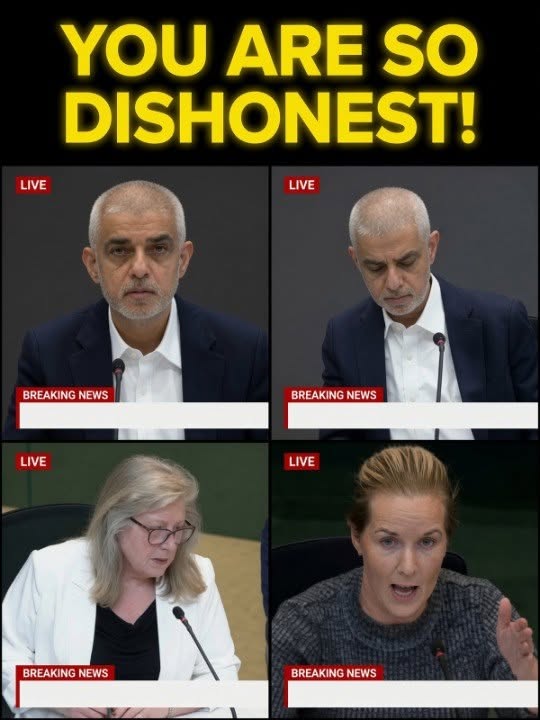
Images circulating online present the confrontation in characteristically dramatic terms. One prominent graphic declares “YOU ARE SO DISHONEST!”, showing Khan alongside London Assembly members during what appears to be a heated scrutiny session.
Such presentation should not itself be treated as evidence of what was said. The words appearing on a social-media graphic cannot automatically be attributed to any person pictured unless the underlying exchange is independently verified.
The wider political dispute, however, is real.
Official London Assembly records show that Khan has repeatedly faced questions during 2026 about potential real-terms reductions in police resources, frontline capacity and whether the Metropolitan Police has sufficient money to meet the demands placed upon it. (Chính phủ London)
At the same time, Khan points to substantial City Hall investment and argues that London’s policing challenges cannot be understood without considering the national funding settlement facing the Metropolitan Police.
The disagreement therefore goes considerably beyond one heated exchange.
At its centre is a fundamental question:
Does London currently have enough policing capacity to deliver the level of public safety its residents expect—and who should be held responsible when resources fall short?
The Metropolitan Police operates on an extraordinary scale
London presents policing challenges unlike those faced by almost any other British city.
The Metropolitan Police must provide everyday neighbourhood policing across a population exceeding nine million while simultaneously dealing with organised crime, terrorism, demonstrations, major sporting events, diplomatic protection and the security requirements associated with the capital’s national institutions.
London is also a global transport and tourism hub.
Millions of visitors move through the city.
Major political demonstrations regularly take place.
International events can require extensive security operations.
The Met therefore performs both local and national functions.
This distinction has become central to Khan’s funding argument.
He maintains that London needs policing resources reflecting the unusual responsibilities placed upon the capital.
His critics respond that whatever the national funding situation, the Mayor must still be judged on the decisions he makes with the resources available to him.
Both arguments contain an important element of truth.
The real-terms funding question
Official records show how directly the funding dispute has entered Mayor’s Question Time.
At the 26 February 2026 session, Conservative London Assembly member Susan Hall asked Khan how much Metropolitan Police funding was projected to fall in real terms during the following three years.
Another question specifically cited an estimate that frontline policing could experience a £113 million real-terms reduction over that period. (Chính phủ London)
A separate question pointed out that Met net expenditure was forecast to rise from approximately £4.6 billion in 2025–26 to £4.8 billion in 2028–29 and asked whether this nevertheless amounted to a real-terms reduction once inflation was taken into account. (Chính phủ London)
This illustrates why debates over “cuts” can become confusing.
A budget can increase in cash terms while declining in real terms.
If wages, equipment, technology, energy, vehicles and other operational costs rise faster than the amount of additional funding, an organisation may technically receive more pounds while possessing less purchasing power.
Politicians can therefore appear to contradict one another while describing different measurements.
One side says:
“Funding has increased.”
Another says:
“Resources have been cut.”
Depending on whether they are discussing nominal or inflation-adjusted spending, both statements can potentially describe aspects of the same budget.
Frontline policing is where the argument becomes politically dangerous
Budget terminology matters to economists.
For the public, the more immediate question is simpler:
Will there be enough police officers available when people need them?
That is why warnings about frontline reductions generate such intense political reactions.
People experience policing locally.
They notice whether officers patrol high streets.
They notice response times.
They notice whether antisocial behaviour is challenged.
Businesses notice shoplifting.
Residents notice drug dealing, aggressive behaviour and repeated disorder.
Victims notice whether investigations progress.
The political consequences of reduced visible policing can therefore extend far beyond official crime statistics.
Even when serious crime indicators improve, a perception that everyday disorder is being tolerated can significantly reduce public confidence.
The unresolved question of 38,000 officers
Another revealing exchange concerns the Met’s previous ambition for London to have approximately 38,000 police officers.
In May 2026, Conservative Assembly member Neil Garratt asked what had happened to that ambition.
The official response acknowledged that 38,000 reflected an assessment of the level of policing London would ideally require given the scale and complexity of demand.
But it also said that the figure represented an ideal level unconstrained by available resources.
The response acknowledged that London’s policing continued to operate within significant financial constraints and stressed that the budget ultimately had to be deliverable and sustainable. (Chính phủ London)
That answer exposes the central tension.
London may have an estimate of how many officers it ideally needs.
But identifying the ideal number does not produce the money required to employ them.
The political argument therefore becomes one of responsibility.
Should Khan have allocated more City Hall funding?
Should central government provide substantially more?
Could the Met operate more efficiently?
Could technology compensate for some staffing pressures?
Or does London simply have to accept that policing capacity will remain below the level leaders believe is ideal?
Khan points to record City Hall investment
The Mayor rejects the suggestion that he is indifferent to police resources.
In a response published in May, Khan said his budget had confirmed a £1.26 billion City Hall investment in policing and crime-prevention measures, describing it as record-breaking.
He said the investment was intended to strengthen neighbourhood policing and allow the Met to continue making improvements needed to reduce crime. (Chính phủ London)
That figure forms a major part of the Mayor’s defence.
His argument is essentially that City Hall is already committing unprecedented resources while national financial constraints limit what the Met can ultimately deliver.
Critics challenge that framing.
They argue that Londoners judge political leaders not by whether a spending figure is historically large, but by what happens to police numbers and services.
A record budget can still be inadequate if costs and demand have risen even faster.
That is why the dispute cannot be resolved simply by quoting the largest number.
Neighbourhood policing has become a crucial test
Neighbourhood policing occupies a special place in the argument because it is the part of law enforcement most visible to ordinary residents.
Residents may rarely encounter specialist counterterrorism teams or organised-crime investigators.
But they notice neighbourhood officers and Police Community Support Officers.
In March 2026, Liberal Democrat Assembly member Gareth Roberts questioned Khan about the decision involving 60 experienced PCSOs and asked how it aligned with the Met Commissioner’s ambition to create what was described as the strongest-ever neighbourhood policing model.
Khan responded by emphasising his commitment to strengthening neighbourhood policing and again pointed to City Hall’s £1.26 billion investment. (Chính phủ London)
The exchange illustrates a recurring difference between strategic and local perspectives.
City Hall may point to total investment.
Residents may focus on whether a familiar officer remains in their neighbourhood.
Both matter.
Then came the Palantir controversy
Perhaps no recent policing decision has demonstrated the complexity of the debate more clearly than the dispute involving technology company Palantir.
The Metropolitan Police had pursued a major data-analytics project intended to increase efficiency.
Khan blocked a proposed £50 million arrangement amid concerns about the procurement process.
According to reporting by the Financial Times, Metropolitan Police Commissioner Sir Mark Rowley warned that losing the expected technological efficiencies could result in around 700 officers being withdrawn from frontline duties.
The Met had hoped automation would allow substantial staffing reductions to be achieved without an equivalent reduction in frontline capacity. (Financial Times)
The Times similarly reported warnings that hundreds of frontline positions could be affected and that the Met was facing substantial job reductions unless alternative savings were found. (The Times)
This immediately created an explosive political narrative:
Had the Mayor’s intervention against a technology contract inadvertently placed police officers at risk?
Khan’s side of the Palantir argument
The Mayor’s position was more complicated than simply opposing police technology.
His office raised concerns about procurement and whether the proposed arrangement represented an appropriate process and value for money.
Khan has subsequently said that police procurement must operate within statutory rules and appropriate oversight requirements.
In response to a London Assembly question concerning Palantir, he noted that procurement legislation limits how public authorities can select or exclude suppliers and said investments above £500,000 are subject to oversight processes. (Chính phủ London)
That argument matters.
Public bodies cannot simply ignore procurement rules because a technology promises operational savings.
A £50 million public contract requires transparency.
Competition matters.
Value for money matters.
Legal compliance matters.
And when technology is intended for policing, questions about data, accountability and public trust become especially important.
The Met’s counterargument: technology can protect frontline capacity
For police leadership, however, the dispute was not merely administrative.
Technology can reduce the amount of time officers spend performing repetitive analytical or bureaucratic tasks.
If software can perform work that would otherwise require hundreds of staff hours, those resources can theoretically be redirected toward operational policing.
That was central to the Met’s argument.
The danger, according to police leadership, was that removing the anticipated technological savings would leave staffing reductions as the remaining alternative.
In other words:
If automation cannot deliver the savings, people may have to.
That makes the dispute considerably more difficult than a straightforward argument about whether technology companies should work with police.
The project did not simply disappear
Subsequent developments further complicated the story.
In June, the Guardian reported that the Met received a 12-month extension for its existing AI pilot while a competitive procurement process was pursued.
The extension meant that technological work could continue temporarily even after Khan blocked the proposed longer-term deal.
The Met continued to emphasise the potential operational benefits of data analysis, while the Mayor’s office maintained that procurement needed to be open, fair and properly justified. (The Guardian)
This development demonstrates why headlines declaring either side completely victorious can be misleading.
The technology debate remained alive.
The procurement route changed.
And the underlying financial problem remained unresolved.
The larger question: can technology compensate for fewer officers?
This is likely to become one of the defining policing debates of the next decade.
Artificial intelligence and data analytics can potentially perform tasks far faster than human analysts.
They can search large datasets.
They can identify connections between cases.
They can prioritise information.
They may reduce administrative burdens.
But technology cannot physically patrol a neighbourhood.
Software cannot arrest a violent suspect by itself.
An algorithm cannot reassure a frightened victim at their front door.
Nor can data analysis entirely replace human judgment.
The most plausible future therefore involves technology supplementing police officers rather than eliminating the need for them.
The political question is how aggressively police forces should pursue those efficiencies—and what safeguards should accompany them.
Surveillance presents another political challenge
Khan’s policing agenda cannot be described simply as hostile to technology.
On 12 August, the Metropolitan Police announced plans for permanent live facial-recognition infrastructure on Oxford Street, with expansion into other areas expected later.
The Mayor supports live facial recognition as a potential public-safety tool while stressing transparency and accountability.
Civil-liberties organisations strongly disagree, warning about privacy, surveillance and possible discriminatory effects. (The Guardian)
That controversy illustrates the Mayor’s more nuanced position.
Khan is not rejecting technological policing in principle.
Instead, the disputes concern which technologies should be deployed, how they are procured, how they operate and what safeguards exist.
Critics may still conclude that his individual decisions are wrong.
But portraying the debate simply as “technology versus no technology” misses important context.
Public safety cannot be reduced to officer numbers alone
Police numbers matter.
But they are not the only variable affecting crime.
Deployment matters.
Investigative quality matters.
Intelligence matters.
Technology matters.
Prosecution matters.
Prison capacity matters.
Youth services matter.
Drug markets matter.
Economic conditions matter.
And the willingness of victims and witnesses to cooperate with police matters.
A force with more officers can still perform badly if those officers are inefficiently deployed.
A force with fewer officers can sometimes achieve strong results through better intelligence and targeting.
Nevertheless, there is obviously a point below which staffing shortages affect service.
The dispute is therefore not whether numbers matter.
It is how much they matter relative to everything else.
Crime statistics and public perception can tell different stories
Another difficulty facing Khan is the gap that can emerge between statistical trends and everyday experiences.
Political leaders frequently point to falling categories of crime.
Critics respond with individual incidents or descriptions of neighbourhood disorder.
Both approaches can be misleading if used selectively.
A single horrific crime does not necessarily prove that crime across London is increasing.
Likewise, a citywide statistical decline does not mean every neighbourhood feels safer.
Crime is unevenly distributed.
Some communities can improve dramatically while others deteriorate.
Different offences can also move in opposite directions.
A responsible assessment therefore needs multiple indicators rather than one headline statistic.
The Mayor’s critics want accountability closer to home
Khan has frequently argued that national government decisions have major consequences for Metropolitan Police finances.
That is undoubtedly true.
Central government provides significant policing resources and sets national financial frameworks.
But opponents argue that a directly elected Mayor cannot continually attribute difficulties to Westminster.
The Mayor controls substantial budgets.
He sets policing priorities through the mayoral governance system.
He appoints leadership within the relevant oversight structures.
He has political influence over strategic direction.
Therefore, critics say, accountability must eventually reach City Hall.
This is a legitimate democratic argument.
The difficult question is how responsibility should be divided.
Central government cannot escape scrutiny either
The opposite argument is equally strong.
London’s Mayor cannot independently create unlimited police funding.
National taxation, Home Office grants and broader government spending decisions substantially determine available resources.
The Met also performs national functions that go beyond ordinary municipal policing.
Protecting Parliament, major diplomatic events and counterterrorism operations benefits the entire country.
If those responsibilities impose exceptional costs, there is a reasonable argument that national government should recognise them adequately.
The policing debate therefore becomes distorted when presented as though either the Mayor or Westminster possesses total control.
Responsibility is shared.
Political credit and blame should reflect that.
Mayor’s Question Time exists precisely for confrontations like this
The intensity of the exchanges should also be understood within the institutional purpose of the London Assembly.
Assembly members are supposed to scrutinise the Mayor.
That means asking uncomfortable questions.
Susan Hall made precisely that point during a July 2026 session, reminding colleagues that the Assembly is a scrutiny body and arguing that its role is to press the Mayor rather than simply provide opportunities for favourable answers. (Chính phủ London)
Heated questioning is therefore not evidence that London government has broken down.
It is part of the accountability mechanism.
The relevant question is whether those exchanges produce useful information.
Viral political graphics create a different impression
Social media frequently transforms scrutiny into spectacle.
A complicated exchange about inflation-adjusted budgets becomes:
“Khan exposed.”
A disagreement over procurement becomes:
“Mayor destroys policing.”
A defensive answer becomes:
“He refuses to answer.”
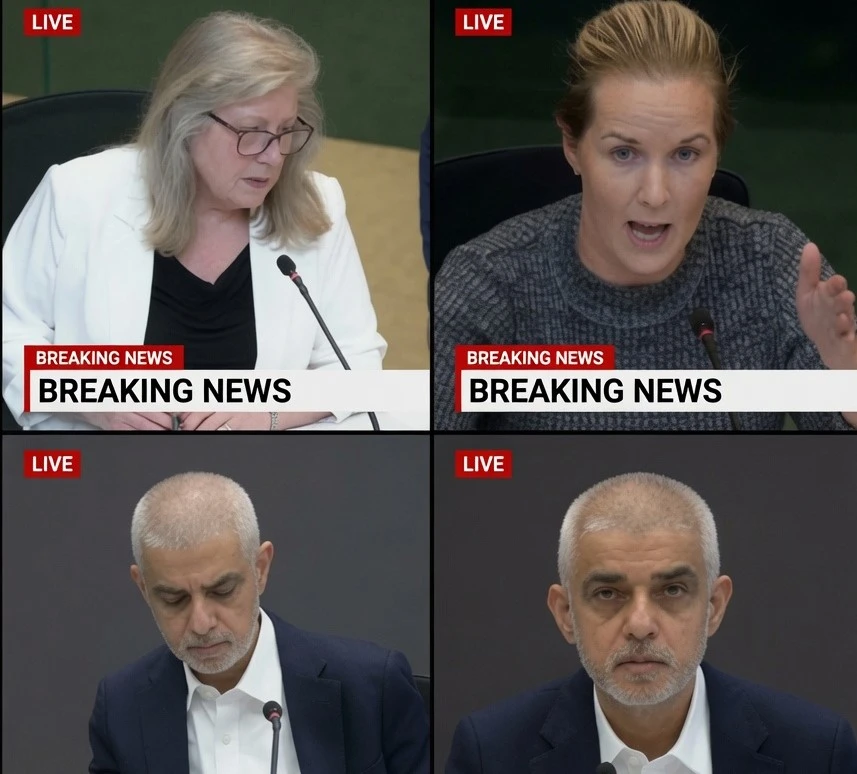
And photographs from different moments can be assembled into a single graphic that appears to document one dramatic confrontation.
The image accompanying the latest claims should therefore be interpreted cautiously.
The people pictured may indeed have participated in political scrutiny.
But the headline “YOU ARE SO DISHONEST!” should not automatically be attributed to an Assembly member without an original transcript or recording establishing who said it and in what context.
That distinction matters.
London’s policing problem is partly financial and partly strategic
If London simply needed more money, the solution would theoretically be straightforward: provide more money.
Reality is more difficult.
Public finances are constrained.
Every additional pound allocated to policing is unavailable for something else unless taxes or borrowing increase.
Government therefore faces unavoidable trade-offs.
That means the Met must also determine how to use existing resources more efficiently.
Should more officers be placed in neighbourhood teams?
Should specialist units receive priority?
Should AI reduce administrative work?
Should more functions be civilianised?
Should police stop responding to certain non-criminal incidents?
These are operational decisions with real consequences.
The public wants visible policing
Whatever experts conclude about optimal deployment, visible policing retains enormous political importance.
People generally want to see officers in their communities.
Visible patrols can provide reassurance.
They can improve local intelligence.
Officers can develop relationships with businesses and residents.
They can identify patterns of antisocial behaviour before problems escalate.
That is why neighbourhood policing frequently becomes politically symbolic.
A reduction in local officers may generate considerably more public concern than an equivalent reduction in a less visible administrative unit.
For Khan, preserving confidence therefore requires more than maintaining total spending.
Londoners need to believe policing remains accessible.
Police morale also matters
Budget pressure does not affect only numbers.
It affects workloads.
Officers asked to cover larger areas or manage more cases can experience burnout.
Investigators carrying excessive caseloads may struggle to progress them quickly.
Neighbourhood officers repeatedly redeployed to emergency duties cannot build long-term relationships with communities.
Staff reductions can therefore create second-order effects.
The remaining workforce may become less effective even before overall headcount reaches a visibly critical level.
Financial debates should take that into account.
What would constitute a genuine policing “cut”?
Politicians should be clearer when using this term.
A cut might mean:
a reduction in total cash spending;
a reduction after inflation;
a reduction in officer numbers;
a reduction in police staff;
a reduction in neighbourhood resources;
a reduction in planned future growth;
or a service reduction caused by rising costs.
Those are different things.
The public deserves to know which one is being discussed.
When political parties use the word “cut” without explaining the measurement, debate becomes unnecessarily confusing.
Khan’s record cannot be judged from one exchange
The Mayor has been in office for a decade.
That provides a substantial record against which his policing policies can be evaluated.
Supporters point to investment, reforms, prevention programmes and areas where crime indicators have improved.
Critics focus on violent crime, antisocial behaviour, confidence in the Met, officer numbers and what they see as misplaced priorities.
A serious evaluation requires looking across that entire record.
One hostile Mayor’s Question Time exchange cannot establish success or failure.
Neither can one favourable statistic.
Public trust remains the ultimate measure
Policing depends on consent.
Londoners need confidence that calling police will produce an appropriate response.
Victims need confidence that reports will be investigated.
Minority communities need confidence that officers will treat them fairly.
Businesses need confidence that persistent theft and disorder will be addressed.
Officers need confidence that political leaders will provide adequate resources.
And taxpayers need confidence that billions of pounds are being spent efficiently.
Losing any one of those forms of trust creates problems.
Losing several simultaneously creates a crisis.
Khan’s challenge
The Mayor therefore faces a difficult political task.
He must persuade Londoners that the Met remains adequately supported while acknowledging genuine financial constraints.
He must defend City Hall spending decisions without appearing to dismiss concerns about frontline capacity.
He must encourage technological modernisation while insisting on procurement and accountability safeguards.
And he must demonstrate that public safety remains the central objective.
Simply pointing to record spending may not be enough.
If Londoners perceive policing as deteriorating, the Mayor will need to explain why their experience differs from his assessment.
The opposition’s challenge
Khan’s critics also face a responsibility.
If they claim that his policies are making London less safe, they should demonstrate the causal connection.
How many officers were lost because of a specific mayoral decision?
What alternative spending would they propose?
Where would the additional money come from?
Which programmes would they reduce?
Would they have approved the Palantir contract?
What safeguards would they impose?
Political scrutiny becomes more valuable when criticism is accompanied by alternatives.
Otherwise, difficult fiscal decisions can be portrayed as though unlimited resources exist.
The Palantir dispute may prove particularly consequential
The outcome of the new procurement process will provide an important test.
If the Met secures equivalent technology through a competitive process without losing anticipated efficiencies, Khan’s intervention may ultimately look more defensible.
It would suggest that stronger procurement oversight did not require sacrificing technological modernisation.
If the delay instead produces substantial frontline reductions without an effective replacement, critics will have stronger grounds for arguing that the intervention imposed significant operational costs.
The story therefore remains unfinished.
London is also entering a new era of technological policing
The expansion of facial recognition demonstrates that technology will continue moving into public spaces regardless of the Palantir controversy.
The debate will increasingly concern boundaries rather than whether technology exists at all.
How accurate must facial-recognition systems be?
Who appears on watchlists?
How long is information retained?
What happens after an incorrect match?
Who audits algorithms?
Can individuals challenge automated decisions?
How transparent should police forces be?
These questions will become central to policing politics.
A city seeking both security and civil liberties will have to answer them.
What the available evidence supports
The broad claim that Khan is facing difficult questions about policing resources is well supported.
London Assembly records document repeated questions about real-terms funding pressures, frontline resources, officer numbers and neighbourhood policing. (Chính phủ London)
The Met has also warned that the failure to achieve planned technological efficiencies could have consequences for frontline staffing. (Financial Times)
Khan, meanwhile, points to £1.26 billion in City Hall investment in policing and crime prevention and maintains that neighbourhood policing remains a priority. (Chính phủ London)
Those are established components of a genuine political dispute.
More sensational interpretations require greater caution.
A heated graphic cannot establish that Khan lied.
A politician facing difficult questions has not automatically been “exposed.”
Nor does disagreement over funding automatically establish that London is becoming more dangerous.
Those conclusions require evidence.
The central issue is capacity
Strip away the partisan language and London’s policing debate becomes much clearer.
The Met faces significant demand.
Its ideal staffing ambitions exceed what available resources can comfortably support.
Technology is being pursued partly as a way of improving productivity.
Political oversight can complicate that process but also exists to protect taxpayers and ensure lawful procurement.
City Hall is committing substantial funding.
National government remains essential to the overall settlement.
And Londoners expect visible, effective policing regardless of which institution controls which part of the budget.
That is the real dilemma.
What happens next matters more than the argument itself
The most important evidence will come from outcomes.
Do officer numbers fall?
Does neighbourhood policing expand or contract?
Do response times improve?
Does the Met find alternative technological efficiencies?
Does crime move upward or downward?
Do Londoners report greater confidence?
And does national government provide a financial settlement capable of meeting the capital’s exceptional policing responsibilities?
Those measures will eventually tell the story more clearly than any confrontational political exchange.
Bottom line
The latest row surrounding Sadiq Khan reflects a genuine and increasingly important struggle over the future of policing in London.
Critics have legitimate grounds to question whether financial pressures could weaken frontline capacity. Official London Assembly records confirm repeated scrutiny of potential real-terms reductions, officer numbers and neighbourhood policing. (Chính phủ London)
The Metropolitan Police itself has warned that losing anticipated technological efficiencies could force officers away from frontline roles. (Financial Times)
Khan also has a substantive defence.
City Hall says it is making a record £1.26 billion investment in policing and crime prevention, while the Mayor argues that London’s police operate under substantial financial constraints and require sustainable long-term funding. (Chính phủ London)
The disagreement is therefore not adequately captured by declaring that one politician has been exposed or another has won an argument.
London faces a real resource problem combined with difficult choices about technology, staffing, neighbourhood policing and national funding.
Those decisions deserve aggressive scrutiny.
But they also deserve accurate scrutiny.
The question that ultimately matters is not who produced the most dramatic moment at Mayor’s Question Time.
It is whether Londoners continue receiving the policing service required to keep a city of more than nine million people safe.
That judgment should be made from budgets, officer numbers, operational performance, crime trends and public confidence—not from the most dramatic caption attached to a political photograph.