Explosive scenes in Parliament as Rupert Lowe demands a crackdown on benefits for non-citizens
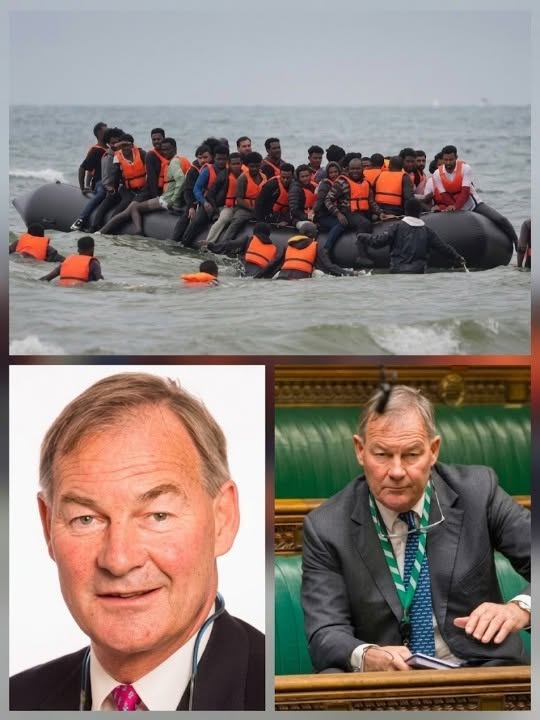
Rupert Lowe Calls for Benefits Ban on Foreign Nationals as Welfare Row Erupts in Parliament
LONDON — Rupert Lowe has called for foreign nationals to be barred from claiming UK welfare benefits and argued that migrants who cannot financially support themselves should be required to leave the country, triggering a sharp confrontation in Parliament over immigration, fairness and the purpose of Britain’s welfare state.
The Restore Britain MP for Great Yarmouth put the issue directly to ministers during Work and Pensions questions in the House of Commons, arguing that billions of pounds currently associated with Universal Credit claims involving foreign nationals should instead remain with British taxpayers.
His intervention produced an immediate rejection from the government.
But beneath the heated exchange lies a much more complicated question than the political slogans suggest: who can actually claim benefits in Britain today, how much is being spent, and what would Lowe’s proposal mean for foreign nationals who have lived and worked in the UK for years?
Lowe Calls for a Sweeping Benefits Ban
Speaking in the Commons on April 27, Lowe cited a figure of £10.1 billion out of £61.2 billion in Universal Credit expenditure during 2024 as being associated with foreign nationals.
He then proposed a far-reaching solution.
Lowe said Britain should prohibit foreigners from claiming benefits and remove migrants who were unable to financially support themselves. He argued that the resulting savings should effectively be returned to British taxpayers.
That position is consistent with the policy Lowe has continued to promote publicly.
In a more recent statement, he said ending benefits for foreign nationals was something he had advocated before it became politically fashionable and added that people unable to support themselves financially should be removed from Britain.
Restore Britain has presented the proposal as part of a broader welfare overhaul.
The principle is straightforward: British welfare should primarily support British citizens, while foreign nationals living in the country should be expected to maintain themselves and their families.
But implementing such a rule would represent a major departure from the current system.
Government Pushes Back on the £10.1 Billion Claim
The government’s response in Parliament was unusually direct.
Work and Pensions Minister Andrew Western said he “fundamentally” disagreed with Lowe’s approach, particularly when applied to people who had lived in Britain for years, worked, paid taxes and subsequently needed financial assistance.
The minister also challenged Lowe’s £10.1 billion figure.
According to Western, the calculation conflated benefit expenditure involving households containing a foreign national with money actually paid directly to foreign nationals.
A household may contain people of different nationalities. Some individual claimants within households classified in the data as having a foreign national may actually be British or Irish citizens.
Western therefore described Lowe’s interpretation as a significant overestimate.
That distinction is crucial when evaluating the scale of the proposal.
It does not mean foreign nationals receive no Universal Credit. Some legally do.
But it means the £10.1 billion figure cannot simply be described as £10.1 billion handed directly to foreign citizens.
Can Any Foreign National Currently Claim Benefits?
No.
One of the biggest misconceptions surrounding the debate is that arriving in Britain automatically provides access to the welfare system.
Current immigration rules generally work in the opposite direction.
The government states that most non-UK nationals receive immigration permission containing a No Recourse to Public Funds, or NRPF, condition.
That normally prevents them from claiming mainstream taxpayer-funded benefits.
Migrants with permission to access public funds must still satisfy the relevant benefit rules, including residency requirements. The government says settlement — usually obtained after several years — is the stage at which many migrants become eligible for public funds.
There are exceptions.
Refugees, people granted certain forms of protection, some people under the EU Settlement Scheme and others with qualifying immigration statuses may be eligible.
Contribution-based benefits are another important distinction.
Someone who has paid sufficient National Insurance contributions may qualify for benefits such as New Style Jobseeker’s Allowance even where some mainstream public funds are unavailable.
What About Illegal Migrants?
Here the existing rules are clearer.
People living in Britain without valid immigration status are not entitled to ordinary Department for Work and Pensions public-fund benefits.
The DWP confirmed this explicitly in response to an earlier parliamentary question from Lowe.
The government has also stated that people with pending asylum applications generally do not claim mainstream benefits such as Universal Credit. Instead, eligible asylum seekers who would otherwise be destitute may receive separate Home Office asylum support.
Refused asylum seekers and people without lawful immigration status are likewise generally prohibited from accessing mainstream public-fund benefits, although limited forms of support can exist under specific legal circumstances.
This makes the terminology particularly important.
“Foreign national,” “illegal migrant,” “asylum seeker,” “refugee” and “settled migrant” are not interchangeable categories.
They carry very different legal rights.
Lowe Wants to Go Much Further
Lowe’s proposal would therefore not merely prevent illegal migrants from claiming Universal Credit — they are already generally barred from doing so.
His position is substantially broader.
He has proposed removing access to benefits for all foreign nationals, including Universal Credit, social housing and disability benefits, while maintaining that people living in Britain as guests should support themselves.
That could potentially affect people who have lived legally in Britain for many years and paid significant amounts of income tax and National Insurance.
This is the central disagreement between Lowe and the government.
Lowe frames welfare as a national safety net that should principally be reserved for citizens.
The government argues that immigration status and existing eligibility rules already restrict access and that people who have contributed to Britain over many years should not necessarily be excluded simply because they do not hold British citizenship.
The Difficult Question of Contribution
Consider a hypothetical worker who has legally lived in Britain for 15 years.
They have paid income tax and National Insurance throughout that period but have never acquired British citizenship.
If they lose their job or become seriously ill, should they receive the same welfare protection as a British colleague who paid identical taxes?
Under Lowe’s citizenship-based approach, the answer could be no.
Under the existing system, the answer depends on immigration status, residency requirements, the benefit involved and other eligibility conditions.
This illustrates why the debate cannot be reduced simply to “British taxpayers versus foreigners.”
Some foreign nationals are themselves British taxpayers.
The political question is whether contributing financially to the country should eventually create entitlement to its social safety net, or whether citizenship should be the decisive dividing line.
Would Removing Benefits Reduce Immigration?
Lowe and supporters of tighter welfare restrictions argue that generous benefit systems can create incentives for migration.
His parliamentary motion on the issue describes access to benefits as a potential immigration “pull factor” and calls for legislation prohibiting foreign nationals from claiming UK welfare benefits.
Determining the actual effect would require evidence about why different categories of migrants come to Britain.
Many temporary migrants already have NRPF restrictions, meaning they cannot normally rely on Universal Credit or other specified benefits.
That complicates claims that unrestricted welfare access is a general feature of Britain’s immigration system.
A Debate Likely to Grow
Lowe’s intervention nevertheless touches on an increasingly prominent question in British politics.
Who should Britain’s welfare state exist to protect?
One position emphasises citizenship and argues that scarce public resources should primarily be reserved for British nationals.
Another emphasises contribution and legal residence, arguing that someone who has worked and paid into the system for years should not automatically lose access to support because of nationality.
The current system sits somewhere between those positions.
Most temporary migrants cannot access public funds. People without lawful immigration status are generally excluded. But certain legally resident foreign nationals — particularly those with settled status or other qualifying immigration status — can receive benefits if they meet the same eligibility requirements imposed on other claimants.
That is why Lowe’s proposal represents more than a crackdown on illegal immigration.
It would potentially redraw the boundary of Britain’s welfare state around citizenship itself.
And that leaves Parliament with a fundamental question that is unlikely to disappear:
Should welfare entitlement ultimately depend on the passport someone holds — or on their legal status, residence, contributions and individual circumstances?