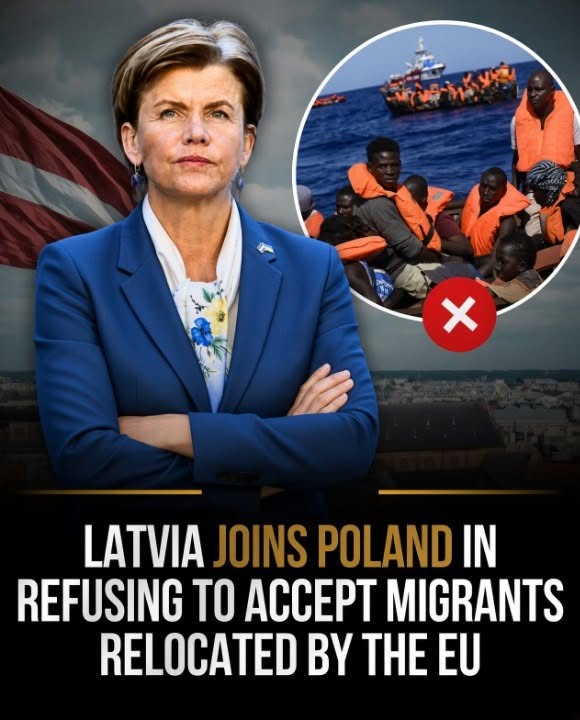
Latvia has joined Poland in refusing to accept migrants relocated by Brussels under the EU’s Migration Pact.
Latvia Rejects Migrant Relocations Under EU Pact, but the €20,000 ‘Penalty’ Claim Needs Context
Latvia has taken a firm position against accepting additional migrants through the European Union’s new migration solidarity system, adding another prominent voice to the resistance against compulsory relocation in parts of Central and Eastern Europe. Foreign Minister Baiba Braže has publicly said that Latvia will not take new migrants under the mechanism and will not simply pay in exchange for refusing them. However, claims that Riga has completely rejected the EU Migration Pact or faces an automatic €20,000 “fine” for every migrant it refuses require important clarification.
The controversy concerns the EU Pact on Migration and Asylum, a package of ten legislative measures adopted in 2024 and brought into application on June 12, 2026. The system is intended to create more uniform rules for asylum processing, border screening, returns and responsibility-sharing between member states. Among its most politically sensitive elements is a permanent solidarity mechanism designed to help countries experiencing disproportionate migratory pressure.
Braže has been unusually direct about Latvia’s position. In an address to the Latvian parliament in January, she said the government’s stance on irregular migration was clear and highlighted Latvia’s strengthening of its eastern border. According to the foreign minister, Latvian authorities had prevented more than 12,000 attempted entries involving what Riga describes as “instrumentalised migrants,” particularly along the border with Belarus.
She then addressed the EU solidarity mechanism directly.
Latvia, Braže said, would share expertise and provide assistance to other European countries, but it would “not accept new migrants” and would “not pay for them.” The formulation reflected Latvia’s attempt to distinguish between refusing migrant relocation and refusing solidarity altogether. Riga instead wants its contribution to be made through other forms of practical assistance.
That distinction is crucial when assessing claims that Latvia has simply defied Brussels.
Under the new pact, solidarity between EU countries is mandatory, but relocation itself is not the only permitted contribution. Member states may generally choose among relocating asylum seekers or beneficiaries of international protection, making financial contributions, or offering alternative solidarity measures such as personnel, operational support and capacity-building assistance.
The frequently cited figure of €20,000 per migrant comes from the financial equivalent used in calculating the solidarity mechanism. It is therefore misleading to describe it simply as a punitive fine automatically imposed every time a government refuses an individual migrant.
The logic of the system is closer to a choice between different forms of contribution.
A government unwilling to undertake relocations can make a financial contribution or, where the rules and agreements allow, provide alternative forms of assistance. The system is compulsory in the sense that member states are expected to contribute to European solidarity, but governments retain significant flexibility over how their contribution is delivered.
The EU’s own figures for the 2026 Annual Solidarity Pool demonstrate this clearly. The Council established a reference level of 21,000 relocations and €420 million in financial contributions for the year. That relationship produces the €20,000 equivalent often cited in political debate.
Latvia itself provides an especially useful example.
The official Council decision does not list Latvia as accepting migrants through relocation for its 2026 contribution. Nor does it list Latvia as making a conventional financial contribution. Instead, it records Latvia providing €1.36 million in alternative solidarity measures.
That is substantially more nuanced than saying Latvia simply told Brussels, “We will take nobody and pay nothing.”
In political terms, Braže can accurately argue that Latvia is not participating through migrant relocation and is not paying the conventional financial contribution associated with refusing relocation. Legally and institutionally, however, Latvia is still participating in the EU solidarity framework through alternative assistance.
Poland’s situation is also different from Latvia’s, despite the two countries frequently being grouped together in political commentary.
Warsaw has repeatedly opposed compulsory relocation. The Polish government announced when the pact entered into application in June that Poland would neither accept relocated migrants from other member states nor bear the associated financial costs. Polish authorities said negotiations had resulted in the country’s circumstances being recognised, particularly because Poland had accommodated millions of people displaced by Russia’s invasion of Ukraine and had faced significant migration pressure on its border with Belarus.
The official 2026 solidarity decision reflects that exceptional position. Poland appears among member states classified as facing a “significant migratory situation,” and its adjusted contribution for relocation or other solidarity support is recorded as zero.
Latvia, by contrast, appears in the category of other member states and contributes through alternative measures.
The countries therefore share a political objection to accepting relocated asylum seekers, but their formal situations under the 2026 solidarity mechanism are not identical.
Latvia’s resistance must also be understood through its security concerns.
Together with Poland and Lithuania, Latvia has spent years confronting irregular migration pressure along the EU’s eastern frontier. European governments have accused Belarusian authorities of deliberately facilitating migrant movements toward EU borders as a form of hybrid pressure. Latvia has strengthened its border infrastructure, expanded surveillance and deployed security personnel in response.
For Riga, migration policy is consequently tied not only to asylum administration but also to national security.
Braže’s argument is that Latvia is already making a substantial contribution by protecting an external EU border and preventing irregular crossings. Latvian officials therefore question why a country confronting pressure on its own frontier should simultaneously be required to receive asylum seekers transferred from elsewhere in Europe.
Supporters of the EU pact answer that the solidarity mechanism was designed precisely to recognise differing national circumstances. Countries facing their own migratory pressure can receive adjustments, while other member states can select different methods of contributing.
The broader dispute reveals a persistent tension inside the European Union.
Mediterranean countries such as Italy, Greece, Spain and Cyprus have long argued that geography leaves them carrying an unfair share of arrivals across Europe’s external borders. They want other EU members to share responsibility.
Governments in Central, Eastern and Baltic Europe often respond that responsibility cannot simply mean redistributing migrants across the continent. Many argue that stronger external borders, faster deportations, cooperation with third countries and prevention of irregular entry should take priority over relocation.
The Migration Pact represents Brussels’ attempt to reconcile these competing demands. It strengthens border procedures and return mechanisms while simultaneously establishing compulsory solidarity.
Whether that compromise will remain politically sustainable is uncertain.
Migration has become one of Europe’s most divisive political issues, and terminology matters enormously. Referring to the €20,000 contribution as a “fine” or “penalty” suggests that Brussels automatically punishes any country that refuses a migrant. The actual structure gives governments several methods of fulfilling their solidarity obligations.
Likewise, saying Latvia has completely rejected the Migration Pact would be inaccurate. Latvia is participating in the system while rejecting relocation as the method of its contribution.
None of this diminishes the political significance of Braže’s position.
Latvia has made clear that it does not intend to solve Europe’s migration pressures by accepting newly relocated migrants. Poland has taken an even more exceptional position for 2026, with its adjusted solidarity obligation effectively reduced to zero.
Together, their positions show how difficult it remains to create a genuinely common European migration policy.
The emerging divide is therefore not simply between countries that support migration and those that oppose it. It concerns a deeper question: what does European solidarity actually require?
For Brussels, solidarity means every member state contributing when another faces disproportionate pressure.
For Latvia, solidarity can mean border protection, expertise and operational assistance without accepting additional migrants.
For Poland, the argument is that a country already carrying exceptional refugee and border-security responsibilities should not be required to take on another burden.
The EU Migration Pact was designed to settle that argument through flexibility.
Instead, as Latvia’s stance demonstrates, the political battle over relocation is likely to continue long after the new rules have formally entered into force.