Poland has introduced rules shielding soldiers, police and border guards from punishment when they break standard firearms rules in certain defined cases.
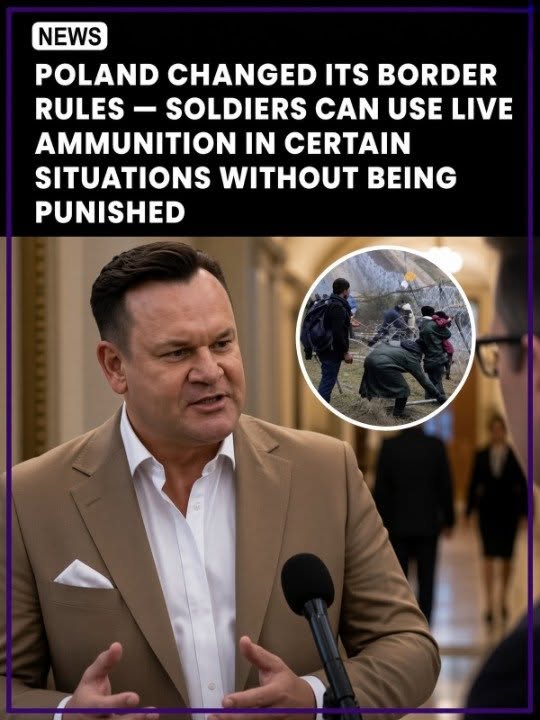
Poland’s New Border Rules Ignite a Fierce Debate Over the Use of Force
Poland has taken another controversial step in its approach to border security, introducing rules designed to protect soldiers, police officers, and border guards from criminal liability when they use firearms in certain narrowly defined circumstances.
Supporters describe the measure as a necessary shield for personnel operating in dangerous and unpredictable situations. Critics, however, warn that the new rules could weaken accountability and create dangerous room for excessive force.
The debate has become particularly intense along Poland’s eastern border, where security forces have faced repeated attempts by groups of migrants to cross into the country.
At the heart of the controversy is a simple but emotionally charged question: How much legal protection should an officer receive when confronted with a potentially dangerous situation at the border?
Under the new rules, personnel may receive protection from punishment for violating standard firearms procedures in specific circumstances. These include situations involving self-defense, attempts by groups to forcibly breach the border after less severe measures have failed, and attempts to seize an officer’s weapon.
Supporters argue that these situations are fundamentally different from ordinary policing.
A border guard facing an aggressive crowd, they say, may have only seconds to determine whether a situation is escalating from a security incident into a threat to life. A soldier whose weapon is being grabbed cannot be expected to react as though he were dealing with a routine administrative violation.
For politicians supporting the measure, the priority is therefore clear: give security personnel sufficient legal protection to act decisively when their lives, the lives of colleagues, or the integrity of the border are under immediate threat.
Polish Member of the European Parliament Dominik Tarczyński has strongly defended this approach. He has described the legislation as necessary protection for Polish personnel and issued a blunt warning against attacks on soldiers stationed at the border.
His argument reflects a broader security-first philosophy: soldiers and border guards should not have to hesitate in a potentially life-threatening situation because they fear prosecution later.
But opponents see the issue very differently.
European human-rights organizations have criticized the measure, arguing that broadening legal protection for the use of firearms could reduce accountability precisely when accountability is most important.
The criticism is particularly connected to Poland’s treatment of migrants at its border with Belarus. Human-rights groups have for years alleged that migrants have been subjected to unlawful pushbacks and have raised concerns about whether people seeking international protection are receiving adequate access to asylum procedures.
From this perspective, the new rules cannot be separated from the wider controversy surrounding Poland’s border policy.
Critics fear that legal protections intended for genuinely dangerous situations could, in practice, make it harder to investigate or prosecute abuses. They argue that the state must distinguish clearly between legitimate self-defense and unnecessary or disproportionate use of force.
That distinction is crucial.
Few people would argue that a police officer or soldier should be left legally exposed after genuinely defending themselves against an armed attacker. The disagreement begins when determining what constitutes an immediate threat, whether force was necessary, and whether other options were genuinely exhausted.
This is where the political argument becomes much more complicated.
Supporters of stronger protections point to the realities faced by personnel on the ground. Border security is not simply a matter of paperwork and fences. Officers can encounter large groups, physical confrontations, attempts to break barriers, and situations that can change rapidly.
They argue that policymakers sitting far from the border should not impose unrealistic expectations on people who must make split-second decisions under pressure.
Critics counter that precisely because border personnel possess significant power, clear rules and effective oversight are essential.
The ability to use firearms is among the most serious powers a state can grant its personnel. Once a weapon is discharged, the consequences can be irreversible. For human-rights advocates, legal safeguards therefore cannot be treated as obstacles to security; they are part of responsible security policy.
The disagreement also reflects a deeper political divide over migration.
For one side, the Polish-Belarusian border represents a national-security challenge requiring firm enforcement. They argue that Belarus has used migration pressure as a tool of political and hybrid warfare against Poland and other European countries.
For the other side, the existence of a security challenge does not eliminate the rights of individuals crossing the border. Migrants, including those who may have entered irregularly, still have legal and humanitarian protections that governments are expected to respect.
The difficult reality is that both concerns can exist simultaneously.
A country can have a legitimate interest in defending its borders while also having obligations toward people seeking protection. Soldiers can require protection from frivolous prosecution while authorities can still be expected to investigate credible allegations of excessive force.
The challenge is finding rules that accomplish both objectives.
Poland’s new measure has therefore become more than a technical change to firearms regulations. It has become a symbol of a much larger European argument about sovereignty, migration, security, and human rights.
How should a democratic government respond when its border personnel face potentially violent confrontations?
Should the law prioritize maximum protection for officers so they can react without fear?
Or should the law maintain strict safeguards because the use of force against migrants and other civilians carries consequences that cannot simply be reversed?
There is another important question: Where should accountability begin when an officer claims that force was necessary?
Supporters may answer that trained personnel acting in good faith should not face criminal punishment simply because a split-second decision is later judged imperfectly.
Critics may respond that legal immunity, even when limited, can create a culture in which mistakes or abuses become harder to challenge.
The wording and implementation of the rules will therefore matter enormously. A narrowly defined protection for genuine emergencies is one thing. A system that effectively prevents meaningful investigation of unlawful violence would be something very different.
For Poland, the controversy comes at a politically sensitive moment. Border security has become one of the defining issues in European politics, while governments across the continent are under pressure to demonstrate that they can control migration and protect their citizens.
At the same time, European institutions and human-rights organizations continue to emphasize the importance of fundamental rights, asylum procedures, and proportionality in the use of force.
The Polish debate illustrates just how difficult it has become to reconcile those principles.
Security personnel need confidence that the law will protect them when they legitimately defend themselves. Migrants and civilians need confidence that state power will not be used against them without accountability.
A functioning democracy ultimately requires both.
The controversy surrounding Poland’s new rules is unlikely to end with the legislation itself. It raises fundamental questions about the limits of state power and the responsibilities of those entrusted with enforcing the law.
Is stronger legal protection for soldiers and border guards a necessary response to an increasingly dangerous border environment?
Or could it weaken safeguards against excessive force and make accountability more difficult?
The answer will depend not only on political rhetoric, but on how the rules are interpreted, applied, investigated, and challenged in real-world situations.
One thing, however, is certain: Poland’s border has become a frontline in Europe’s larger battle over security and human rights.
And as governments across Europe confront growing pressure over migration, the question of how far security forces should be allowed to go — and where the law must draw the line — will remain one of the continent’s most difficult debates.
Do you support Poland’s decision to give greater legal protection to soldiers, police, and border guards in defined firearms situations?
YES or NO?
This article summarizes and discusses public statements and reported policy developments for informational and discussion purposes. The views attributed to Dominik Tarczyński and the positions of critics do not necessarily reflect the views of this page.